
Century is moving beyond its Japanese home market
Toyota is preparing a global future for Century, the nameplate long associated with Japan’s official and business elite. At the 2025 Japan Mobility Show, Toyota presented Century as a distinct brand rather than simply another model in the Toyota range. Its position is above Lexus, while Lexus remains the group’s broader luxury brand. Toyota has not confirmed a launch timetable, prices or a final list of countries for the Century brand in Europe or North America.
That distinction matters. Toyota has confirmed the direction of the brand, but it has not announced a conventional market launch. The company is interested in international feedback and wants to establish Century as a Japanese ultra-luxury proposition. Whether that leads to regular sales in the United States or Europe remains open.
A name with a very specific history
The first Century arrived in 1967. Toyota developed it as a chauffeur-driven luxury car at a time when Western manufacturers dominated Japan’s high-end chauffeur market. The name refers to the centenary of Sakichi Toyoda’s birth, according to Toyota’s own history of the model. Over the decades, the Century became associated with senior officials, executives and members of Japan’s Imperial family.
For most of its life, Century was a low-volume, Japan-focused product. That gave it a strong domestic identity, but it also means the name has little recognition among luxury-car buyers elsewhere. Toyota cannot assume that international customers will automatically place Century beside Rolls-Royce, Bentley or Maybach simply because the Japanese market treats it as a top-level car.
At the 2025 press briefing, Chairman Akio Toyoda said Toyota had decided to launch the Century brand and described it as more than another Toyota brand. The company’s stated themes include “One of One”, Japanese pride, craftsmanship and a willingness to preserve the model’s cultural identity while taking it to a wider audience.
The range already has two different directions
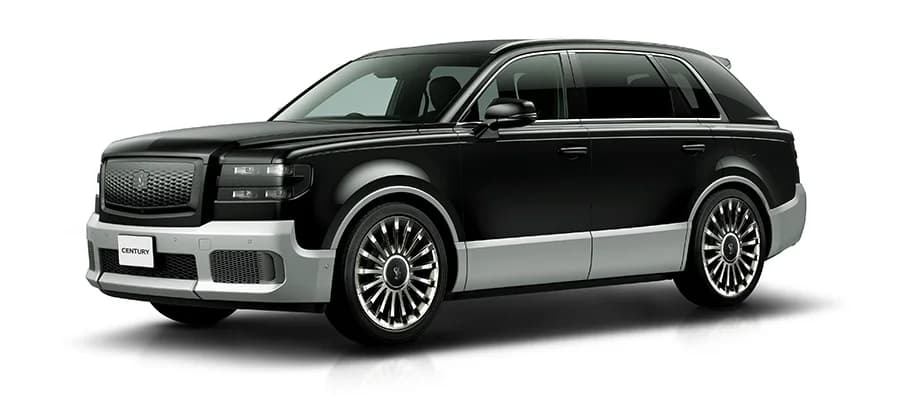
The move towards a broader brand started before the 2025 show. In 2023, Toyota introduced a new Century body style designed around chauffeur-driven travel. Toyota does not present it simply as a conventional SUV; the company focuses on the rear-seat experience, privacy and the ability to rest or work during a journey.
The 2023 model has four seats, wide-opening rear doors and a plug-in hybrid powertrain. Toyota’s Japanese specification uses a 3.5-litre V6 and E-Four Advanced all-wheel drive. The manufacturer listed a Japanese suggested retail price of 25 million yen before recycling fees and options, along with a base sales volume of 30 vehicles per month. Those figures apply to Japan and are not a European or US price guide.
Toyota also describes the Century as globally customisable, with individual choices for colours, materials and interior details. That is a description of the brand’s customer approach, not a promise that every market can order every option. Production for the 2023 model is handled at Toyota’s Tahara plant in Japan.
The Century SUV is sold in China and has reached some other Asian and Middle Eastern markets in small numbers, according to the supplied report. Toyota has not confirmed a full US or European retail programme. Chairman Akio Toyoda arriving in Detroit in a Century SUV, and Toyota executives seeking feedback from industry officials, show that the company is testing interest. They do not by themselves confirm local sales.
Why Century sits above Lexus
Lexus has been Toyota’s international luxury brand since 1989. It serves a wide range of customers with sedans, SUVs, coupes and electrified models. Century is being defined more narrowly: low-volume vehicles focused on rear-seat comfort, chauffeur use, hand-finished details and personalisation.
Toyota’s 2025 Lexus briefing said that placing Century in the exclusive ultra-luxury space gives Lexus more freedom to develop its own identity in the wider luxury market. In practical terms, the group is separating two jobs. Lexus needs to compete across a global premium market, while Century can remain limited and more closely tied to Japanese hospitality and craftsmanship.
The comparison with Rolls-Royce, Bentley and Maybach is useful as market context, but Toyota has not published a direct competitive target, pricing structure or volume plan. Century’s proposition is also different. The company is not leading with an engine-output contest; it is talking about quietness, rear-seat privacy, carefully selected materials and a service relationship built around each customer.
Toyota has also shown a low-slung Century coupe concept. It appeared at the 2025 Japan Mobility Show and suggests that the brand may not remain limited to the traditional sedan and the tall chauffeur-focused model. A concept is not a production announcement, however. Toyota has not confirmed its engine, price, range, production date or final body design.
The challenge of going global
Taking Century outside Japan would require more than shipping a few cars. Toyota would need a sales and service structure suitable for very low volumes, trained staff, parts support, market-specific homologation and a process for ordering heavily personalised vehicles. A conventional Toyota showroom network could provide access, but it would not automatically deliver the private, appointment-led experience expected in the ultra-luxury sector.
Brand awareness is another issue. European and North American buyers know Toyota for models such as the Corolla, RAV4 and Land Cruiser, and they know Lexus as the group’s luxury division. Century has a powerful reputation in Japan but much less name recognition elsewhere. Toyota will need to explain the model’s history and justify its position through the ownership experience, not only through equipment.
There is no official information yet about EU approval, US dealers, European pricing or Romanian availability. The Japanese price of the 2023 model cannot be converted directly into a local expectation because taxes, transport, equipment and service arrangements would change the final cost.
A global ambition without a global launch date
Toyota’s five-brand strategy now gives Century a clearly defined place alongside Toyota, Lexus, GR and Daihatsu. The company’s financial presentation describes a model range led by Century, but a global brand strategy does not mean that every Century vehicle will be sold in every country.
For now, Toyota has confirmed the brand architecture, the international ambition and the existing presence of the Century SUV in selected markets. It has not confirmed a European or US launch schedule. The upcoming phase may include feedback, showcases and market studies before any commercial decision.
Century is therefore moving from a rare Japanese flagship into a carefully controlled international experiment. The sedan preserves the historical identity, the 2023 model expands the chauffeur-focused format, and the coupe concept points towards a broader design language. The next concrete step will be Toyota’s decision about where, how and through which retail structure Century can be sold without losing the exclusivity that made the name valuable in Japan.
Sources
- Toyota Global Newsroom — Japan Mobility Show 2025 CENTURY Press Briefing
- Toyota Global Newsroom — Toyota to Launch New Century in Japan
- Toyota Global Newsroom — Century World Premiere
- Toyota Global Newsroom — FY2026 Financial Results, five-brand strategy
Image: Toyota Global Newsroom, official Toyota Century press photograph. Local WebP asset: /resources/blog/toyota-century-global-brand-2026.webp. The image is not taken from the Motor1 article.


