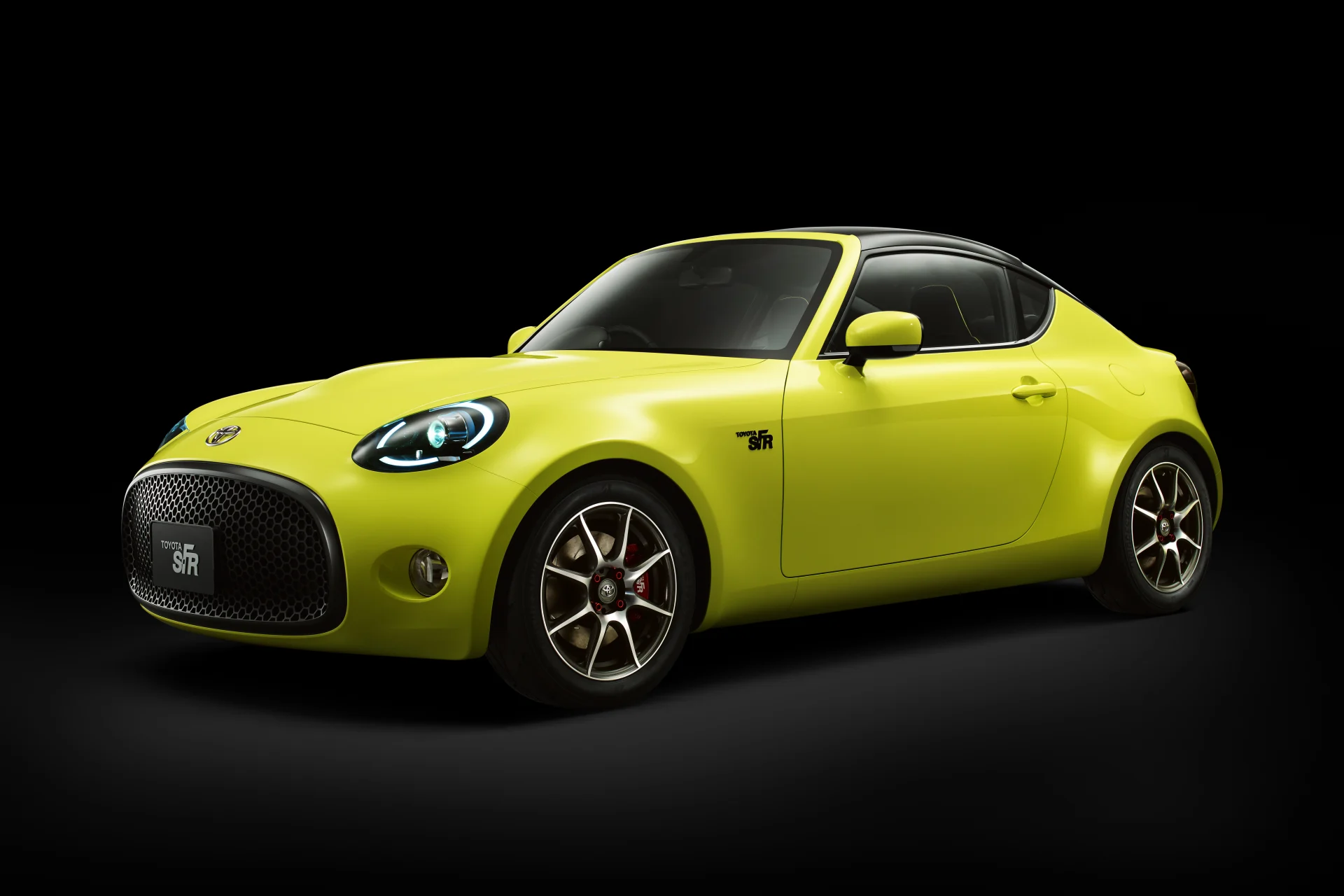
Official Toyota press photograph of the 2015 S-FR concept. It does not show a confirmed 2027 production car.
A new Japanese report says Toyota is considering reviving the S-FR name for a kei-sized, rear-wheel-drive coupe that could appear in 2027. Toyota has not announced the programme, approved a production model or disclosed a sales market. The reported date and technical details are therefore a rumour, not a launch plan.
The proposal described by Response is substantially different from the S-FR concept Toyota showed in 2015. Its suggested dimensions — 3,395 mm long, 1,475 mm wide and 1,230 mm high, with a 2,265 mm wheelbase — exactly match Daihatsu’s official figures for the K-OPEN concept unveiled at the 2025 Japan Mobility Show. That overlap is the basis for speculation that the two cars could share engineering, but neither company has said that they will.
The reported 660 cc specification is not a Toyota specification
The Japanese report points to a turbocharged 660 cc three-cylinder engine producing roughly 64 PS, a five-speed manual or continuously variable transmission, and rear-wheel drive. Those values fit the expected outline of a Japanese kei sports car. They have not appeared in a Toyota press release, homologation document or product page.
Important packaging questions are unanswered. The 2015 S-FR concept had four seats, while Daihatsu’s K-OPEN is a two-seat roadster. No credible public document settles whether a possible Toyota derivative would be a two-seater or a 2+2, where the engine would sit, how much it would weigh, or which rear suspension it would use.
There is also no price. Calling the car “cheap” describes its intended position below the GR86 rather than a verified transaction figure. Kei-car tax treatment is specific to Japan, and a domestic-market price could not be carried directly into a European comparison without accounting for specification, tax, transport and homologation. Toyota has not confirmed an export version for the EU, the UK or any other market.
The original S-FR was larger and technically distinct
Toyota revealed the S-FR at the 2015 Tokyo Motor Show as an entry-level lightweight sports-car concept. The company specified a front-midship engine position, rear-wheel drive, independent suspension and a six-speed manual gearbox. It described the car as a four-seater designed around direct, responsive handling.
The concept measured 3,990 mm in length, 1,695 mm in width and 1,320 mm in height. Its wheelbase was 2,480 mm. Compared with the dimensions now attached to the rumoured kei model, it was 595 mm longer, 220 mm wider and had 215 mm more wheelbase. A 2027 car built to the reported outline would consequently be a reinterpretation, not the belated production release of the 2015 show car.
Toyota did not publish an engine displacement or output for the global S-FR concept in that announcement. Numbers subsequently repeated online should not be treated as official specifications for either the old concept or a new programme. The six-speed manual and FR layout are documented; the rumoured 660 cc engine and five-speed transmission belong to the newer, unconfirmed report.
Daihatsu has built working rear-drive K-OPEN prototypes
The strongest factual context comes from Daihatsu, a Toyota subsidiary. At the Japan Mobility Show in October 2025, Daihatsu presented the K-OPEN as a two-seat, combustion-engined kei roadster. Its official dimensions are the same as those attributed to the supposed Toyota coupe, and it uses a front-engine, rear-wheel-drive layout.
Daihatsu also built a separate K-OPEN Running Prototype. The company said the study reused in-house components and investigated low mass, a low centre of gravity and an optimised front-to-rear weight distribution. The running car remained 3,395 mm long and 1,475 mm wide, but was 1,280 mm high and had a shorter 2,230 mm wheelbase than the display concept.
Development continued with the K-OPEN Running Prototype 2 shown publicly at the January 2026 Tokyo Auto Salon. Daihatsu moved the longitudinal engine rearwards into a front-midship position, revised the rear suspension and added a roll cage. It linked those changes to better steering stability, road holding, body rigidity and occupant protection in its motorsport testing programme.
That work proves Daihatsu is exploring how a rear-drive sports car can fit within kei dimensions. It does not prove that Toyota will sell a fixed-roof sister car. Daihatsu called the vehicle a pre-production study and said the relevant event exhibits were concepts not intended for public-road use. A working prototype is a more concrete signal than a styling model, but it remains short of production approval.
The end of the current Copen creates an opening, not a timetable
Daihatsu ended production of the second-generation Copen in August 2026. When it announced the decision in September 2025, the company said it was continuing studies aimed at bringing the Copen back to market. It did not give the next model a launch date or confirm that K-OPEN would become that replacement.
Sharing a platform between a future Daihatsu roadster and a Toyota coupe could spread development costs across two vehicles. It is a logical industrial scenario, especially within the same corporate group. Matching dimensions alone are insufficient evidence, however, because both proposals would be constrained by the same kei-class limits.
The body styles would also create different engineering demands. A fixed roof can change stiffness and mass compared with a convertible, while a 2+2 cabin would require a different balance between seating, fuel system, luggage space and crash structure. No published Toyota material resolves those choices.
Where a small S-FR would sit beside the GR86
Toyota’s current GR86 provides a useful scale reference. The production sports coupe uses a 2.4-litre naturally aspirated flat-four engine, rear-wheel drive and six-speed manual or automatic transmissions. Toyota’s 2021 Japanese launch pricing ranged from 2,799,000 to 3,512,000 yen, but those historic domestic prices are not a forecast for a different car in 2027.
A 660 cc S-FR would occupy a clearly separate role: lower speed, smaller dimensions and potentially lower running costs, with driver involvement coming from low mass and rear-wheel drive rather than GR86-level output. Whether buyers outside Japan would accept kei-car performance and packaging is one of the unanswered commercial questions.
The next reliable milestone would be a Toyota or Daihatsu announcement naming the vehicle, production status, factory and launch market. Until then, the 2027 date, 64 PS output, transmission choices and Toyota–Daihatsu platform link should remain labelled as reported possibilities.
Sources
- Toyota Motor Corporation — 2015 S-FR concept announcement
- Daihatsu — K-OPEN and K-OPEN Running Prototype at Japan Mobility Show 2025
- Daihatsu — K-OPEN Running Prototype 2 at Tokyo Auto Salon 2026
- Daihatsu — current Copen production ended in August 2026
- Toyota — current-generation GR86 official launch data