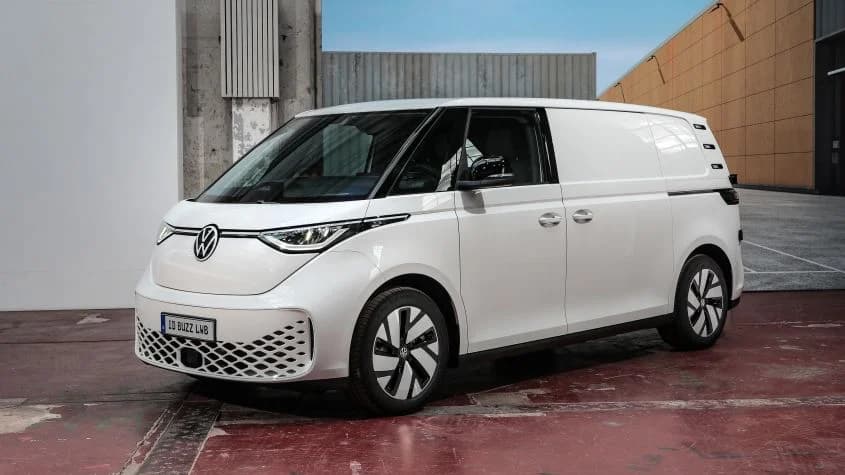
Volkswagen Commercial Vehicles has added a long-wheelbase version to the electric ID. Buzz Cargo range. The LWB model extends the wheelbase by 250 mm, increases cargo volume from 3.9 to 4.4 cubic metres and uses the 86 kWh battery already associated with the long passenger version. German orders open first: the 250 kW 4MOTION model starts at €50,630 before VAT, while the 210 kW rear-wheel-drive version follows one week later at €48,490 before VAT.
Those prices apply in Germany and exclude delivery and registration charges. Volkswagen has not published a single launch timetable or price for every European country. France, for example, is due to open orders during November, with local pricing to follow.
What the extra 250 mm provides
The load floor is 2,458 mm long, exactly 250 mm longer than in the standard-wheelbase Cargo. The additional length produces another 0.5 m³ of capacity. Width between the wheel housings is 1,230 mm, so the gain comes principally from length rather than a wider body.
Volkswagen fits a wooden cargo floor and a second sliding side door as standard. The enlarged sliding-door aperture is 190 mm wider than before and can accept a Euro pallet. At the rear, buyers can specify either a large top-hinged tailgate or conventional split doors. The cab remains available with two or three seats, and the specification now includes manually adjustable lumbar support.
The passenger ID. Buzz established the basic long-wheelbase dimensions earlier: its wheelbase grew from 2,989 to 3,239 mm and overall length reached 4,962 mm. The 2026 Cargo announcement focuses on the working compartment rather than repeating the full exterior data, but it uses the same extended architecture and is built at Volkswagen Commercial Vehicles’ Hanover plant.
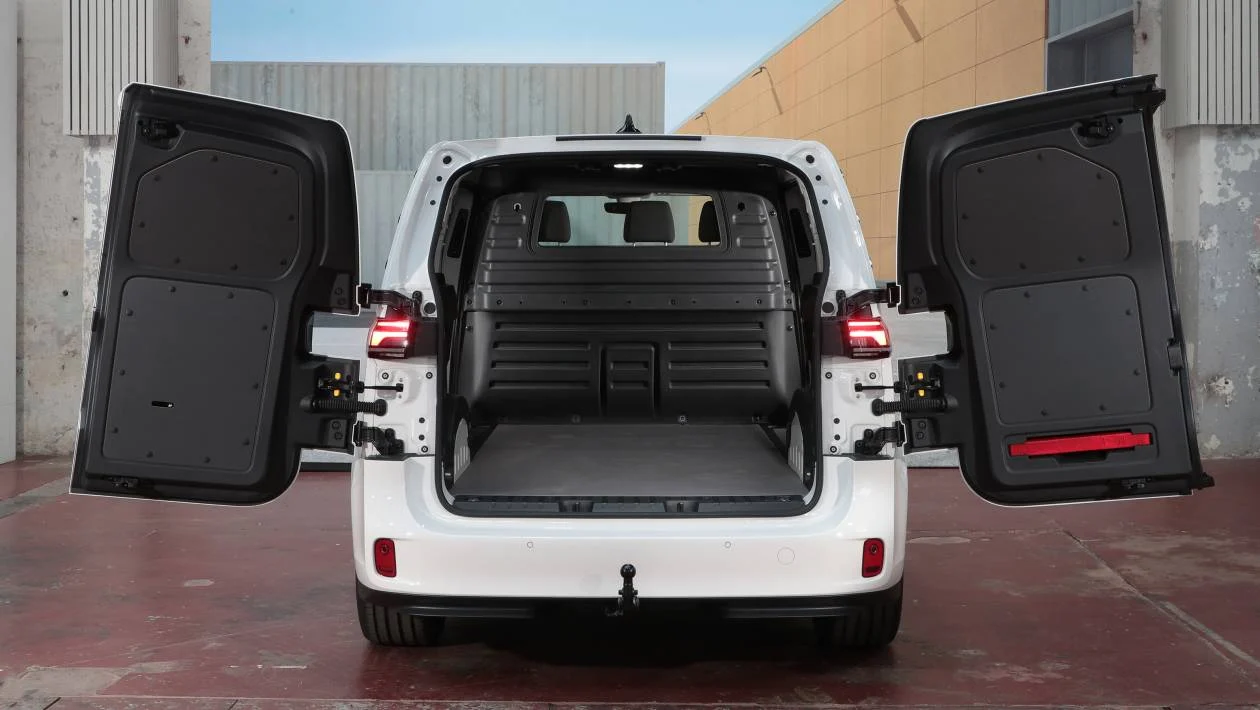
The 4.4 m³ load bay has a 2,458 mm floor. Image published by Auto Express; rights remain with the original creator or supplier.
Payload varies with the drivetrain
The rear-wheel-drive model carries up to 700 kg according to Volkswagen’s French release. Adding the front motor and 4MOTION reduces the quoted maximum payload to 606 kg. That 94 kg difference is material for a van frequently operated near its gross vehicle weight, and buyers should check the plated figure for the exact trim and options ordered.
Volkswagen’s Dutch distributor gives a market-specific maximum of 690 kg without separating the two powertrains in the same way. The variation is a useful reminder that equipment and national homologation can alter a headline payload. A fleet calculation should use the certificate for the actual vehicle, not the highest number found in a regional press release.
Both LWB drivetrains are quoted with a maximum braked towing capacity of 1,800 kg on gradients of 8% and 12%. That is notably above the 1,200 kg shown for the current rear-drive, standard-wheelbase Cargo in Volkswagen’s UK technical data.
An 86 kWh battery with rear- or all-wheel drive
The LWB Cargo is paired with an 86 kWh net battery, compared with 79 kWh for the standard-wheelbase version used in Volkswagen’s launch comparison. The rear-drive model produces 210 kW, or 286 PS. The two-motor 4MOTION version raises total system output to 250 kW, or 340 PS.
Volkswagen has not included model-specific WLTP range or charging time in the 23 September Cargo release. The company’s earlier documentation for long-wheelbase passenger variants associates the same 86 kWh battery with up to 200 kW DC charging and roughly 30 minutes from 5% to 80% in suitable conditions. Those battery figures are context, not confirmation of an identical result for every LWB Cargo configuration.
The distinction matters because vans can spend much of their life with a variable payload, roof equipment or conversions. Official WLTP values are measured under defined conditions; they do not describe range with 700 kg in the back, a trailer attached or prolonged motorway driving in winter. Volkswagen is expected to provide homologated figures as national ordering systems open.
Physical steering-wheel buttons return
The refreshed cockpit replaces touch-sensitive steering-wheel surfaces with newly designed physical buttons. It also gains the Innovision infotainment system and an app store covering audio, video streaming, parking, charging and games.
An optional version of Travel Assist can now respond to traffic lights. When the system detects a red signal, it can brake the van to a complete stop within its operating limits. This is a driver-assistance function, not autonomous driving, and the driver remains responsible for observing signals and intervening.
One-pedal driving is another addition. It increases regenerative deceleration and can bring the vehicle to rest without the brake pedal in the conditions supported by the system. For stop-start delivery work, that changes the driving routine more directly than an extra infotainment application.
Vehicle-to-Load allows external equipment to draw power through an adaptor at the charging port. Volkswagen Netherlands specifies 2.0 kW of continuous output and cites a table saw or site radio as examples. A UK media report refers to 3.6 kW, so output should be checked against the local specification and adaptor rather than assumed to be common across Europe.
Where the LWB model fits
The longer Cargo addresses a straightforward limitation of the original van: 3.9 m³ is useful for urban work, but it trails several compact electric rivals when volume is the priority. At 4.4 m³, the LWB model matches the headline load volume quoted for vehicles such as the Kia PV5 Cargo and long-body versions of the Stellantis compact vans. Load shape, door dimensions and payload still matter as much as the volume figure.
For a courier or service fleet, the decision is not automatically in favour of the longer body. The standard model occupies less road space, and operators who rarely fill 3.9 m³ may gain little from the extension. The LWB version is more relevant when a Euro pallet must pass through the side, tools approach 2.5 metres in length, or simultaneous access from both sides saves time.
Volkswagen says the German LWB premium is about €2,340 before VAT over the equivalent normal-wheelbase model. That figure gives European fleets a first cost reference, but a proper comparison still requires local pricing, WLTP consumption, insurance and the payload of the selected configuration.