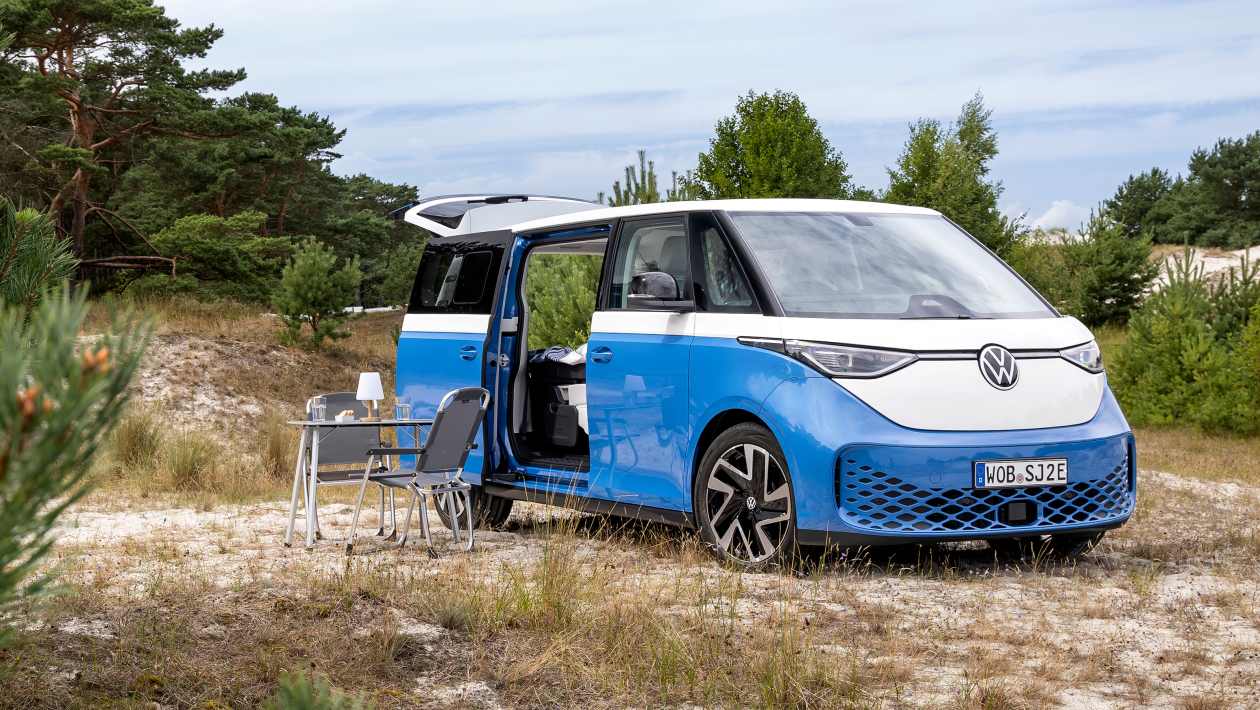
The Volkswagen ID. California Cruise will be offered with a short or long wheelbase. Photo: Auto Express / Volkswagen Commercial Vehicles
Volkswagen ID. California Cruise: electric camper with a double bed and V2L power
Volkswagen Commercial Vehicles has presented the ID. California Cruise, the first production electric model in the California family. The camper is based on the ID. Buzz Pro, offers a sleeping place for two people and can power electrical appliances directly from the traction battery.
The public premiere is at Caravan Salon 2026 in Düsseldorf. First deliveries are scheduled for early 2027, and the price announced in Germany starts at 60,761 € for the short-wheelbase version. Volkswagen had not published a price for Romania at the time of writing.
Two wheelbases and 79 or 86 kWh batteries
The ID. California Cruise can be ordered on both ID. Buzz body versions: short wheelbase and long wheelbase. The rear-mounted electric motor develops 210 kW (286 hp) and drives the rear wheels.
The short version uses a battery with a usable capacity of 79 kWh, and the long model gets the 86 kWh battery. Volkswagen has not yet type-approved the specific range of the California Cruise version. As a reference, the ID. Buzz Pro models it is based on reach up to 460 km and 498 km WLTP respectively, but camping equipment and extra mass can change the final result.
Maximum charging power was not detailed separately in the launch release. Equivalent ID. Buzz configurations accept up to 175 kW or 200 kW of direct current, depending on the battery, but the exact figures for the camper must be confirmed after type approval.
A 2.03-metre bed, a table and two seats
The ID. California Cruise does not copy the interior of a traditional California with a fixed kitchen, sink and pop-up roof. The layout is simpler and keeps the vehicle easy to use every day.
The folding mattress is 2.03 metres long, 1.20 metres wide and 9 cm thick. When not in use, it packs onto a platform next to the tailgate. Volkswagen also includes two folding seats, a camping table, ventilation grilles for the front side windows and opaque covers for all windows.
Cars ordered with a panoramic roof get a dedicated sunshade. Each component has its own storage space, so camping parts do not remain loose in the cabin while driving.
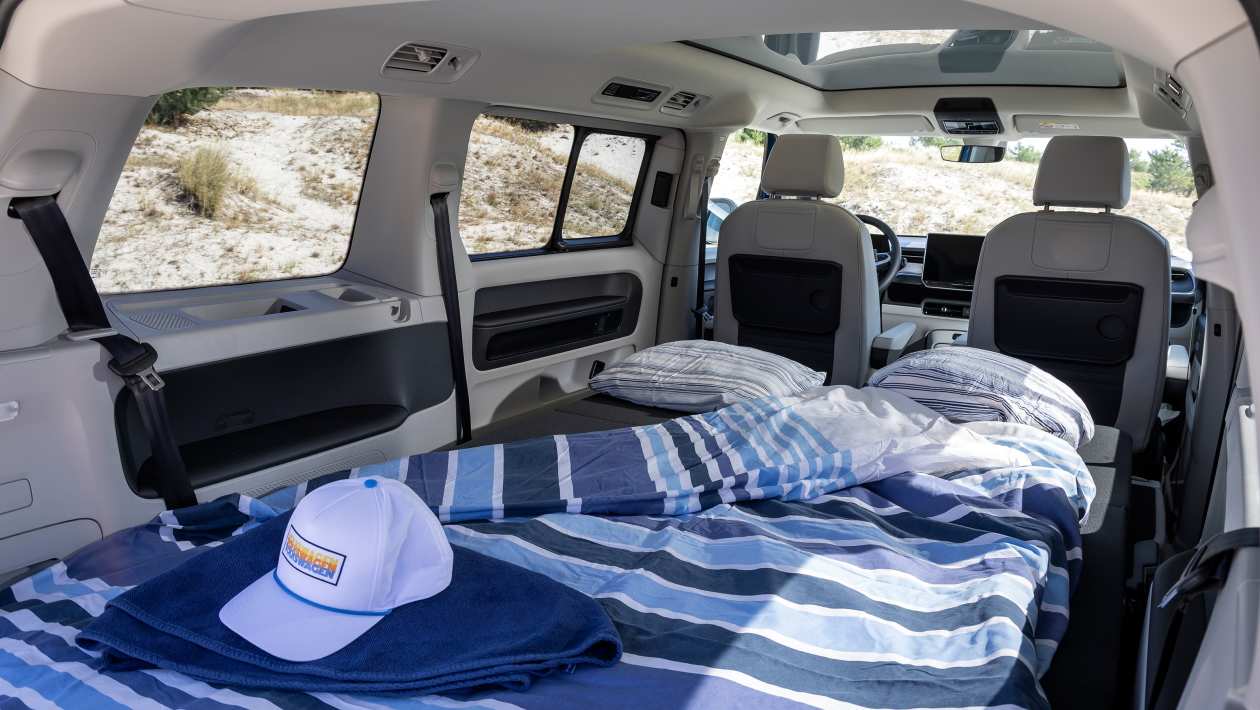
The bed is 2.03 metres long and 1.20 metres wide. Photo: Auto Express / Volkswagen Commercial Vehicles
California Mode can keep the climate control on for up to 48 hours
The new California Mode groups on the screen the functions used when the car is stationary. Occupants can control lighting and certain comfort functions, and USB ports remain powered.
Climate control can heat or cool the cabin for up to 48 hours. Actual duration depends on the battery level, outside temperature and the requested difference between outside and inside. Using this function consumes energy that would otherwise be available for driving.
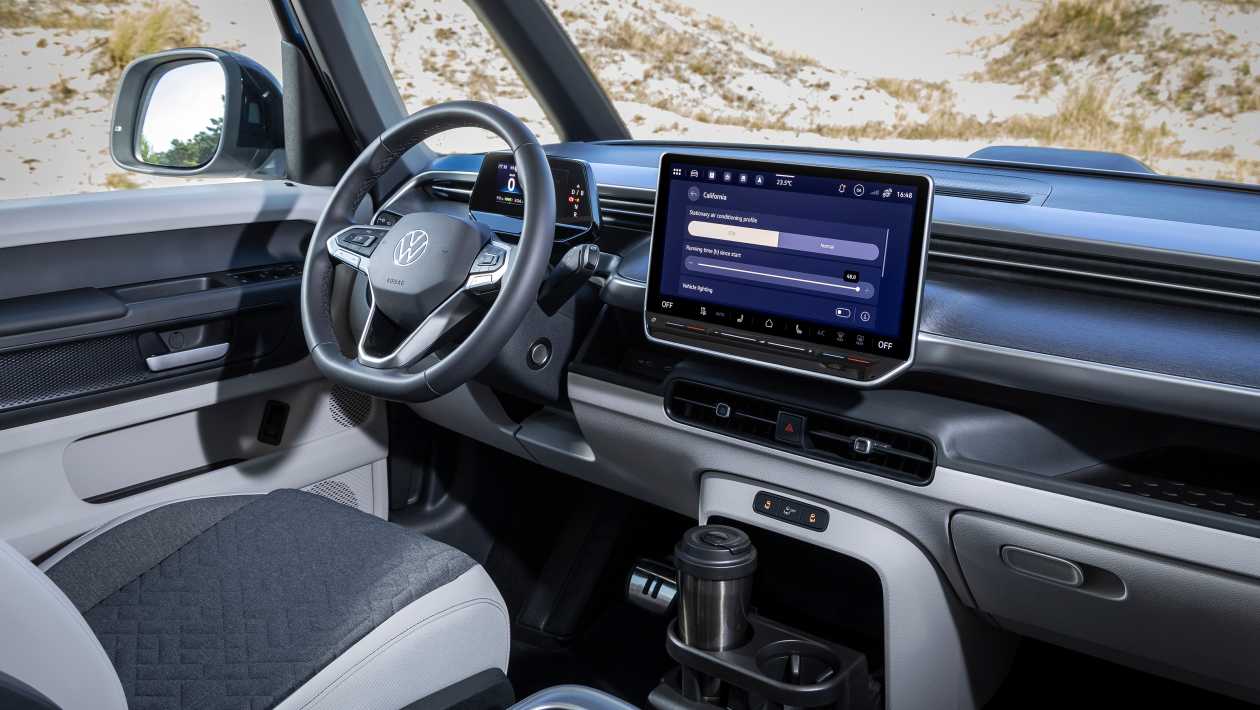
California Mode allows control of climate and comfort functions while stationary. Photo: Auto Express / Volkswagen Commercial Vehicles
V2L offers 2 kW continuously and 3.6 kW for short periods
The PowerSocket adapter uses the vehicle-to-load (V2L) function to turn the car’s battery into a power source for external loads. Continuous power available is 2 kW, and the 3.6 kW peak can be maintained for short periods.
The capacity is enough for a coffee machine, a kettle, a cool box or camping lighting, provided the total power of appliances connected at the same time stays within the system’s limits. The V2L adapter, Interior Style package and Comfort package are included in the California Cruise equipment announced for Germany.
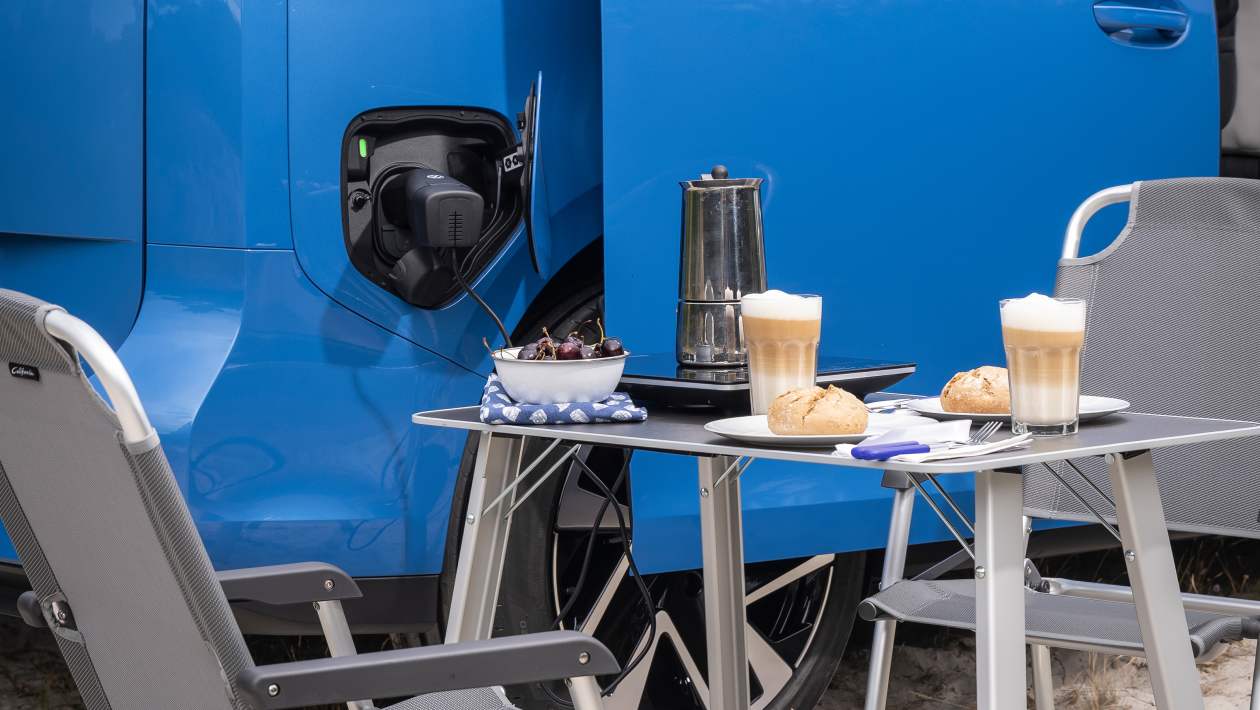
The V2L adapter can deliver 2 kW continuously and up to 3.6 kW temporarily. Photo: Auto Express / Volkswagen Commercial Vehicles
What it lacks compared with a classic California
The ID. California Cruise is closer to an ID. Buzz with a factory-integrated sleeping pack than to a full camper. In the equipment presented it does not have a fixed kitchen, a sink or the ample furniture storage found on the Multivan-based California.
That choice keeps the rear bench and cabin useful for daily trips, but it limits camping independence for those who want to cook and store water in the vehicle. Equipment needed for longer journeys will have to be carried separately and will reduce the space available for luggage.
Volkswagen says the ID. California Cruise opens a new family, not that it immediately replaces every petrol, diesel or hybrid California. Other fully electric California models are planned through 2028.
The price for Romania is not yet available
The 60,761 € figure is the entry price announced for Germany. The offer in Romania may differ through equipment, taxes, transport costs and battery or wheelbase configuration.
Before ordering, buyers should check remaining payload after the equipment is fitted, the type-approved range of the chosen configuration, charging power, the exact accessory list and the warranty terms for the traction battery. Those data matter more for a camper than the maximum range of an ID. Buzz without the conversion.
Frequently asked questions
How many people can sleep in the ID. California Cruise?
The layout presented by Volkswagen has a bed for two people.
What are the bed dimensions?
The sleeping surface measures 2.03 metres in length and 1.20 metres in width, and the mattress is 9 cm thick.
What battery does the Volkswagen electric camper use?
The short-wheelbase version has a usable 79 kWh battery, and the long-wheelbase version uses 86 kWh.
Does the ID. California Cruise have a kitchen and a sink?
Not in the configuration presented at launch. The camper has a bed, table, seats and equipment for shading and ventilating the cabin, but not a fixed kitchen.
How much does the Volkswagen ID. California Cruise cost?
The price starts at 60,761 € in Germany. The price for Romania had not been announced on 28 August 2026.
When do deliveries start?
Volkswagen schedules first deliveries for early 2027.