
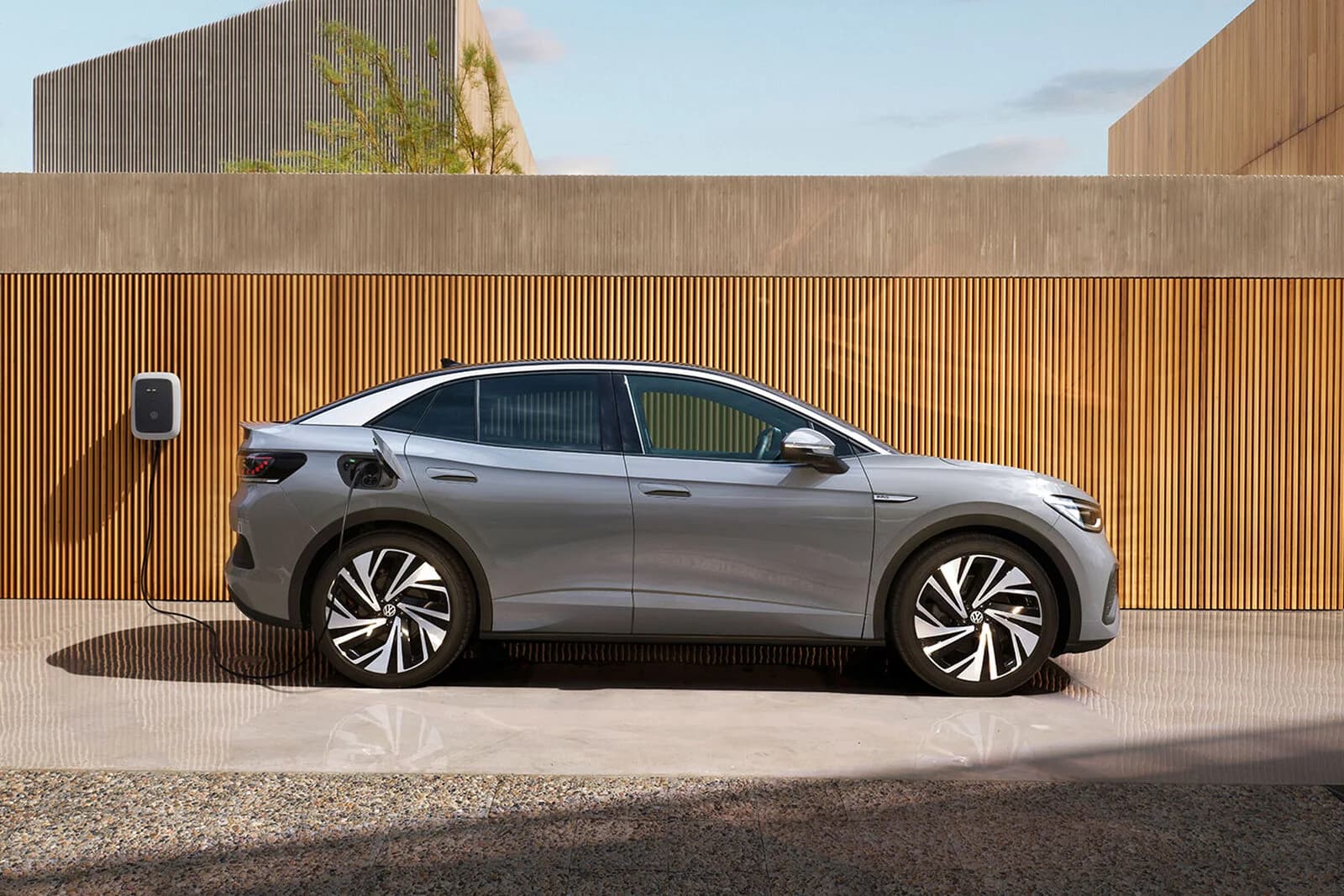
Volkswagen has confirmed that the electric ID.5 will leave the range without a direct successor. The new ID. Tiguan will take over the roles previously covered by both the ID.4 and ID.5. Volkswagen plans to reveal the electric SUV in early October, with European sales expected to begin at the start of 2027.
The absence of a direct replacement was confirmed by Volkswagen spokesperson Stefan Voswinkel in a statement quoted by Motor1. The company will no longer maintain two closely related electric SUVs with conventional and coupe-style bodies. Instead, it will use the Tiguan name for a more upright vehicle focused on everyday practicality and interior space.
A short life for Volkswagen’s electric coupe-SUV
The ID.5 arrived in 2021 as Volkswagen’s first electric SUV coupe. It shared the MEB platform and much of its hardware with the ID.4, but used a lower roofline and a more elongated rear section. The design gave the ID.5 a different visual identity and a more streamlined profile. It also reduced some of the available space at the back and in the luggage area compared with the more upright ID.4.
Volkswagen positioned the car as a companion to the ID.4 rather than as its replacement. Both models shared electric drive technology, software and a large part of their interior architecture. The upgrade announced in 2023 brought the ID.5 a 210 kW motor in Pro versions, while the ID.5 GTX was rated at 250 kW. Volkswagen quoted up to 556 kilometres of WLTP range for the ID.5 Pro in the most favourable equipment configuration.
Those figures come from official test procedures and do not represent a guaranteed distance in everyday driving. Temperature, speed, road conditions, driving style, vehicle load and the use of heating or air conditioning all affect real-world range. They nevertheless show where Volkswagen placed the ID.5 within its electric portfolio during its latest major update.
Why the coupe body is being dropped
Volkswagen has not published an official sales breakdown for the ID.5 in the announcement about its future, nor has it identified one single financial reason for the decision. Motor1 reports that the more conventional ID.4 proved more popular, while the ID.5 competed in a narrower part of the SUV market. Buyers had to accept less cargo and rear-seat practicality in exchange for the sloping roof.
A conventional SUV is simpler to explain to families and fleet customers. The taller body generally makes access to the rear seats easier, leaves more usable room behind the tailgate and gives the vehicle a straightforward relationship with the established Tiguan. A coupe-like profile can look more distinctive, but its practical advantages are less obvious when the underlying platform and drivetrain are shared with a conventional SUV.
The new ID. Tiguan will therefore bring customers who once chose between two related body styles into one electric SUV line. Volkswagen has not yet published the complete production specification at the time of writing. It is not possible to say that the ID. Tiguan will use exactly the same motors, battery sizes or dimensions as the ID.4 and ID.5.
Volkswagen’s naming strategy is changing
The ID.5 decision is part of a wider change in how Volkswagen names future electric cars. In 2025, the brand said it would transfer established names to new electric vehicles. Volkswagen pointed to names such as ID. Polo and to additional electric cars for the small and compact segments, while also keeping familiar combustion and hybrid models in the range.
The Tiguan name has a different job from a simple number in the ID family. It is already associated with a compact Volkswagen SUV and gives customers an immediate reference for size and use. Applying it to a fully electric model can make the new vehicle easier to understand, even though its drivetrain and software architecture will differ from the combustion-powered Tiguan.
This does not mean that all ID models are being removed at once. In March 2026, Volkswagen still announced software upgrades and ordering availability for the ID.4, ID.5 and ID.7. The new confirmation should therefore be read as a decision about the next stage of the range, not as a statement that existing cars have suddenly become unsupported or that every market will stop taking orders on the same day.
What existing ID.5 owners should expect
Discontinuing a model does not automatically cancel servicing, warranty coverage or software support for cars already delivered. Owners should continue to use the official Volkswagen and dealer channels for maintenance, recalls and updates. New-car stock can also vary by market, and the announcement does not define the final production or order cut-off for every country.
For buyers who specifically want an electric Volkswagen with a sloping SUV roof, the brand’s future range will offer fewer choices. Other Group products and rival manufacturers may occupy a similar design space, but they will not be official ID.5 successors. The ID. Tiguan will be asked to serve both audiences, and its October reveal should clarify how much interior space, range and charging technology it brings.
The ID.5 will therefore remain a brief chapter in Volkswagen’s first phase of electric model expansion. It showed that the company could derive two different SUV body styles from one electric architecture. The new direction favours a more concentrated portfolio and familiar names. Prices, final equipment, battery sizes and range for the ID. Tiguan remain unconfirmed until Volkswagen publishes the production details.


