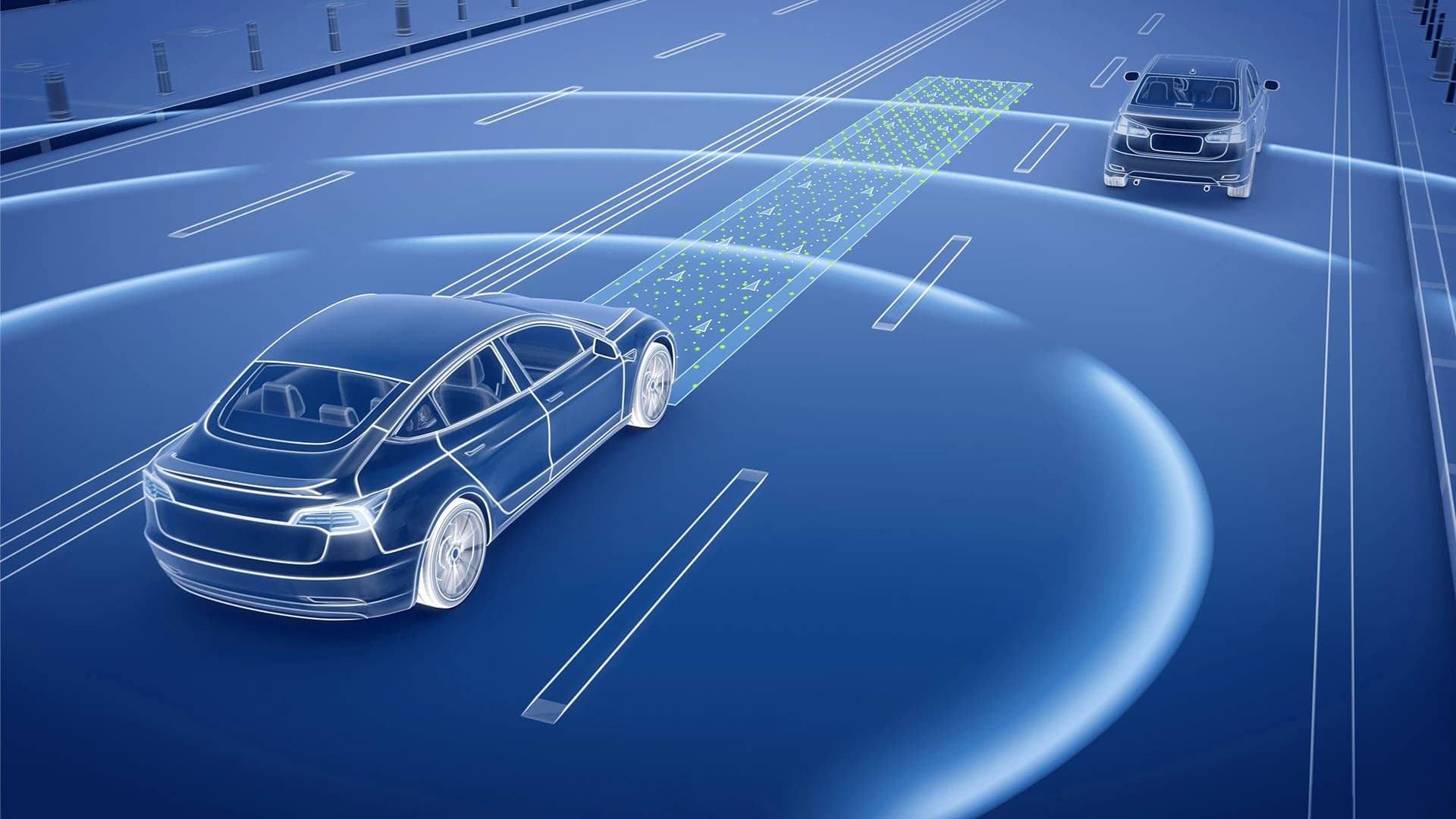
Illustrative image for how ADAS systems work.
Volkswagen is expanding the IQ.DRIVE package for Atlas, Golf, Tiguan and ID. Buzz models of the 2027 model year. The novelties announced in the United States include a driver-initiated lane change, automatic stop on the hard shoulder when the driver no longer responds, pedestrian detection when reversing, and adaptive cruise control more attentive to signs and motorway exits.
The announcement comes from Volkswagen of America, and the manufacturer has not confirmed that the same configuration and timetable will apply in Europe or Romania. The term “model year 2027” is specific to the North American market and should not be confused with a local launch date.
Lane change starts from the driver’s indicator
With Travel Assist active and at a speed above 72 km/h, the driver can request a lane change with a partial press of the indicator stalk. Rear radars check traffic in the adjacent lane, and the car executes the manoeuvre only if the system considers there is enough space.
If another vehicle blocks the move, the function can wait up to 12 seconds for the lane to clear. The manoeuvre remains driver-initiated; the driver must watch traffic and be ready to intervene. It is not an autonomous-driving function.
Emergency Assist Plus can move the car to the right
The most important change is Emergency Assist Plus. In Travel Assist mode, the system starts the warning sequence if it detects no steering-wheel input for 25 seconds. Visual and acoustic warnings, brake pulses and belt pretensioning are used to try to regain the driver’s attention.
If the person at the wheel does not respond, the front camera looks for space on the right. The car can change lanes and stop on the hard shoulder; if there is not enough room, it stops as close as possible to the right edge of the carriageway. During the manoeuvre, indicators, hazard lights and brake lights are activated.
After stopping, the transmission is put in Park, the doors unlock, exterior lights come on, and the system places an emergency call. The function depends on the visibility of markings, available space and sensor limits. The driver remains responsible for control of the car.
Automatic braking for pedestrians when reversing
Certain Atlas, Tiguan and ID. Buzz versions will get a reversing camera able to detect pedestrians. Between about 2 and 10 km/h, the system can apply the brakes automatically to reduce the risk of a collision while reversing.
Volkswagen does not say the function will be standard on all trims. Availability differs by model and version, so buyers will have to check the exact specification of the car.
Adaptive cruise control anticipates motorway exits
Predictive Adaptive Cruise Control receives new logic for speed signs and exit ramps. The system can propose adopting a higher limit more quickly, and the driver confirms by pressing the accelerator. A press of the “Res” button rejects the suggested change.
With an active navigation route or after using the indicator, adaptive control can also start reducing speed before a motorway exit. The change is shown in the digital instruments and can be accepted or refused by the driver.
ID. Buzz will also use traffic-collected data
In the United States, the 2027-model-year ID. Buzz gets access to the Road Experience Management cloud service. Anonymised data supplied by cars about markings, signs and street lighting are used to improve the maps on which assistance systems rely.
Volkswagen says the information can help centre the car when markings are hard to see and adapt speed to traffic flow, without exceeding the legal limit. The service is included for one year in the American In-Vehicle Premium package, after which it requires a subscription. This condition does not automatically apply to the other models or to the European market.
What it means for drivers in Romania
IQ.DRIVE is an umbrella name for several assistance systems, and equipment differs between the United States and Europe. European Volkswagen versions already offer combinations of Travel Assist, Lane Assist, adaptive cruise control and Emergency Assist, but the new hard-shoulder stop function has not been officially announced for Romania.
Even when all these systems are active, the car operates at automation level 2: it can control steering and speed simultaneously in certain conditions, but it does not take over driving responsibility. The driver must supervise the road at all times and be able to intervene immediately.
Sources: Volkswagen of America – official IQ.DRIVE presentation, Self Drive News – IQ.DRIVE functions for model year 2027, Motor1 – announcement of IQ.DRIVE updates