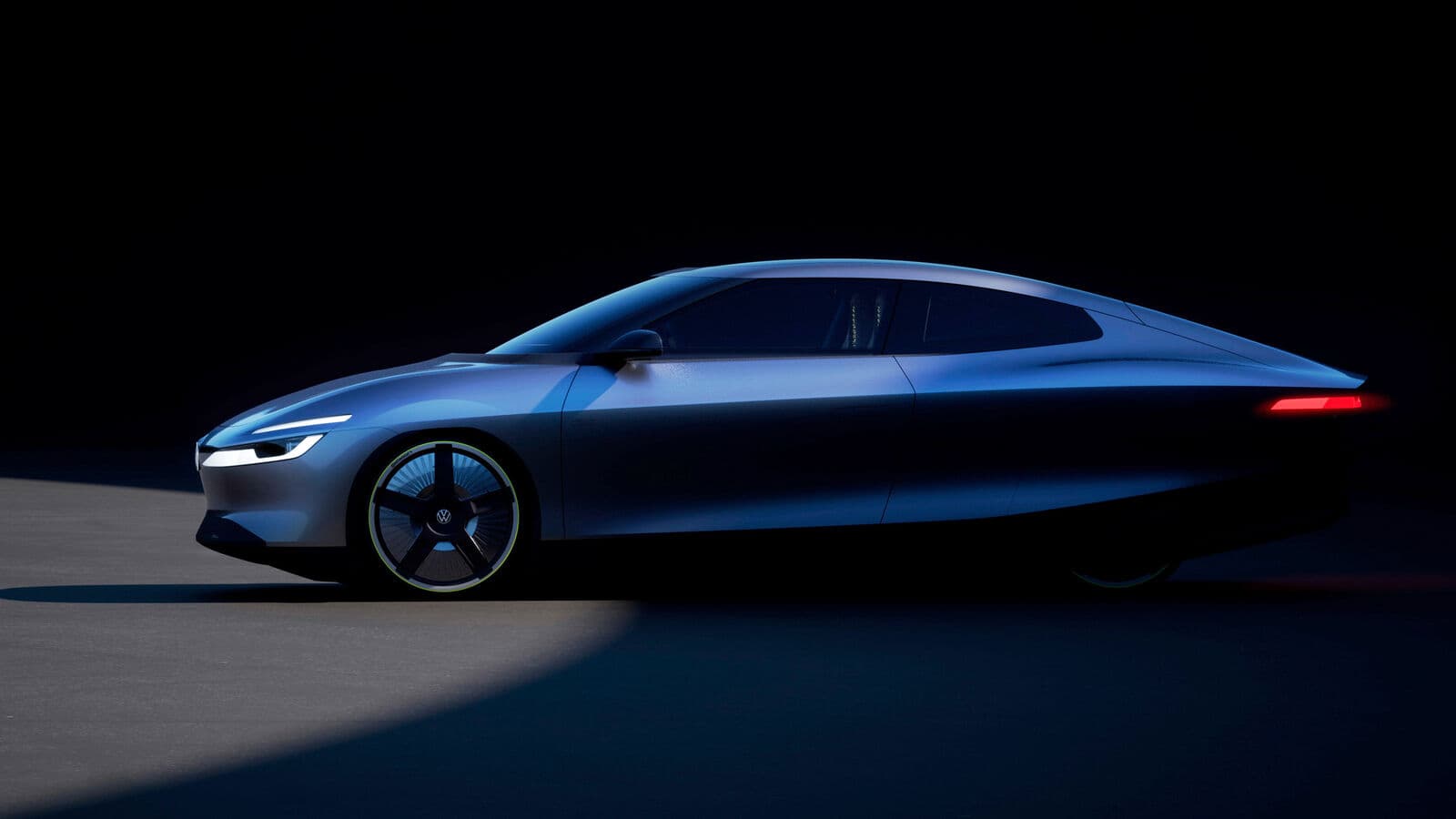
Photo: Volkswagen. Press image of the Mission Efficiency concept.
Volkswagen has presented Mission Efficiency, an electric concept built to test how far consumption can be reduced without a very large battery. The prototype covered 1,278.36 km, from the development centre in Wolfsburg to Vienna, with a single stop for charging and with an estimated 164 km of remaining range on arrival.
On the route that passed through Poznań and Olomouc, the on-board computer indicated an average consumption of 6.89 kWh/100 km, excluding losses during charging. Measured at the socket, consumption was 7.51 kWh/100 km. The figures are unusually low for an electric car, but they were obtained by an aerodynamic prototype, at an average speed of 67.72 km/h, not by a model available in showrooms.
54.9 kWh battery and the future ID. Polo motor
Mission Efficiency uses the MEB+ architecture with front-wheel drive. The battery has a net capacity of 54.9 kWh, and the electric motor develops 99 kW, equivalent to 135 hp. Volkswagen says both components come from the technical family prepared for the production ID. Polo and ID. Cross models.
The maximum speed reached on the journey to Vienna was 138 km/h. The manufacturer has not presented a WLTP-certified range figure, and the concept is not intended for sale. The aim of the project is to transfer efficiency solutions to future production cars, not to launch a direct successor to the XL1.
The car also uses photovoltaic cells integrated into the roof and the rear window. The energy they produce feeds the auxiliary electrical network, reducing the load on the traction battery. Volkswagen has not specified how many kilometres were gained thanks to the solar panels on the record run.
Drag coefficient of 0.158
The central element of the concept is aerodynamics. Volkswagen declares a drag coefficient of Cd 0.158 and a frontal area of 2.08 m². The body has a teardrop shape, the rear wheels are covered, the floor is fully faired, and the cooling air intakes open only when needed.
The door handles are integrated into the bodywork, the windows have no frames, and the wheels use patented deflectors that control airflow around the tyres. These solutions matter especially at high speeds, when aerodynamic drag becomes the main source of consumption.
According to Volkswagen’s measurements, above 80 km/h, Mission Efficiency uses more than 30% less energy than the production version of the ID. Polo. At 140 km/h, the prototype would require roughly the same energy that the ID. Polo uses at 100 km/h. The comparison belongs to the manufacturer, and independent data for the two cars have not been published.
6.48 kWh/100 km in ideal conditions
Volkswagen separately carried out a consumption test in controlled conditions. At a constant speed of 68 km/h, on a route with no elevation changes and with the air conditioning off, the concept recorded 6.48 kWh/100 km.
The company presents three results as records: the drag coefficient of 0.158 for a car registered for road use, the consumption from the ideal test, and the efficiency of the near-production prototype. These results are not equivalent to a WLTP homologation, because the procedure, speed and use of auxiliary consumers are different.
For comparison, the official consumption of a production electric car includes a cycle with accelerations, stops and variable speeds. In real use, temperature, rain, wind, cabin heating or air conditioning and motorway speed can raise the energy required considerably.
Four seats and a 481-litre boot
The concept measures 4,775 mm in length and only 1,392 mm in height. The cabin has a 2+2 layout, and the boot offers 481 litres. The front seats can be used without declared restrictions, but the rear seats are designed for people no taller than about 1.60 metres.
To reduce mass, the aluminium monocoque structure is combined with carbon-fibre and aramid composite elements. Several components nevertheless come from the ID. Polo, precisely so that the project can test technology that may reach volume production.
The front axle uses MacPherson suspension and hydraulic brakes taken from the ID. Polo. At the rear, Volkswagen and supplier Aumovio have fitted an electromechanical brake. This eliminates some of the pipes and brake fluid for the rear axle, reduces friction losses and allows more precise control of braking distribution and energy recuperation.
What could reach production Volkswagen cars
The extremely low shape, covered rear wheel arches and expensive materials are not suited to a family car produced in large volumes. Easier to transfer are thermal management, the 99 kW motor, MEB+ electronics, active shutters, floor optimisation and rear-brake control.
Mission Efficiency also shows why enlarging the battery is not the only path to range. At a consumption of about 7 kWh/100 km, a compact pack can cover distances that would require an almost doubled battery in a heavy SUV. The advantages are lower mass, a lower cell cost and shorter charging times for the same recovered distance.
The prototype has individual approval for use on European roads and meets the applicable protection, strength and impact requirements, according to Volkswagen. That allowed the route to be completed in real traffic, but it does not turn Mission Efficiency into a production model, nor does it confirm that all of its solutions will appear on the ID. Polo.
Sources: Volkswagen Newsroom – Mission Efficiency results and technical data, Volkswagen Newsroom – technical presentation of the concept, Motor1 – presentation of Volkswagen Mission Efficiency