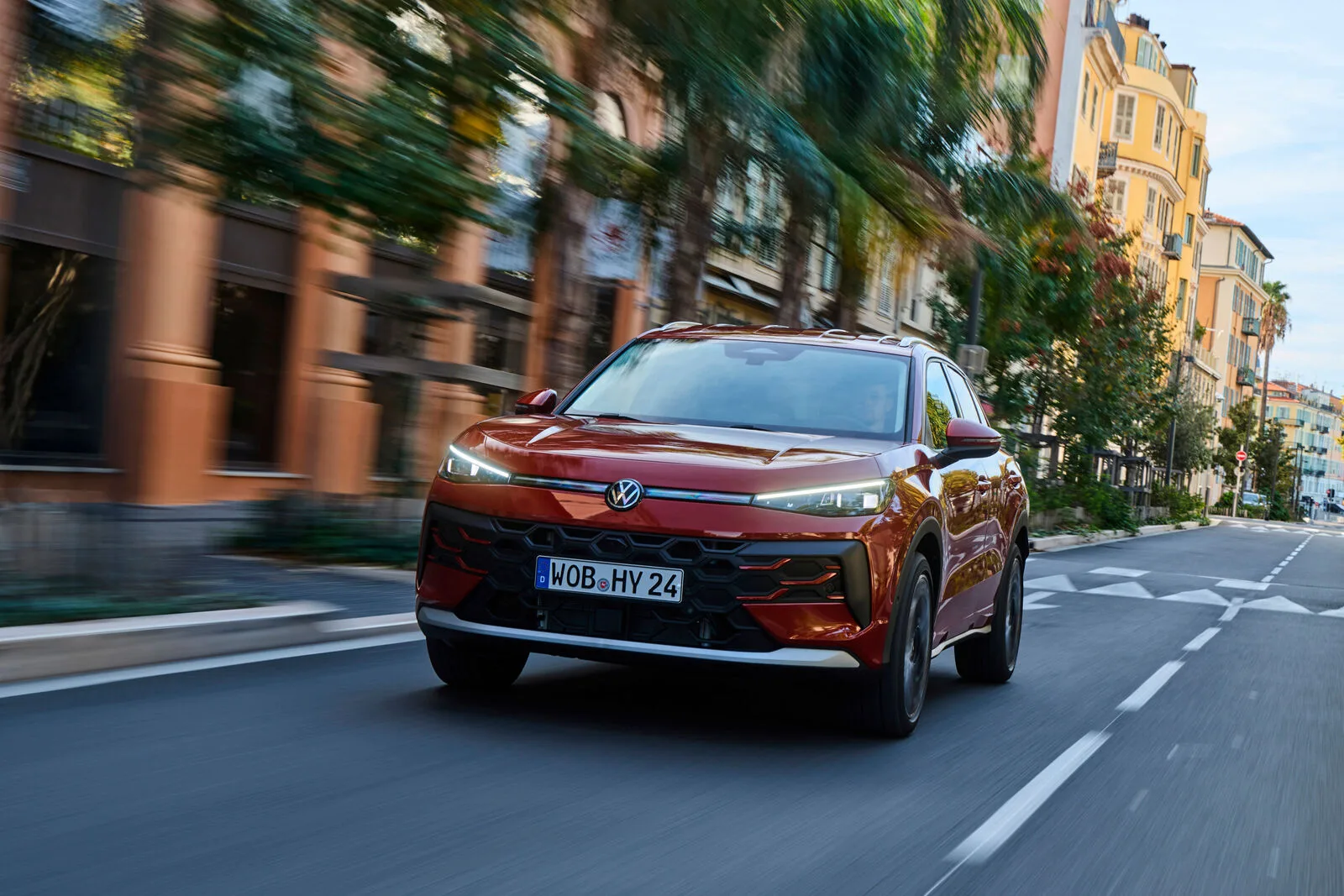
The Volkswagen T-Roc Full Hybrid can now be ordered in Romania, adding a self-charging hybrid option between the brand’s mild-hybrid petrol models and vehicles that need to be plugged in. The range opens at a list price of €34,640 including VAT for the 136 PS Life model, while the first customer cars are expected during winter 2026.
There are two power outputs and three trim levels in the initial range. More importantly, there are several different numbers on Volkswagen’s Romanian website. They represent a list price, a launch offer and conditional campaign discounts, not three conflicting prices for an identical transaction.
Romanian prices and why the offer can be lower
The launch price list starts with the 136 PS Life at €34,640. A 136 PS Style costs €38,248, while the 170 PS Style is €40,419. The 170 PS R-Line sits at the top of the initial range at €41,480. All four figures include Romanian VAT.
Volkswagen Romania also advertises the 136 PS Life from €31,700 on its dedicated full-hybrid offer page. A separate campaign can show a figure close to €26,900 after a customer benefit and a finance bonus have been applied. Those lower prices depend on campaign validity, eligibility, selected stock and, where applicable, a finance agreement.
That distinction is essential for anyone comparing cars. The list price describes the standard positioning of a version, whereas a promotional figure may expire or require a particular contract. Volkswagen states that the displayed prices are recommended, can change and do not replace the binding quotation from an authorised retailer. Buyers should compare the cash vehicle price, discount and total amount payable under finance rather than relying on the largest number in an advert.
What is included with Life trim
The Romanian launch specification for Life includes an automatic hybrid transmission, LED headlights and 16-inch Bilbao alloy wheels. Driver assistance equipment listed by Volkswagen comprises adaptive cruise control, Front Assist, Lane Assist, Side Assist and autonomous emergency braking.
Park Pilot sensors and a Rear View camera cover low-speed manoeuvring, while the winter package includes a heated steering wheel. Style can be paired with either power output. R-Line is initially linked to the 170 PS system and provides the sportier visual treatment. Final equipment should always be checked against the order form because campaigns and standard specifications can be updated.
How Volkswagen’s first full-hybrid system works
The powertrain combines a 1.5 TSI evo2 petrol engine with two electric machines. One acts as a starter-generator; the other drives the front wheels and recovers energy when the car slows. A liquid-cooled, 1.6 kWh gross battery sits beneath the rear bench and contains 84 prismatic NMC cells.
In the entry version, the combustion engine produces 131 PS and the system output is 136 PS, with 288 Nm of torque. The stronger model uses a 150 PS petrol engine and develops 170 PS as a system, with approximately 310 Nm. The individual peak figures are not simply added because the petrol and electric motors do not deliver their maximum output at the same point in every operating mode.
Volkswagen identifies the transmission as the TQ250-1F, a one-speed hybrid gearbox. The Romanian offer uses the term CVT, but this is not the dual-clutch DSG fitted to some TSI and eTSI versions. The layout is designed to blend electric drive, series-hybrid operation and direct assistance from the petrol engine without conventional gear changes.
The T-Roc can pull away electrically when the battery state and power demand allow it. At low speeds, the combustion engine may remain off for short periods. Volkswagen says electric driving is possible up to around 60 km/h under suitable conditions, but this is not a guaranteed threshold: strong acceleration, low battery charge or temperature requirements can start the petrol engine sooner. At higher speeds the TSI usually becomes the main source of propulsion, with the electric motor supporting it when necessary.
Consumption, performance and range
Volkswagen Romania quotes combined WLTP consumption of 5.0 to 5.6 litres per 100 km and CO2 emissions of 115 to 127 g/km for the T-Roc Hybrid family. The brand’s international technical data puts the 136 PS model at 4.9-5.5 l/100 km and the 170 PS version at 5.0-5.6 l/100 km, depending on wheels and equipment.
The 136 PS T-Roc reaches 100 km/h in 9.7 seconds. The 170 PS model takes 8.5 seconds, and both have a 180 km/h top speed. Volkswagen claims a combined WLTP range of more than 800 km, using petrol and recovered electrical energy together.
There is no official electric-only range comparable with a plug-in hybrid. The small battery is intended for short electric phases, launch assistance, energy recovery and power support. It cannot be charged from the grid, and it is not designed to complete a long daily commute without petrol. This makes “full hybrid” materially different from both a mild hybrid, which generally cannot propel the car alone, and a plug-in hybrid with a much larger battery.
Urban and suburban routes with repeated slowing offer the best opportunity to recover energy. On a steady motorway journey the petrol engine operates for more of the time, so the efficiency advantage can narrow. WLTP values are useful for comparing versions under a common test, but traffic, temperature, speed and driving style will determine the real result.
Size and everyday practicality
The current T-Roc is 4,373 mm long, 1,828 mm wide and 1,573 mm tall, with a 2,629 mm wheelbase. Volkswagen’s model factsheet lists a 475-litre boot, expanding to 1,350 litres with the rear seats folded, plus a 50-litre fuel tank. Drive is sent to the front wheels.
Those figures keep the T-Roc in the heart of the compact SUV class. Placing the battery beneath the rear seat allows the hybrid hardware to be integrated without a charging cable or external charging port. From the driver’s perspective, the car is filled with petrol and used like a conventional automatic; the control software decides when to recover energy, switch off the engine or combine both power sources.
For Romanian buyers, the 136 PS Life is the rational entry point, while Style and R-Line add equipment, performance or both. A discounted offer may make the hybrid considerably more attractive than its €34,640 list price suggests, but only the full dealer quotation reveals the real deal. Delivery timing, options, fees, interest and mandatory insurance can all change the total cost.
Sources
- Volkswagen Romania: Golf and T-Roc full-hybrid launch and specifications
- Volkswagen Romania: Golf and T-Roc Full Hybrid offer
- Volkswagen Romania: hybrid range commercial campaign
- Volkswagen Newsroom: T-Roc Hybrid in brief
- Volkswagen Newsroom: hybrid drive technology in detail
- Volkswagen Newsroom: new T-Roc factsheet
Image: Volkswagen AG press material, licensed for editorial use.