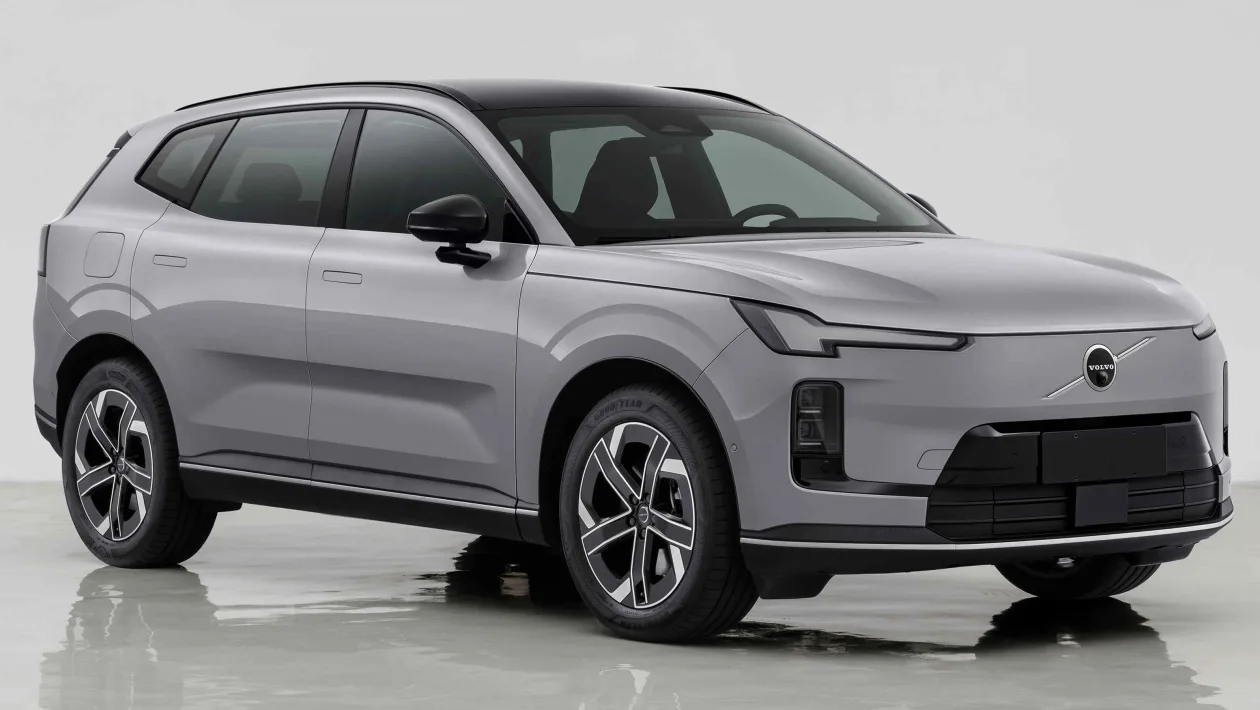
The Volvo XC70 is the brand’s first plug-in hybrid with extended electric range. The version presented for China claims more than 200 km in the CLTC cycle. Photo: Volvo Cars
Volvo is preparing plug-in hybrids meant to be driven daily as electric cars
Volvo is changing the role of the plug-in hybrid in its range. Instead of a car with a combustion engine helped by a relatively small battery, future models will be designed so that most ordinary journeys take place electrically, with the petrol engine providing the security of long range on long trips.
The target discussed by company management is about 160 km of electric running for the next generation of plug-in hybrid models. It is not yet a homologated WLTP figure for a car that can be ordered in Romania, but the technical objective presented by Volvo directors for the future range.
The difference will not be only a larger battery. Volvo wants the car to keep the prompt acceleration, quietness and response of an electric model even when the driver asks for more power, without the combustion engine starting frequently in daily use.
How the new generation of Volvo hybrids will work
Michael Fleiss, Volvo’s director for strategy and products, describes the future models as electric cars with a backup engine. Electric propulsion will be used first in the city and in stop-start traffic, where it is efficient and can recover energy under braking.
The combustion engine will not, however, serve only as a generator. According to Fleiss’s explanations, it will be able to connect mechanically to the wheels when the battery reaches a low level or when that solution is more efficient, for example at constant motorway speeds.
Future Volvos should therefore not be confused with range-extender electric cars in which the petrol engine produces energy only, without being able to drive the wheels. Volvo’s architecture remains hybrid, but it is conceived around electric use.
The company estimates a total range, from battery and tank, of 800–1,000 km. Final figures will depend on model, market, equipment and the homologation cycle.
The XC70 already shows the direction, but the 200 km figure must be read correctly
The first example is the new Volvo XC70, built on the SMA platform dedicated to long-range plug-in hybrids. The model launched initially in China offers, according to the manufacturer, more than 200 km electric and more than 1,200 km total range.
The 200 km were determined in the Chinese CLTC cycle, which is not directly comparable with the WLTP standard used in the European Union and tends to give more optimistic figures. Volvo states in the model documentation that the figure applies to the version intended for the Chinese market.
The XC70 can charge the battery from 0 to 80% in 23 minutes and can supply electricity to external devices through an adaptor. These functions bring it closer to the way an electric car is used, even though it retains the internal-combustion engine.
The manufacturer has announced the intention to bring the XC70 to Europe as well, at a later stage. European specifications, WLTP range, prices and availability in Romania have not been confirmed.
What changes compared with current Recharge models
Volvo plug-in hybrid models already on the market can run electrically and give priority to the electric motor in Hybrid mode. They still come, however, from a generation in which the combustion engine remains a central part of the drivetrain, and petrol-free range is lower than the target of the new models.
In the next generation, the larger battery and more powerful electric motor should allow the daily commute, urban trips and many regional journeys without starting the petrol engine. It will intervene especially on long trips or when charging is not available.
Volvo presents the solution as an intermediate stage for customers who value electric running but are not ready to depend solely on charging infrastructure. The strategy does not mean abandoning fully electric models, but extending the period in which the two types of propulsion will be sold in parallel.
For whom it would make sense in Romania
A plug-in hybrid with about 160 km of electric range can cover several days of commuting without petrol for a driver who charges it at home or at work. At the same time, the combustion engine removes the need to plan charging stops on holidays or on routes where stations are scarce.
The advantage depends, however, on a simple habit: the car must be charged regularly. If it is used mostly with a depleted battery, it permanently carries the mass of the battery, the electric motor and the thermal system, and the fuel saving falls considerably.
A larger battery also brings extra cost, mass and complexity. For someone who can charge easily and often makes long trips, the compromise can be suitable. For someone without constant access to a socket, a conventional hybrid can be simpler, and for someone who always stays within battery range, a fully electric car avoids combustion-engine maintenance.
The practical conclusion is that future Volvo plug-ins will try to reverse the current logic: petrol will no longer be the source used every day, but the reserve for situations in which electric range is not enough. The success of this formula will depend on real WLTP range, charging speed and the prices of the European versions, still unannounced.