
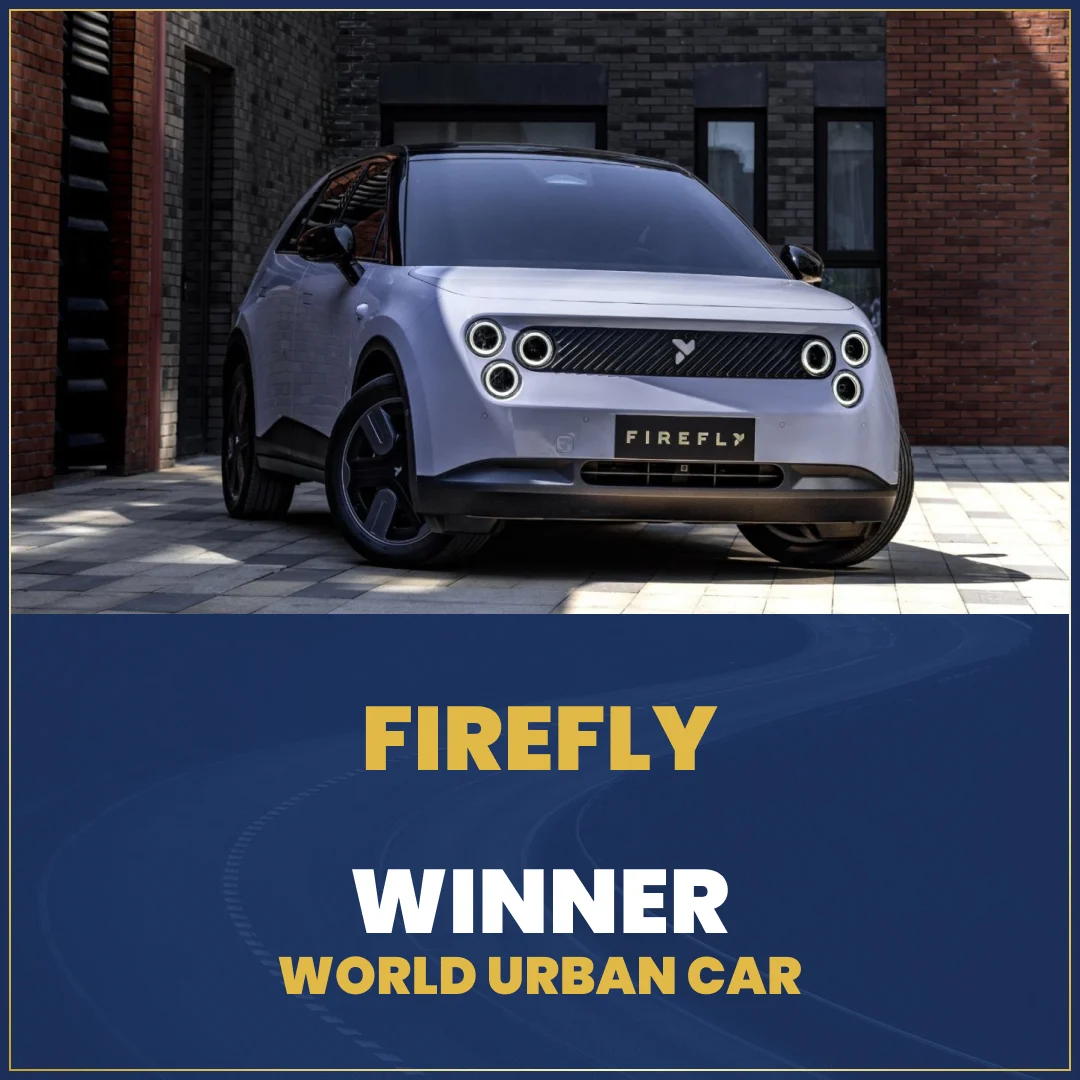
The World Car Awards has published its provisional list for the 2027 season. The main World Car of the Year category contains 56 eligible vehicles, and Chinese brands or groups account for a notably large share of the field. These are candidates, not finalists, and the list does not indicate which car will win. It marks the beginning of the jurors’ evaluation process.
A 56-car field
The official list includes established names such as BMW, Hyundai, Kia, Mercedes-Benz, Mazda, Renault, Subaru, Volkswagen and Volvo. It also includes BYD, Changan, Chery, Deepal, Exeed, GAC Aion, Geely, iCAUR, Jetour, Leapmotor, Lepas, Lynk & Co, MG, Omoda, Onvo, XPeng and Zeekr.
The range is broad. The Geely EX2, Leapmotor T03 and GAC Aion UT sit at the compact end of the list, while the BYD Ti7, Jetour G700 and Exeed Exlantix ET represent larger SUV products. Deepal, XPeng and Zeekr appear with vehicles aimed at different parts of the electric market. The list also includes plug-in hybrids and combustion-engine vehicles, so the main award is not an electric-only competition.
The phrase “more than half Chinese” needs context. World Car Awards publishes model names rather than a field for ownership, engineering origin or production location. A count can differ if it includes Chinese-owned international brands, joint ventures or cars built in China for a global badge. The official data supports the broader conclusion: Chinese manufacturers and industrial groups have a major presence in the 2027 field, but the organisers do not publish a separate nationality total.
What makes a car eligible
For the World Car of the Year category, a vehicle must be produced at a minimum volume of 10,000 units per year. It must be priced below the luxury-car level in its main markets and be on sale in at least two major markets on two different continents. The programme lists China, Europe, India, Japan, Korea, Latin America and the United States among those markets.
The eligibility period runs from January 1, 2026 to March 19, 2027. The “on-sale” requirement is more demanding than a global reveal or an online reservation system. The official criteria refer to a vehicle being physically available for purchase or lease through dealers in the relevant markets. For newer Chinese brands, that condition is an important test of whether an announced international expansion has become a real retail operation.
The vehicles must be new or substantially revised. Any vehicle eligible for another World Car category is automatically eligible for World Car Design of the Year. That gives the candidates a second evaluation route, although the design award follows its own process and should not be confused with the overall title.
Chinese groups are present across segments
The list is not limited to one type of Chinese product. BYD Ti7, Jetour G700 and Exeed Exlantix ET target the large SUV market. Geely EX2, Leapmotor T03, GAC Aion UT and MG4 EV Urban are closer to the compact and urban end. XPeng, Zeekr, Deepal and Onvo bring electric vehicles into several body styles and price positions.
The corporate structure also matters. MG is controlled by SAIC; Omoda, Exeed and Jetour are associated with Chery; Lynk & Co and Zeekr belong to the wider Geely ecosystem; and Onvo was launched by Nio. Polestar is presented as an international premium EV brand but is also linked to Geely. Counting only the badges can therefore hide the scale of Chinese ownership and investment behind the candidates.
Some entries have a more international background. Buick Electra E7, Chevrolet Captiva EV / PHEV, Nissan Frontier Pro and Mazda CX-6e / EZ-60 should not be described in exactly the same terms as a model from a Chinese-only brand. They illustrate how engineering, production and joint-venture structures increasingly cross national boundaries.
More candidates appear in the other awards
The main award is not the only category with Chinese representation. World Luxury Car candidates include Avatr 06, Avatr 07, Avatr 12, Denza BAO 5, XPeng G9, XPeng G9L, XPeng X9 and Zeekr 9X. They compete alongside models from Audi, BMW, Genesis, Jaguar, Polestar, Porsche and Range Rover.
The luxury category uses a 5,000-unit annual production threshold and the same two-market, two-continent availability principle. In World Performance Car, Lynk & Co 02 and Zeekr 7GT are listed with performance products from Alpine, Cadillac, Chevrolet, Genesis, Kia, Lotus, Mercedes-AMG and Porsche. That category requires at least 1,000 units per year and an overt performance focus.
World Urban Car is governed by separate requirements, including a maximum length of 4.25 metres, public-road approval and production of at least 5,000 units per year. The electric category also has its own list. A battery-electric car is not automatically entered in every category, while all vehicles eligible for another category are automatically considered for design.
The shortlist comes in January
Jurors are scheduled to test-drive the eligible vehicles from September 2026 through January 2027. Round One voting closes on December 28, 2026. On January 5, 2027, the organisers will announce the Top Ten for World Car of the Year and the Top Five finalists for the luxury, performance, urban and design awards.
Round Two voting closes on February 16, and the winners will be announced on March 24, 2027, at the New York International Auto Show. Until that point, an eligible vehicle is not a finalist and should not be presented as a likely winner. The current list confirms that a car can enter the process; it says nothing about its final ranking.
For European buyers, the 2027 field is a test of practical global reach. Chinese companies are represented in small urban cars, family SUVs, premium models and performance vehicles. The next step is to prove that the cars are genuinely available across markets, satisfy the formal criteria and perform well enough in the hands of an international jury.


