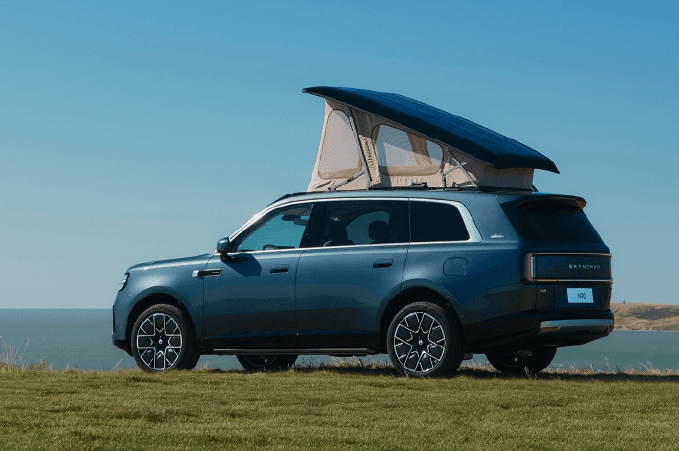
The SkyNomad N90 Max Explorer has an electric roof that rises only when the car is stationary. Photo: Xiaomi.
The Xiaomi SkyNomad N90 Max launched with a roof-integrated tent and 11 cabin layouts
Xiaomi has launched in China the SkyNomad N90 Max, a large seven-seat SUV with electric drive assisted by a combustion engine used as a range extender. Alongside the ordinary version, the manufacturer offers an Explorer edition with an electrically extending roof, a bed mounted above the cabin and equipment intended for camping.
The N90 Max is not a motorhome in the classic sense. With the roof down, it looks like a family SUV with three rows of seats. When the car is parked off public roads, the upper section rises and creates a second sleeping space. The solution is installed at the factory, not added later as a tent clipped to roof bars.
The Max version starts in China at the equivalent of about €32,500, and the Explorer costs around €36,000, before taxes and costs that would apply to any eventual export. Xiaomi has not announced commercialisation of the model in Romania or in the rest of the European Union.
What the Explorer version adds
The extending roof is electrically operated and forms a cabin with textile walls, mesh windows and a sleeping platform. Xiaomi presents it as extra space for rest, outdoor photography or longer trips. The edition also includes side cupboards, mounting points for an exterior tent, a detachable table and the option of installing a projection system.
The raised roof increases the car’s height from 1,825 to 1,925 mm. Kerb mass reaches about 2,840 kg, and the mechanism can be used only with the vehicle stationary. That restriction matters: the extension is not an aerodynamic roof for driving, but a camping fit-out.
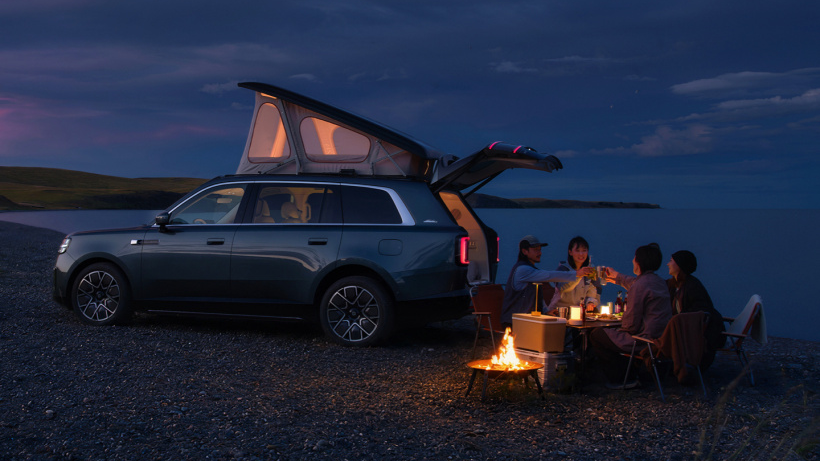
The Explorer version combines the extending roof with camping accessories. Photo: Xiaomi.
11 layouts for the seven seats
The standard cabin uses a 2+2+3 layout. The floor is flat, and the seats and centre console move on long rails. Xiaomi says the system can create 11 configurations, depending on passenger numbers and the chosen activity.
The front seats can rotate 180 degrees when the transmission is in park. Occupants in the first and second rows can thus sit face to face, and the moving console can be turned into a table. Other modes prioritise relaxation, access to the third row, luggage transport or obtaining a sleeping surface inside.
Xiaomi does not describe the 11 variants as 11 completely different architectures. They are predefined scenarios achieved by moving, rotating and folding the same seats, together with adjusting the console, lighting and climate control.
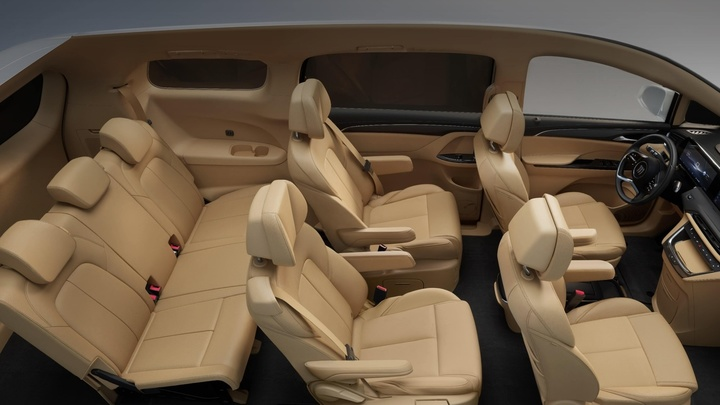
The N90 Max keeps a three-seat bench on the last row, unlike many Chinese SUVs configured for six people. Photo: Xiaomi.
The second row has two individual chairs with a footrest. The front seats and those in the second row can receive heating, ventilation and massage. The moving console integrates a 9-litre compressor fridge, and the multimedia system uses a 16.1-inch central screen, HyperOS and a Qualcomm 8650 processor.
With the seats folded, the maximum declared luggage volume is 1,831 litres. The figure has not yet been measured to the European VDA method, so it should not be compared directly with data published in the spec sheets of SUVs sold in Romania.
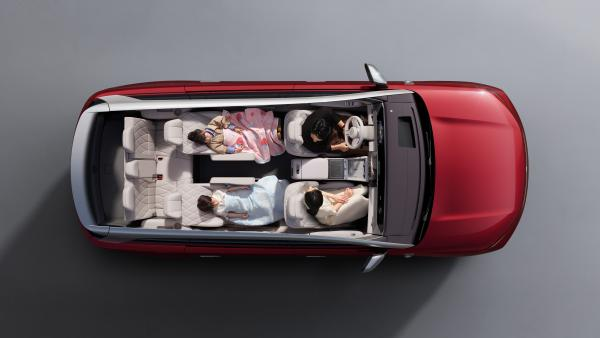
The flat floor and longitudinal rails allow the seats and centre console to be moved. Photo: Xiaomi.
A 5.29-metre SUV with air suspension
The SkyNomad N90 Max measures 5,285 mm in length, 1,998 mm in width and has a wheelbase of 3,080 mm. It is therefore longer than most seven-seat SUVs available in Europe and close in size to large American models.
Standard equipment includes 21-inch wheels, double-wishbone front suspension, a multi-link rear axle and five-level adjustable air suspension. Xiaomi declares a maximum water-fording depth of 750 mm and says the car can float for a short time in an emergency. That is a rescue function, not a normal way of travelling on water.
The structure includes a safety cell with steel of up to 2,200 MPa and 12 airbags. Assistance systems use a 700 TOPS Nvidia Thor processor, a roof-mounted lidar, a rear-facing lidar, 4D radar, 11 cameras and 12 ultrasonic sensors. The autonomous functions available in China are not automatically type-approved for Europe.
How the EREV system works
The wheels are driven by two electric motors: one of 210 kW on the front axle and one of 100 kW on the rear axle. Total electric-system power is 310 kW, equivalent to about 422 hp.
The 1.5-litre turbo petrol engine develops 112 kW and works mainly as a generator for the 76 kWh battery. The layout is EREV: at the wheels the car behaves like an electric car, and the thermal unit produces energy when the battery level falls.
Xiaomi announces for the N90 Max an electric range of 464 km and a combined range of 1,705 km, both determined in the Chinese CLTC cycle. These values are more optimistic than results usually obtained in the European WLTP cycle and cannot be used as a direct estimate for motorway use.
With the battery depleted, declared consumption is 6.26 l/100 km in the WLTC cycle. Fast charging can add, according to the company, energy for 285 km CLTC in 15 minutes. Real performance will depend on battery temperature, station power and the car’s consumption.
What is known about a possible launch in Europe
The SkyNomad N90 Max has been launched exclusively for China. Xiaomi is preparing to expand its car business in Europe, but has not confirmed that the N90 will be one of the imported models, nor announced prices, type approvals or a service network for Romania.
Dimensions, mass and digital systems would need adaptations for European rules. Even if it arrived officially here, the price would include transport, taxes, VAT, different equipment and the costs of a local network, so the direct equivalent of the Chinese price is not an estimated price for Romania.
The launch completes the initial presentation of the Xiaomi SkyNomad family, which also includes the smaller N70.
Frequently asked questions
Can the Xiaomi SkyNomad N90 tent be raised while driving?
No. The extending roof is intended for use only with the car stationary and off public roads.
Does the petrol engine drive the wheels?
The SkyNomad N90 is presented as an EREV. Propulsion at the wheels is electric, and the 1.5-litre engine is used to produce energy when the battery needs charging.
Do the 11 modes mean the car has 11 types of seats?
No. They are 11 cabin-arrangement scenarios, obtained by rotating, moving and folding the seats and by moving the centre console.
Will the Xiaomi SkyNomad N90 be sold in Romania?
There is no confirmation. The announced prices and specifications are for the Chinese market.