Grande Panda Hybrid: Fiat back in the B-segment with mild-hybrid tech
The Fiat Grande Panda Hybrid marks the Italian brand’s return to familiar ground—the B-segment, where it sold more than 23 million units in Europe over decades. The compact model offers electrified technology at a competitive price, targeting urban drivers who want a greener option without the compromises of a full battery electric.
T-Gen3 system: 1.2-litre turbo plus 28 hp electric motor
Grande Panda Hybrid uses the T-Gen3 setup: a 1.2-litre three-cylinder turbo producing 100 hp, a 28 hp electric motor and 110 hp combined. A 48 V Li-ion battery (0.876 kWh) feeds a six-speed eDCT automatic that integrates the electric motor, inverter and control unit.
e-launch, e-creeping and e-parking allow fully electric operation at low speed—up to 1 km on electric power below 30 km/h, according to Fiat. Official WLTP consumption is 5.0–5.1 l/100 km.
Performance figures: 160 km/h top speed, 0–100 km/h in 10 seconds. CO₂ emissions 115–117 g/km depending on trim (manufacturer data).
Smart Car architecture and front-wheel drive
The Stellantis Smart Car platform supports hybrid and full-electric powertrains. It is shared with the Citroën C3 and Opel Frontera.
Dimensions: 3.99 m long, 1.76 m wide, 1.58 m tall, with a 10.9 m turning circle. Front-wheel drive keeps it agile in town.
Target buyers: urban, commuters, small families
Grande Panda Hybrid suits daily urban use and regular commuting. Automatic transmission and low official consumption help stop-start traffic.
Five seats and a 412-litre boot—51 litres more than the electric version—make it workable for small families. European list pricing starts below €19,000 in Fiat’s positioning for accessible electrification.
Design and interior: space and sustainable materials
Grande Panda revisits the geometric design of the 1980 original with modern lines.
Exterior
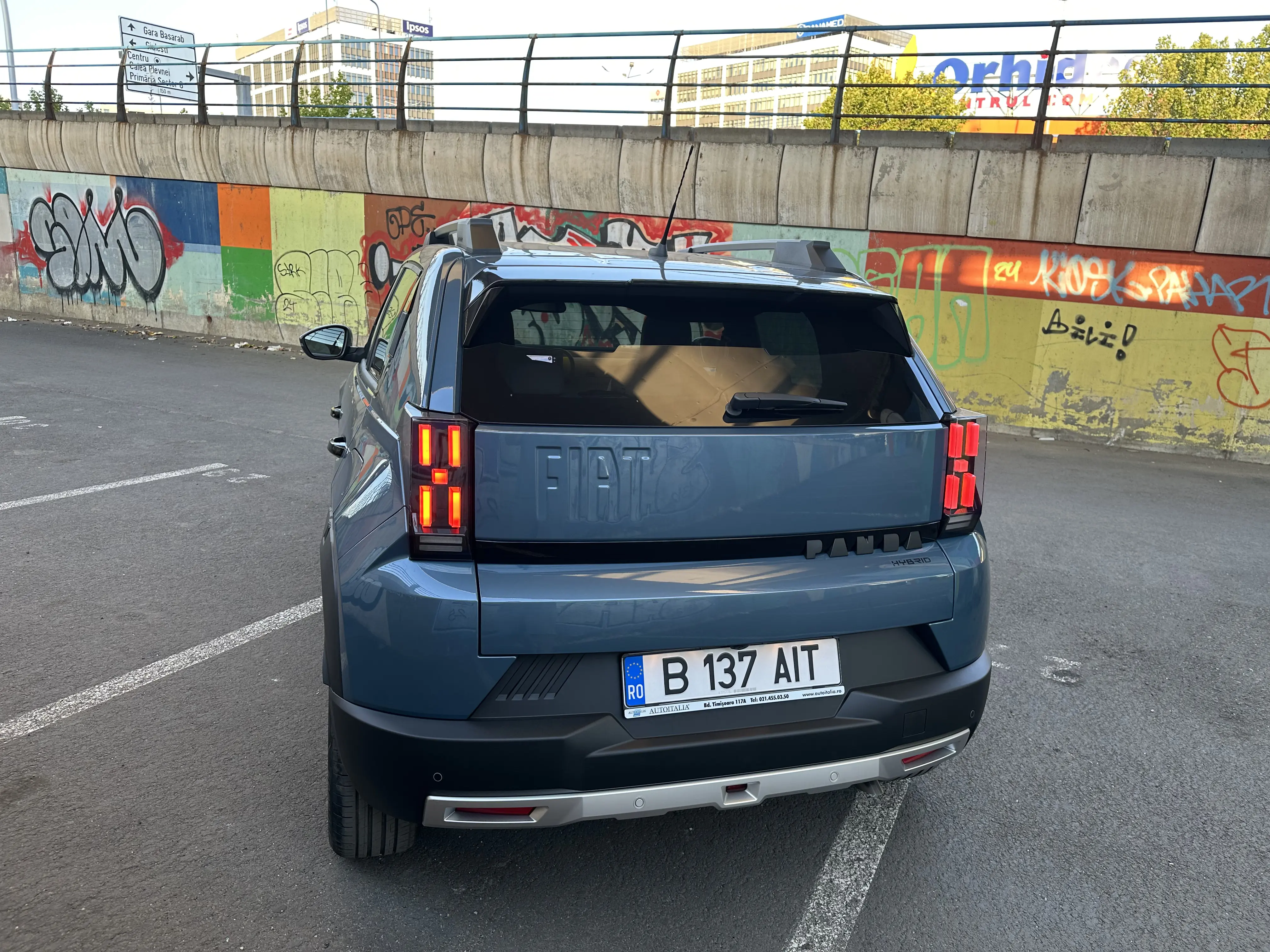
Straight lines and a grille inspired by the Lingotto building in Turin. Pixel LED headlights and a 3D Panda logo on the doors. La Prima adds 17-inch alloy wheels and silver roof bars.
Fiat offers seven colours in its “No Grey” initiative: Limone yellow, Luna bronze, Acqua azure, Lago blue, Passione red, Cinema black and Gelato white.
Interior and materials
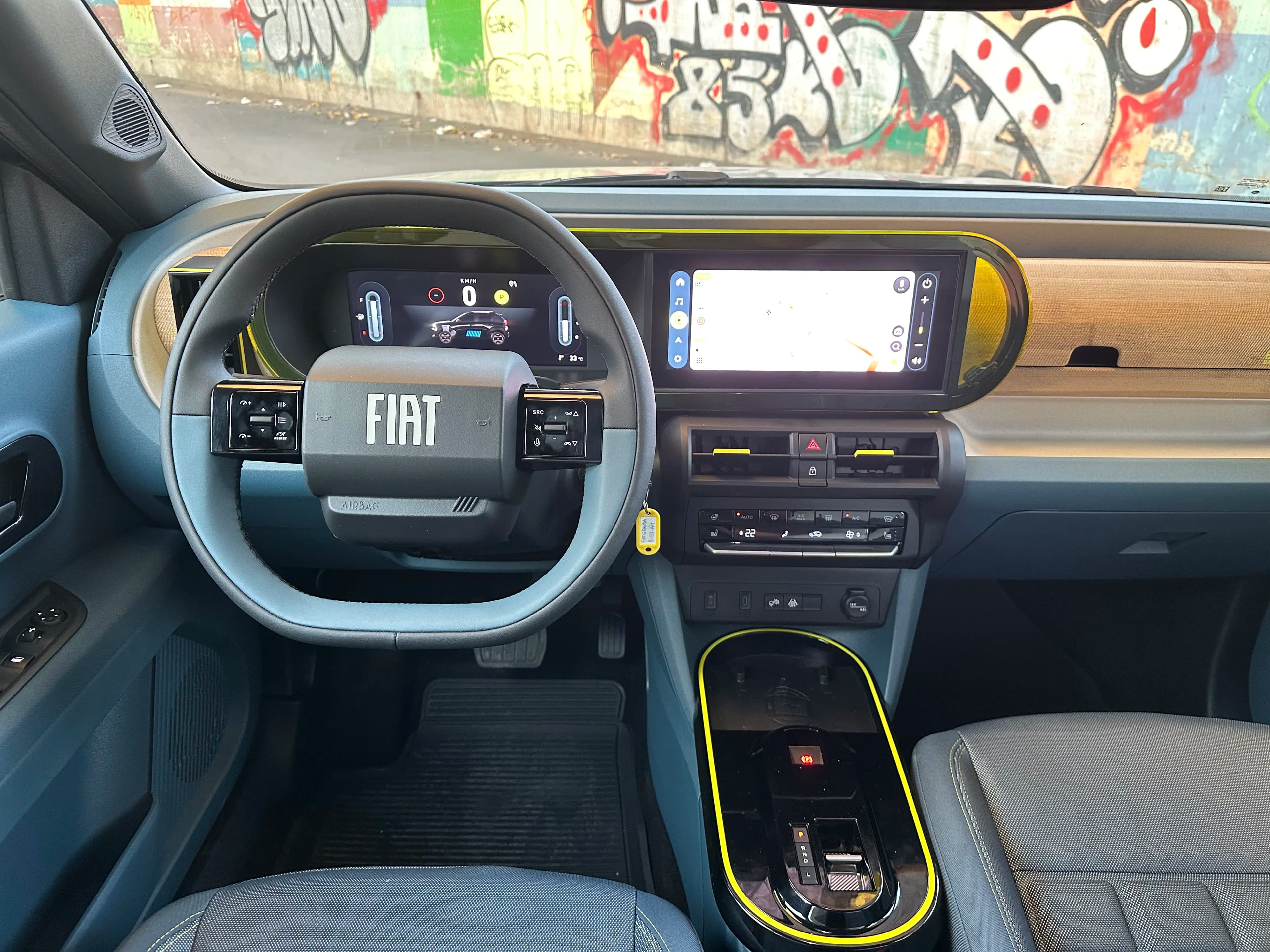
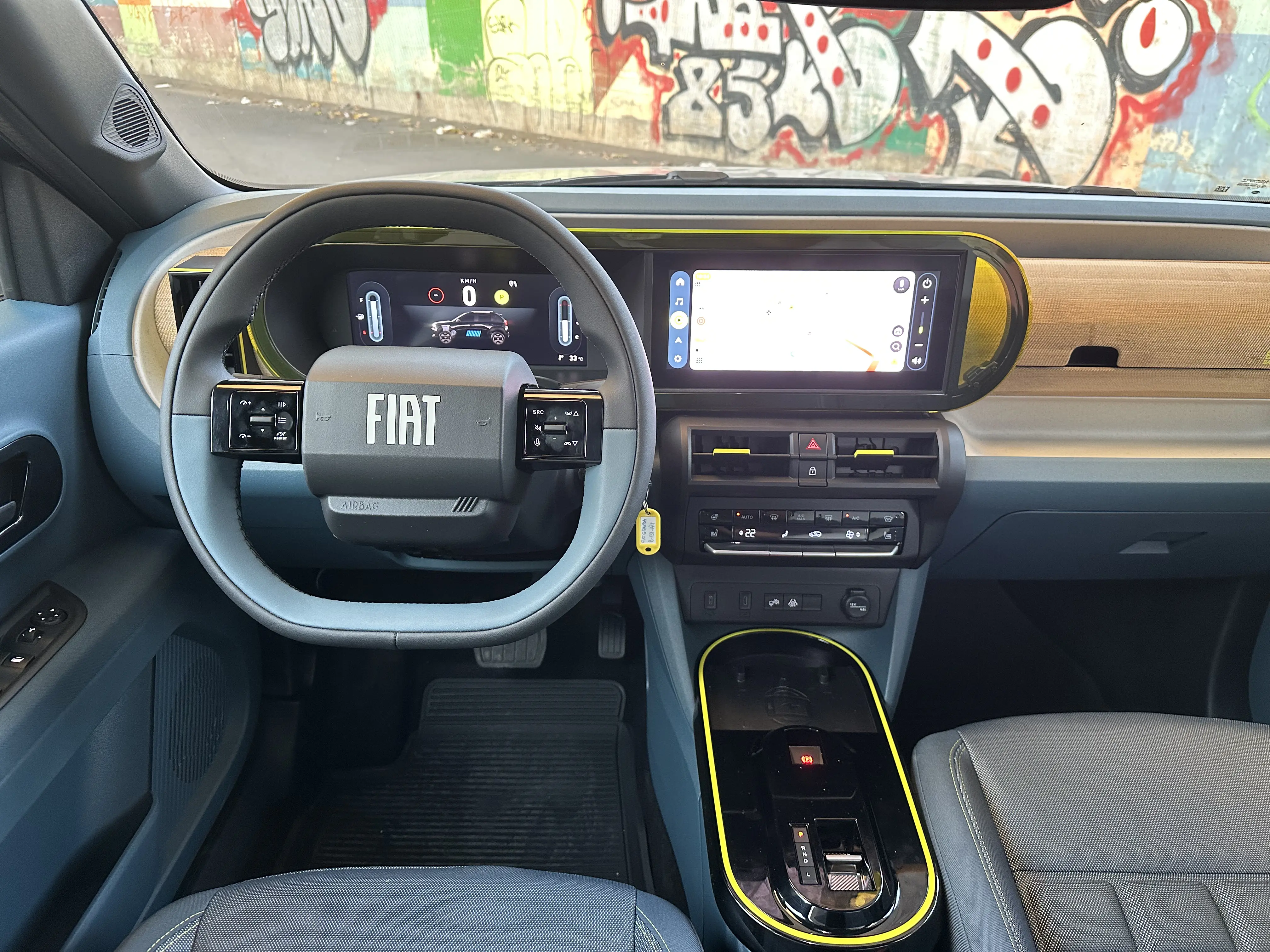
The oval dashboard, inspired by the Lingotto test track, uses BAMBOX Bamboo Fiber Tex® (33% bamboo fibre). “Blu Tasmania” and bright yellow accents on the centre console stand out.
Fiat highlights recycled content—each Grande Panda uses material equivalent to 140 recycled drink cartons, visible in blue plastic parts. Dashboard storage totals 13 litres.
Load space
Hybrid boot volume is 412 litres (51 litres more than the EV). With seats folded: 1,366 litres versus 1,315 litres on the electric.
Comfort
MacPherson struts front and torsion beam rear handle most bumps; the tune feels firm on broken low-speed surfaces. Noise insulation is class-appropriate; wind noise rises on motorways. Automatic climate control and ergonomic seats help longer trips.
On the road: real-world testing in Romania
On paper, 10 seconds to 100 km/h looks modest, but instant electric torque makes the car feel quicker in urban traffic.
Urban agility and electric response
e-launch gives quiet, smooth getaways. Fiat claims up to 1 km purely electric below 30 km/h—useful in car parks or dense traffic.
The six-speed eDCT shifts quickly; light steering helps tight spaces. The 10.9 m turning circle is average for the class.
Fast roads
At the 160 km/h limit the car stays stable, though the three-cylinder becomes vocal at high revs. Hybrid benefits fade on motorways where regeneration is limited.
Overtakes need planning—the gearbox can hesitate briefly under sudden throttle, but combined output is enough for safe manoeuvres.
Suspension and control
Compared with the Citroën C3 on the same platform, the Grande Panda feels slightly stiffer. On poor Romanian roads it transmits more vibration than expected, but body roll stays predictable.
Noise and real consumption
Silent electric periods in town contrast with wind and tyre noise on highways—noticeable but not extreme.
Official WLTP 5.0–5.1 l/100 km translated to about 6.1 l/100 km in our real-world testing—roughly 20% above the catalogue figure, still competitive for the class.
Prices and equipment: three trims from €18,850
Fiat positions Grande Panda Hybrid among the most affordable electrified B-segment cars.
Pop, Icon and La Prima
Pop is the entry point; Icon adds mid-level refinement; La Prima is top spec with premium trim.
Price structure: €18,850–€21,850
Romanian pricing starts at €18,850 for Grande Panda Hybrid Pop. With the scrappage (Rabla) programme, Fiat advertised €16,460. Icon is €19,850; La Prima €21,850 before options.
Standard kit and options
Pop includes a 10-inch digital screen, manual air conditioning, electric parking brake and hill-start assist. Icon adds 16-inch alloys, 10.25-inch touchscreen, six-speaker audio and full LED headlights.
Optional Tech pack: automatic climate control, navigation and wireless charging. La Prima adds 17-inch wheels, premium upholstery and BAMBOX Bamboo Fiber Tex®.
Versus rivals
Against the Toyota Yaris Cross (£23,700 in the UK reference cited in the source material) or Renault Captur (£20,100), Grande Panda Hybrid undercuts on price. Yaris Cross official consumption (4.5 l/100 km) beats Fiat’s 5.1 l/100 km, but Grande Panda offers 412 litres of boot space versus 397 litres on the Toyota.
Conclusion
Grande Panda Hybrid brings Fiat back to the B-segment with mild-hybrid tech and sharp pricing—€18,850 (€16,460 with Rabla). Real-world 6.1 l/100 km sits about 20% above WLTP 5.1 l/100 km, acceptable in class.
T-Gen3 helps most in town below 30 km/h. The 412-litre boot beats Yaris Cross (397 litres); ride is firmer than Citroën C3 on the same Smart Car platform.
Pop, Icon and La Prima cover budgets from basic 10-inch screen to 17-inch wheels and bamboo-fibre trim. Optional Tech adds auto climate and navigation.
Best as urban runabout or commuter; motorway wind and tyre noise confirm that role. For a first step into electrification at low cost, it deserves consideration.
Key takeaways
- Price: from €18,850 (€16,460 with Rabla)
- Powertrain: 1.2-litre turbo + 28 hp electric, 110 hp combined; about 6.1 l/100 km in our tests
- Space: 412-litre boot, five seats
- Electric running: up to 1 km below 30 km/h (manufacturer)
- Design: retro-modern look with recycled-material story (140 drink-carton equivalent)