The Mini Cooper E 2025 is a major step for the brand: a new architecture and full battery-electric drive while keeping the handling character Mini is known for.
Romanian market launch adds another option in the compact electric hatch class. After two weeks on Bucharest streets, motorway and daily routes, we assessed traffic behaviour, real range, charging and onboard technology.
Design and specifications
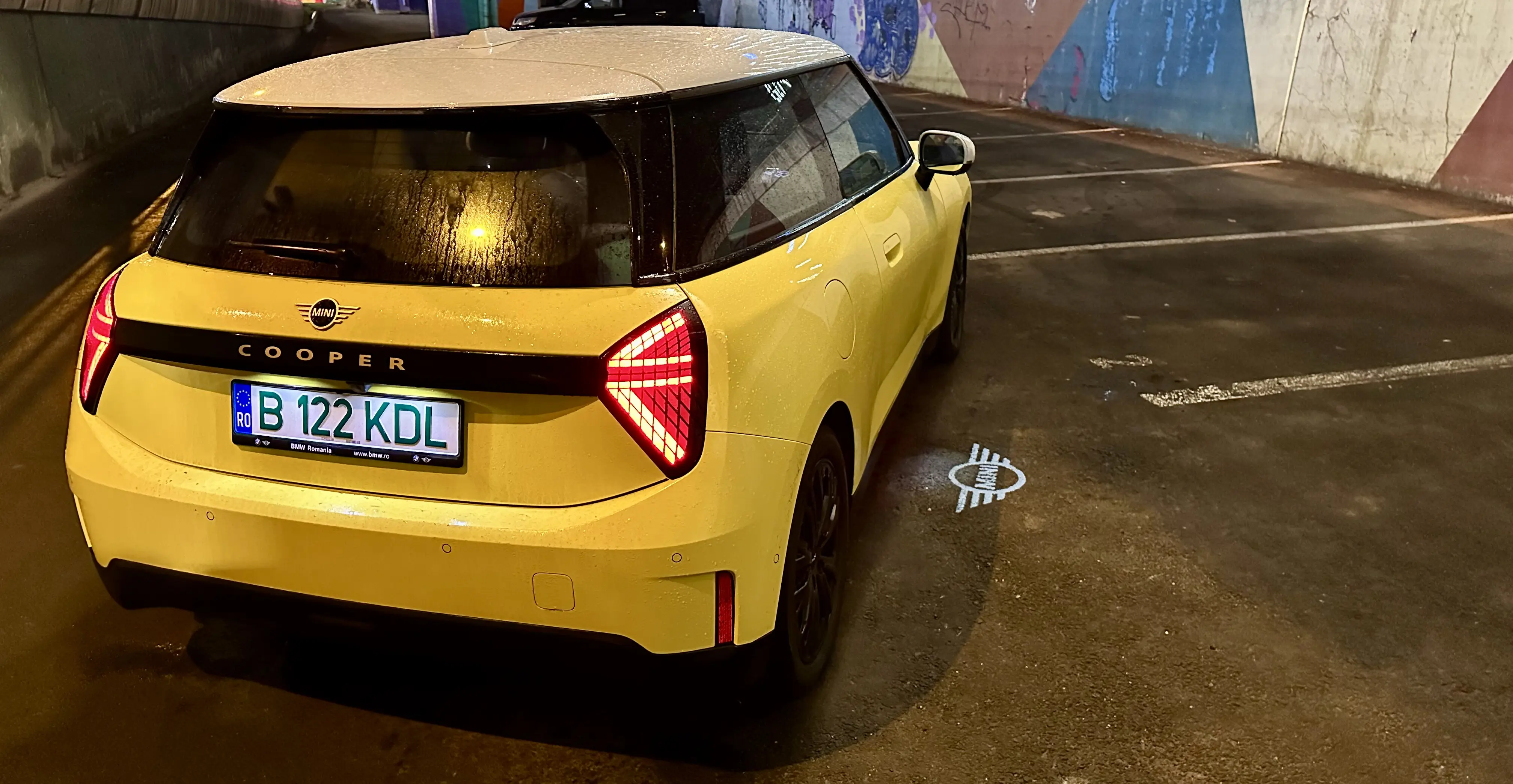
The Cooper E keeps the familiar silhouette with refined electric-era details. Round headlamps gain three light signatures; Union Jack rear lights can be personalized. A light show greets you when the key or phone is detected.
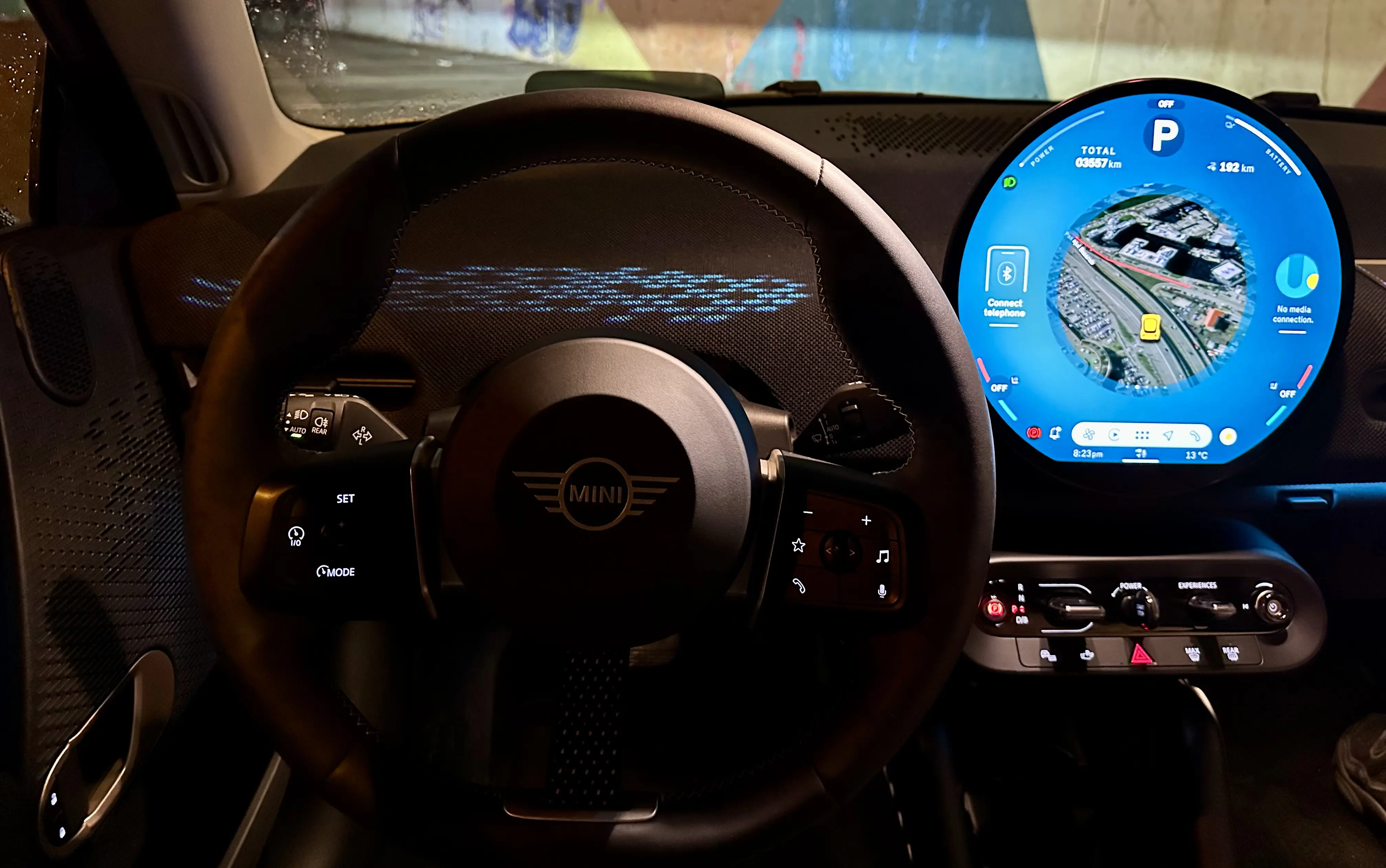
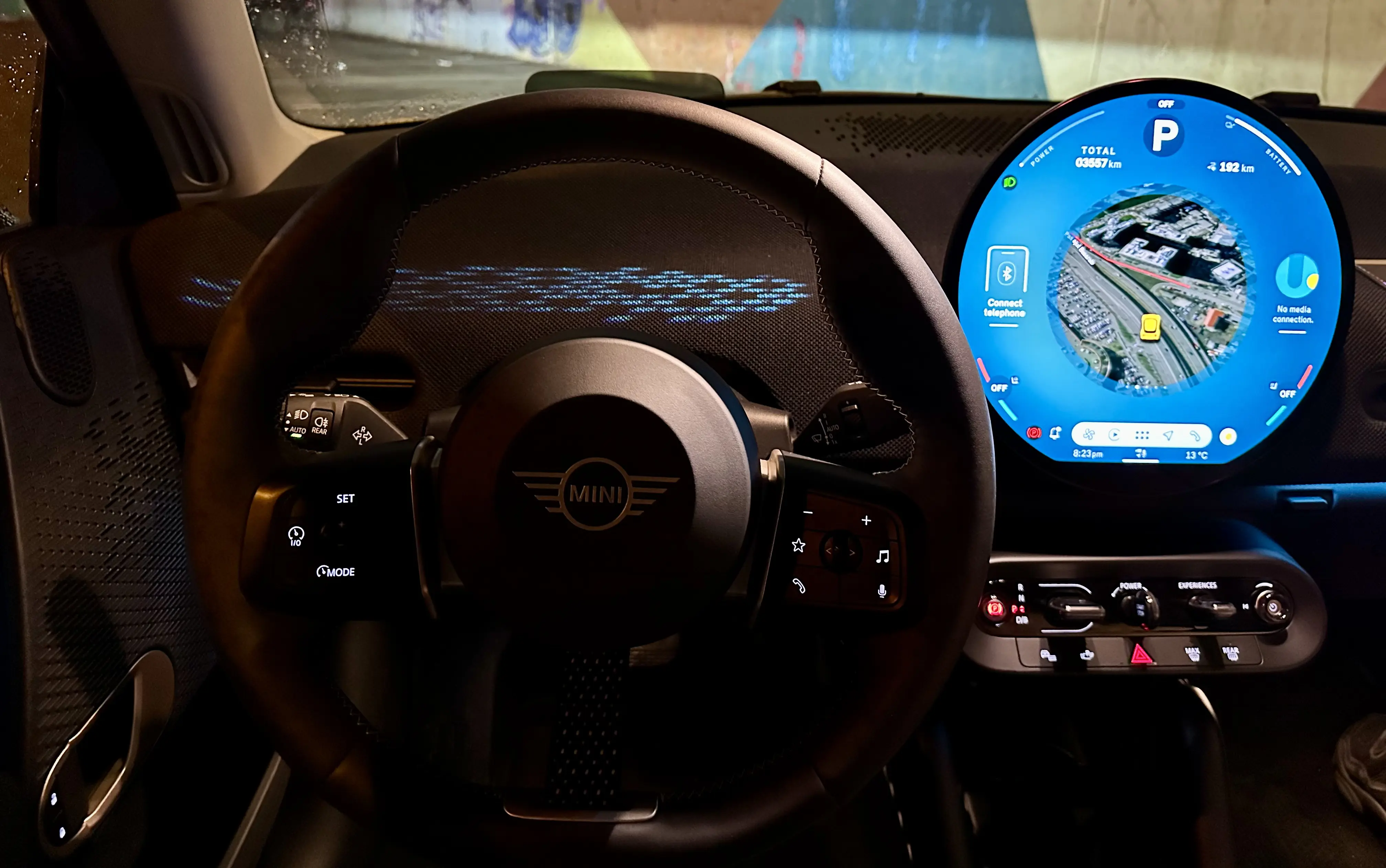
Exterior surfacing is cleaner; inside, a 24 cm circular OLED replaces conventional instruments in the central tradition.
Boot space is only 210 litres — well below Peugeot e-208 (311 litres) or MG4 (363 litres), though folding seats open 800 litres. In Bucharest traffic the car draws attention; woven textiles on dash and doors add warmth, and assembly quality is high, though unlined door bins rattle on rough roads.
The circular OLED looks striking; Android Auto and Apple CarPlay appear in a narrow letterbox layout. Long-term OLED burn-in remains an open question.
Performance in Bucharest traffic
On congested capital streets the Cooper E shows its true character. Handling — a traditional Mini strength — survives electrification.
Cooper E delivers 135 kW (184 hp) and 0–100 km/h in 7.3 seconds. Cooper SE rises to 160 kW (218 hp) and 6.7 seconds, beating the Abarth 500e hot hatch on paper.
Instant torque (214 Nm E, 243 Nm SE) simplifies urban gaps. On wet or uneven surfaces we noted wheelspin and slight torque steer under hard throttle. Go-kart agility remains: precise steering, tight turning circle and compact size help underground parking where large SUVs struggle.
Traction control intervenes without killing playfulness. Firm suspension is the main trade-off — bumps on Unirii Boulevard or Calea Călărași transmit into the cabin despite good noise isolation. Compared with Peugeot e-208 (more comfort) or MG4 (balanced), Mini clearly prioritizes sport.
Synthetic motor sound under acceleration can be switched off.
Real-world range
Range is central to any EV assessment. Two weeks with the Cooper E in Romania produced clear numbers.
Line-up: Cooper E with 36.6 kWh usable battery; Cooper SE with 49.2 kWh. WLTP claims roughly 290–300 km for E and up to about 247 km for SE depending on trim.
In mixed Bucharest use, Cooper E real range ran 185–205 km — below WLTP and behind MG4 (230–250 km real), comparable to Peugeot e-208 (~180 km), below VW ID.3 58 kWh (~230 km).
Driving style matters: hard acceleration cuts range; SE can torque-steer when pushed. Regeneration helps, but fragmented city traffic still kept us under official figures. Standard heat pump aids winter efficiency. Versus the previous generation’s ~100–110 km real, progress is obvious but rivals still lead.
A2 Bucharest–Constanța (~230 km) exposed motorway limits: Cooper E needs a charge stop; SE can theoretically complete it with little reserve. At steady 120–130 km/h, expect roughly 170–180 km for E. Wind and temperature swing consumption noticeably.
Urban-only buyers may accept Cooper E from €31,713.5; frequent inter-city users should look at SE, priced higher.
Cabin technology and comfort
Digital focus defines the Cooper E. The 24 cm OLED is the command centre — impressive visually, weaker ergonomically. Climate buttons are small and hard to reach on the move; touch response sometimes lags. Base Cooper E shows speed only on the OLED; upper trims add head-up display.
Standard audio: six speakers, 100 W. Harman Kardon 10-speaker 315 W system is €4,000 via Level 2 pack.
Wireless and wired Apple CarPlay/Android Auto work, but circular-screen framing wastes space. Central tray is anti-slip; wireless phone charging needs SE or Level 1 (€2,000).
Driver seat comfort and lateral support are good; lumbar adjust needs Level 3. Rear space is tight versus rivals — no rear doors, two rear seats only, limited leg room though head room is acceptable. Door pockets unlined.
Charging and running costs in Romania
Bucharest’s public network (Renovatio, Electrica, EnelX) is growing but less dense and less reliable than in western Europe. Home wallbox optional; domestic socket works overnight (8–10 hours full on Cooper E).
DC fast charge: Cooper E up to 70 kW; SE up to 95 kW. Observed times: AC 22 kW 20–100% ~3 h (E); home 2.3 kW full charge 15–16 h. Peugeot e-208 and MG4 charge slightly faster on paper — minor for typical use.
Running cost roughly €5–6/100 km urban at ~€0.15/kWh public rates versus €10–12/100 km for a petrol Mini — about 50% saving.
List prices (VAT incl.): Essential €31,713.5, Classic €33,733.5, Favoured €37,024.5, John Cooper Works €37,568.5 with WLTP range between 290 and 300 km by trim. Operational leasing from €349 + VAT may suit company buyers with EV tax benefits in Romania.
Rivals on the Romanian market
Versus Peugeot e-208, Mini is quicker (7.3 s vs over 8 s) but shorter on real range (~150–160 km vs ~225 km for e-208). Peugeot wins comfort, five seats and four-door access. Mini targets drivers who want engagement.
MG4 offers better price-to-range ( ~218 km real base) and 363-litre boot versus 210 litres; five seats. Mini fights back with materials, handling and brand cachet.
Resale and Mini service coverage in Romania are stronger than for newer rivals such as MG — relevant for three- to four-year ownership.
Conclusion
Cooper E keeps Mini dynamics but trades range for sport. After intensive testing, Cooper SE at €37,024.5 is the balanced pick between range and performance.
Base real range 180–200 km remains the main limit when MG4 exceeds 200 km in similar conditions. Premium finish, agility and personality partially offset that.
Cooper E suits urban-focused drivers who accept range limits; SE fits occasional long trips. Strong resale and service network help total cost of ownership versus Peugeot e-208 or MG4. It is not the perfect EV, but it translates authentic Mini feel into an efficient electric format.
FAQs
Real urban range? About 180–200 km (E); SE can reach 210–230 km mixed urban.
Bucharest traffic? Excellent — instant response, small footprint, precise steering.
Charging in Romania? Public DC/AC, optional wallbox or home socket; 30 minutes to 15–16 hours depending on method.
Running costs vs petrol Mini? Roughly half — ~€5–6/100 km vs €10–12/100 km.
Main advantages vs rivals? Performance, premium cabin, handling, brand and resale in Romania.