Renault 4 remains the best-selling model in the French brand’s history, with 8,135,424 units produced over 33 years between 1961 and 1994. That pioneering hatchback now returns in fully electric form, keeping distinctive design elements of the original while adopting modern EV technology.
The new 2025 Renault 4 E-Tech electric measures 4.14 metres in length, has a 2,624 mm wheelbase and offers 375 litres of load volume. The interior has been redesigned for the digital era, and the starting price in Romania is set at €28,890. The model sits directly in the compact B segment, competing with Alfa Romeo Junior Elettrica, Ford Puma Gen-E and Opel Mokka Electric.
Testing the new Renault 4 E-Tech let us assess whether this electric reinterpretation justifies the investment and whether it succeeds in blending nostalgia with modern practicality. The model is not just a sentimental comeback—it is a clear statement about Renault’s vision of future urban mobility.
What is Renault 4 E-Tech Electric and who is it for
The new Renault 4 E-Tech Electric keeps the essence of the 1961 model but fully embraces modern electric technology. The compact vehicle presents itself as a true voiture à vivre—a car for life—adapted to current requirements, able to cross varied terrain and meet a wide range of needs.
Retro design reinterpreted for 2025
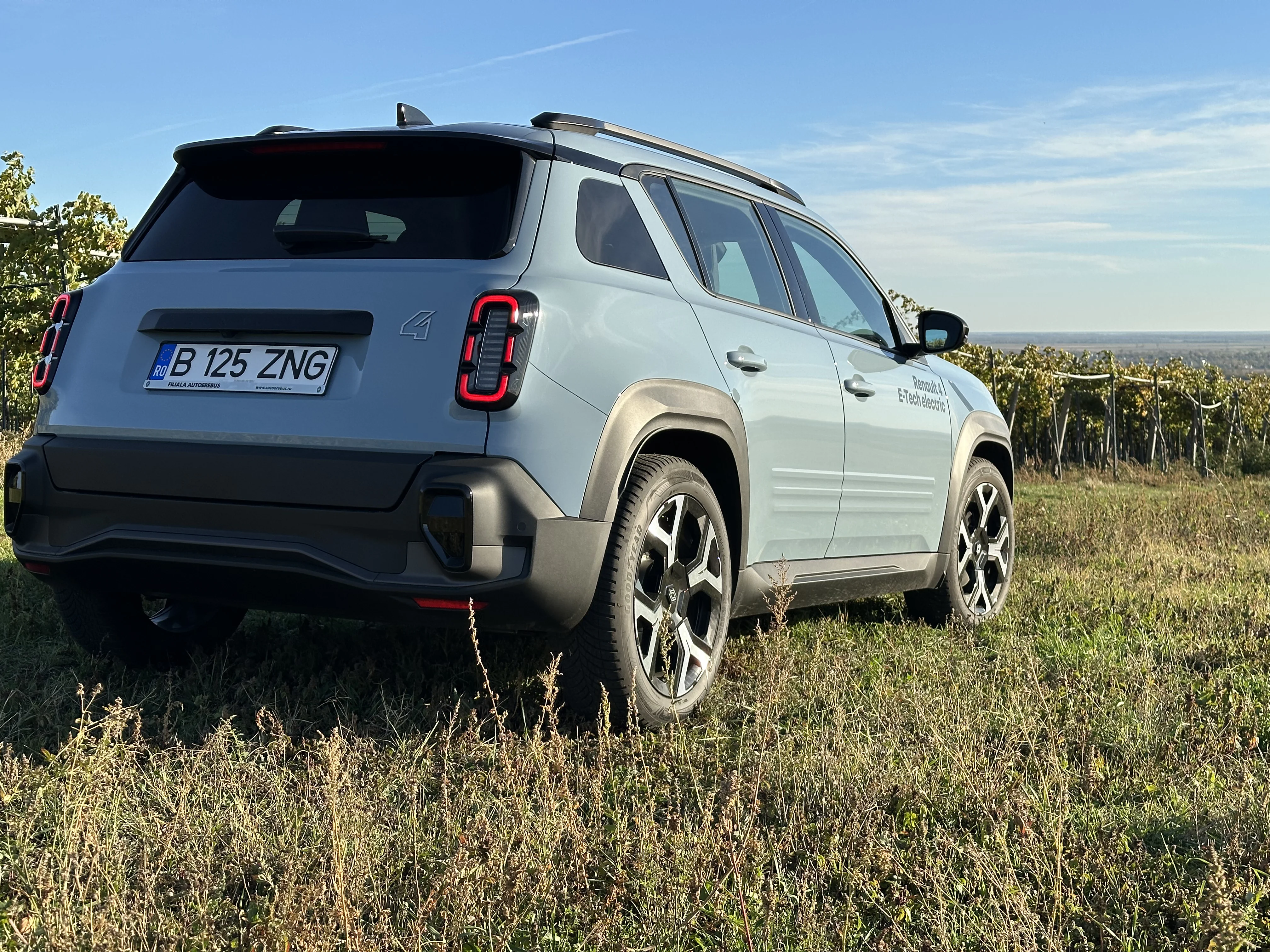
The most striking element is the illuminated front grille—a world first as a single 1.45-metre piece. Integrated round headlights remain faithful to the original, creating an instantly recognisable visual signature.
The side profile keeps the distinctive silhouette: the special bonnet shape, plunging rear and characteristic trapezoidal rear-quarter window. Designers deliberately integrated nostalgic elements—door protectors, rear windows and roof bars—all contributing to a look that blends past and present.
The colour range includes seven options: Ice White, Road Grey, Étoilé Black, Carmin Red, Terracotta, Hauts-de-France Green and Celeste Blue. With more than 600 possible combinations, including “plein sud™” textile or rigid roofs with bars, personalisation can reflect each owner’s taste.
Target audience: urban, young, families
Unlike Renault 5 E-Tech Electric, which mainly targets urban users, Renault 4 E-Tech Electric addresses a broader segment, including young families. The electric crossover keeps its main advantage: extreme versatility.
Its concept allows varied use—from daily commuting to weekend escapes, in the city or on country roads. Ground clearance of 18.1 cm and the Extended Grip system give it the ability to cope with difficult terrain or slippery surfaces.
Generous interior space and 420 litres of boot capacity are significant advantages for families. The modular layout includes a folding rear bench and a front passenger seat that folds completely flat—a novelty for Renault electric vehicles. That flexibility allows transport of long or bulky objects.
Differences from Renault 5 E-Tech
Although they share the AmpR Small platform and common technology, the two models serve different needs. Dimensionally, Renault 4 is significantly larger: 4.14 m length versus 3.92 m, 1.80 m width versus 1.77 m and 1.57 m height versus 1.50 m.
The extended wheelbase (2.62 m versus 2.54 m on R5) provides 16.4 cm of rear knee room and 85.3 cm of headroom in the back. R4’s 420-litre boot eclipses R5’s 277 litres, making the difference for family needs.
The driving position is higher in R4, offering superior visibility thanks to the body style. Seats prioritise comfort in R4, while R5 adopts sportier seats. R5 feels more “cocooning” for the driver, while R4 prioritises spaciousness.
Towing capacity reaches 750 kg, useful for various family activities. V2L and V2G functions through Mobilize services add extra utility for powering external devices or feeding energy back into the grid.
AmpR Small platform and available powertrains
The new Renault 4 E-Tech Electric uses the AmpR Small platform, developed by the Ampere division for compact electric vehicles. The architecture shares half its components with the existing CMF-B platform, reducing production costs and making EV technology accessible to a wider market segment.
Urban Range version: 120 hp, 40 kWh battery
The base Urban Range variant gets a 90 kW (120 hp) electric motor with 225 Nm torque. The 40 kWh battery uses NCM (nickel-manganese-cobalt) lithium-ion technology for optimised energy density. Official WLTP range reaches 322 km, with around 245 km in real conditions.
Charging is via AC stations up to 11 kW or DC at 80 kW power, with 15–80% taking about 30 minutes. Energy recovery works both on deceleration and braking, and the standard heat pump helps increase range.
Comfort Range version: 150 hp, 52 kWh battery
Comfort Range benefits from a more powerful 110 kW (150 hp) motor and 245 Nm torque. The 52 kWh battery offers 409 km WLTP range, with around 315 km in real-world use. The 400 V architecture accepts 100 kW DC fast charging, keeping the same 30-minute time for 15–80%.
Recent tests recorded efficiency of 4.1 miles per kWh (15.5 kWh/100 km), equivalent to 213 miles (343 km) real-world range. That represents 86% of the official figure, compared with an industry average of 80%.
Performance: 0–100 km/h in 8.2 seconds
Comfort Range accelerates from 0 to 100 km/h in 8.2 seconds, while Urban Range completes the same sprint in 9.2 seconds. Both versions reach a 150 km/h top speed.
One Pedal function, a Renault first, maximises regenerative braking and allows a complete stop without using the brake pedal. On the motorway the vehicle offers high comfort with effective noise isolation and enough power for safe overtakes.
Real-world range and consumption
Testing the new Renault 4 E-Tech’s electric capabilities took place on the road to Casa Timiș, where pleasant weather and varied routes offered an optimal framework for evaluating real performance. Civilised traffic and steady temperatures allowed precise measurements of consumption and range in various use scenarios.
Urban consumption: 9.8 kWh/100 km
Tests in urban areas and towns on the way to Casa Timiș recorded consumption of just 9.8 kWh/100 km. That remarkable urban efficiency demonstrates Renault 4 E-Tech’s ability to manage energy optimally, even in heavy traffic with frequent stops and accelerations. With the 52 kWh battery, theoretical urban range could exceed 500 km—an excellent figure for predominantly city drivers.
Mixed consumption: 12.6–13.4 kWh/100 km
Over two days of mixed testing, average consumption was 12.6 kWh/100 km on the first day and 13.4 kWh/100 km on the second. These values sit below Renault’s official 15.5 kWh/100 km, indicating the vehicle can be more efficient in real use than homologation data suggest.
Tests by other publications confirmed similar results, with efficiency around 14.9 kWh/100 km. Favourable weather, with temperatures between 20–23°C, contributed to optimising the vehicle’s energy performance.
Estimated real-world range: 300–350 km
Recorded real consumption and the 52 kWh battery allow an estimated real-world range between 300 and 350 km in mixed conditions. That figure represents roughly 85–86% of the official 409 km WLTP range—a percentage above most tested EVs, which usually reach only 80% of declared values.
Motorway driving at steady 120 km/h reduces range to around 220–250 km, behaviour typical of EVs at high speed. Urban environments offer superior range thanks to higher efficiency and energy recovery when braking.
Winter conditions will reduce range to around 150 km in mixed use—an important factor for users in regions with severe winters.
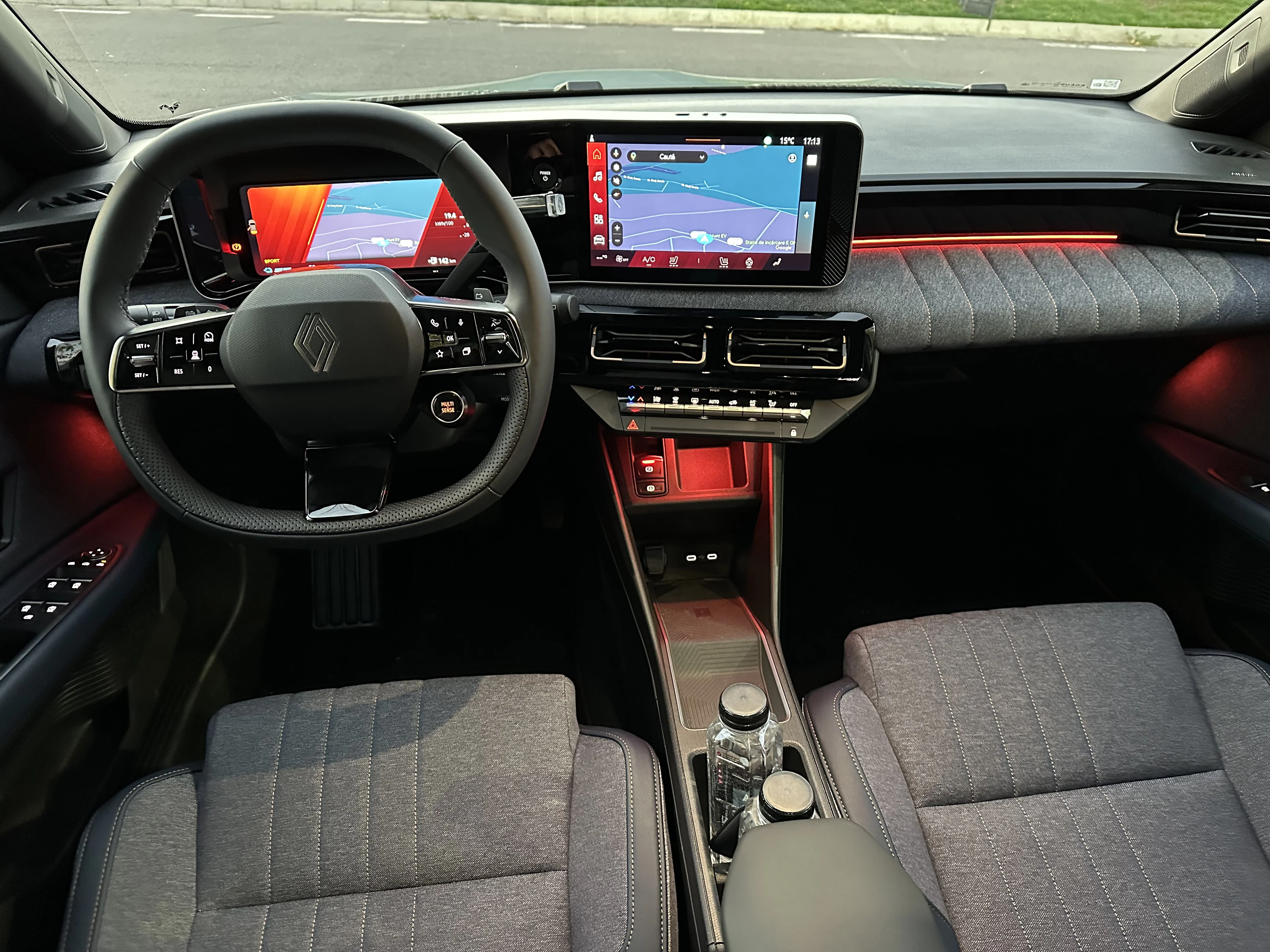
Renault 4 interior: space, materials and technology
The Renault 4 E-Tech Electric cabin offers generous space relative to compact exterior dimensions. The cabin comfortably seats five, with emphasis on practical functionality.
Passenger space and 420-litre boot
The 2.62-metre wheelbase gives rear passengers 16 cm of knee room, adequate for average-height adults. Interior height of 85 cm ensures comfort for tall people too. Elbow room measures 1,385 mm front and 1,371 mm rear, creating a sense of spaciousness.
The 420-litre boot is accessed via an electric tailgate with hands-free opening. Loading height of just 60.7 cm makes luggage handling easier—about 10 cm lower than on some rivals. An additional 35-litre compartment under the floor houses the charging cable. Folding the rear bench extends capacity to 1,405 litres, allowing transport of objects up to 2.20 metres long.
Recycled materials and 3D personalisation
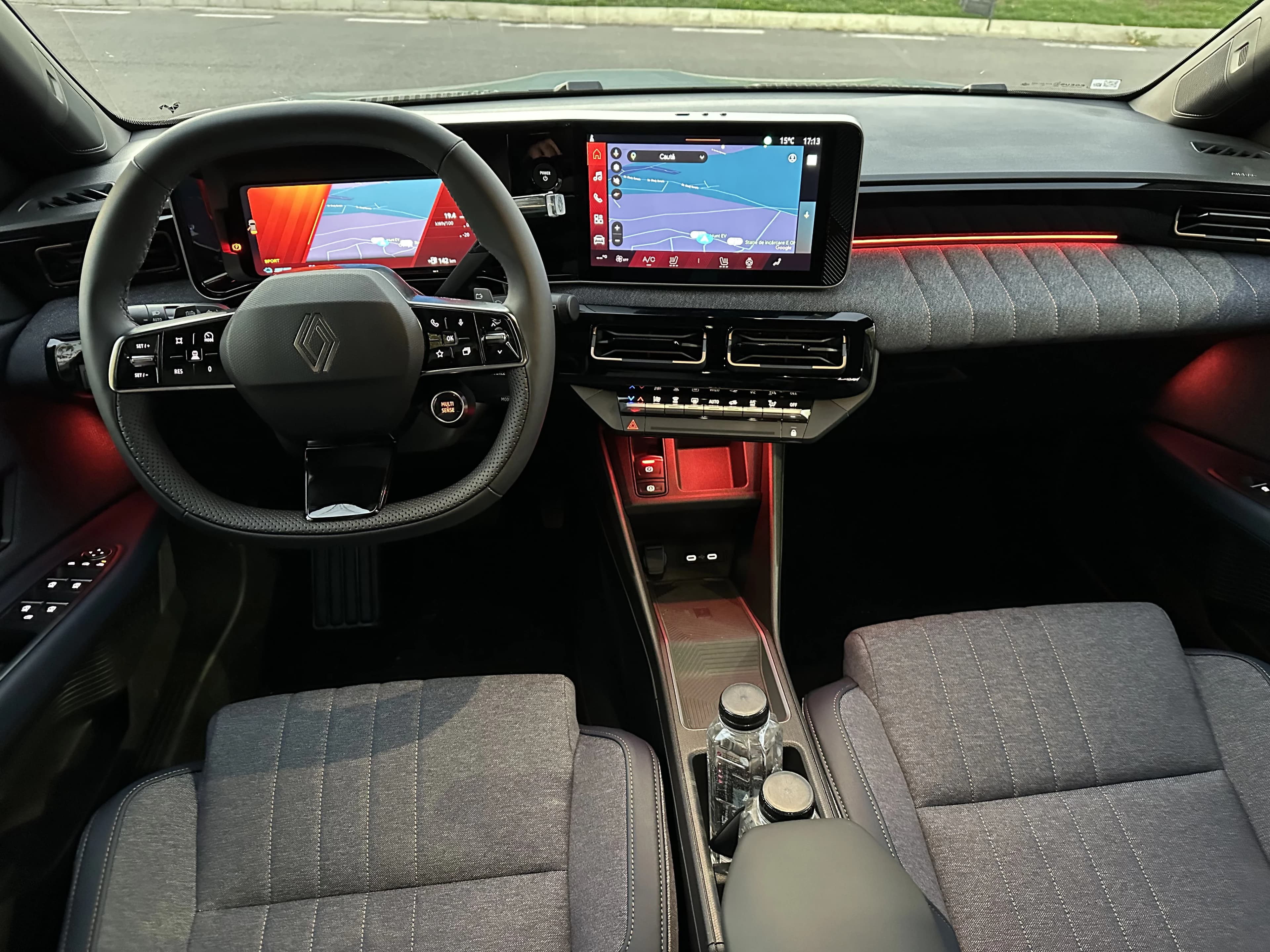
Interior materials are 100% recycled, including denim upholstery with visible copper stitching or checked textile with a yellow band. Renault has completely dropped leather, adopting a more responsible environmental approach.
Personalisation is possible through 3D print@flins accessories, produced at the Renault plant in Flins: central organiser, storage compartments and the e-pop shifter for the customisable steering wheel.
OpenR Link multimedia with Google Automotive
The dashboard integrates two 10-inch screens forming the OpenR Link system. Functions include Google Maps navigation with real-time updates, Google Assistant for voice commands and access to more than 50 apps. The system offers EV-specific features such as route planning with charging stations and battery pre-conditioning.
One Pedal function and regenerative braking
Renault 4 introduces One Pedal for the first time in the brand’s range, allowing driving predominantly with the accelerator pedal. The system offers four levels of regenerative braking controlled via steering-wheel paddles. Maximum level allows a complete stop without the brake pedal, optimising energy recovery and range. Above 12 km/h the indicator light turns blue, confirming system activation.
Prices in Romania and comparison with direct rivals
Romania’s compact electric crossover segment is shaped by aggressive pricing strategies. Renault 4 E-Tech Electric establishes its position with a direct, competitive price structure.
Starting price: €28,890 (Evolution version)
The model debuts with Evolution Urban Range at €28,890, equipped with the 120 hp motor. Comfort Range, with the 150 hp powertrain and 52 kWh battery, starts at €30,690. Mid-level Techno Comfort Range costs €32,750 and includes integrated Google plus a wireless smartphone charger.
Iconic version tested: €34,750
Top Iconic Comfort Range specification sells for €34,750. The package includes heated seats, premium upholstery and a heated steering wheel—equipment that substantially improves the daily experience.
Compared with Ford Puma Gen-E, Fiat 600e, BYD Atto 2
Ford Puma Gen-E attacks the same segment at a similar price of around €30,000. Renault 4’s advantage lies in standard equipment: 18-inch wheels, the 10.1-inch screen and heat pump are included, while Ford charges an extra €1,600 for equivalent kit. BYD Atto 2 costs €34,990, positioning directly against the French model’s Iconic version.
Conclusion
Testing the new Renault 4 E-Tech Electric confirms the model goes beyond nostalgic exercise. The French built a functional electric crossover that keeps distinctive visual elements of the original while offering modern EV technology adapted to daily use. Real-world range of 300–350 km in mixed conditions satisfies most users, and urban consumption of 9.8 kWh/100 km demonstrates the efficiency of the electric architecture.
The combination of generous interior space and a 420-litre boot positions the model as a viable option for young families. One Pedal, a Renault first, and recycled materials complete the technology package. A price of €28,890 for Evolution Urban Range places it competitively against Ford Puma Gen-E and BYD Atto 2 on the Romanian market.
The main limitation remains range dropping to around 150 km in winter—relevant for buyers in Romania. The AmpR Small platform and efficient motors nonetheless confirm Renault’s direction toward accessible electric mobility.
Renault 4 E-Tech Electric succeeds in capturing the spirit of the original, adapted for the electric era. It offers practicality, versatility and accessibility for the transition to electric mobility. For those seeking an electric crossover with distinctive character and practical capability, the model deserves serious consideration.
What to remember
The new Renault 4 E-Tech Electric successfully combines retro design nostalgia with modern electric technology, offering a practical, accessible alternative in the compact electric crossover segment.
Impressive real-world range: 300–350 km in mixed conditions with urban consumption of just 9.8 kWh/100 km, exceeding expectations for a vehicle in this category.
Superior space and practicality: generous 420-litre boot and optimised interior space for families, with 16 cm rear knee room.
Competitive price on the Romanian market: from €28,890 for Evolution, favourably positioned against rivals such as Ford Puma Gen-E.
Innovative technology: One Pedal (a Renault first) and OpenR Link multimedia with integrated Google Automotive for a modern experience.
Winter limitation: range falls to around 150 km in winter—important for users in Romania.
Renault 4 E-Tech Electric is more than a simple nostalgic revival—it is a statement about the future of accessible urban mobility, combining retro charm with modern practicality in an attractive package for young families.