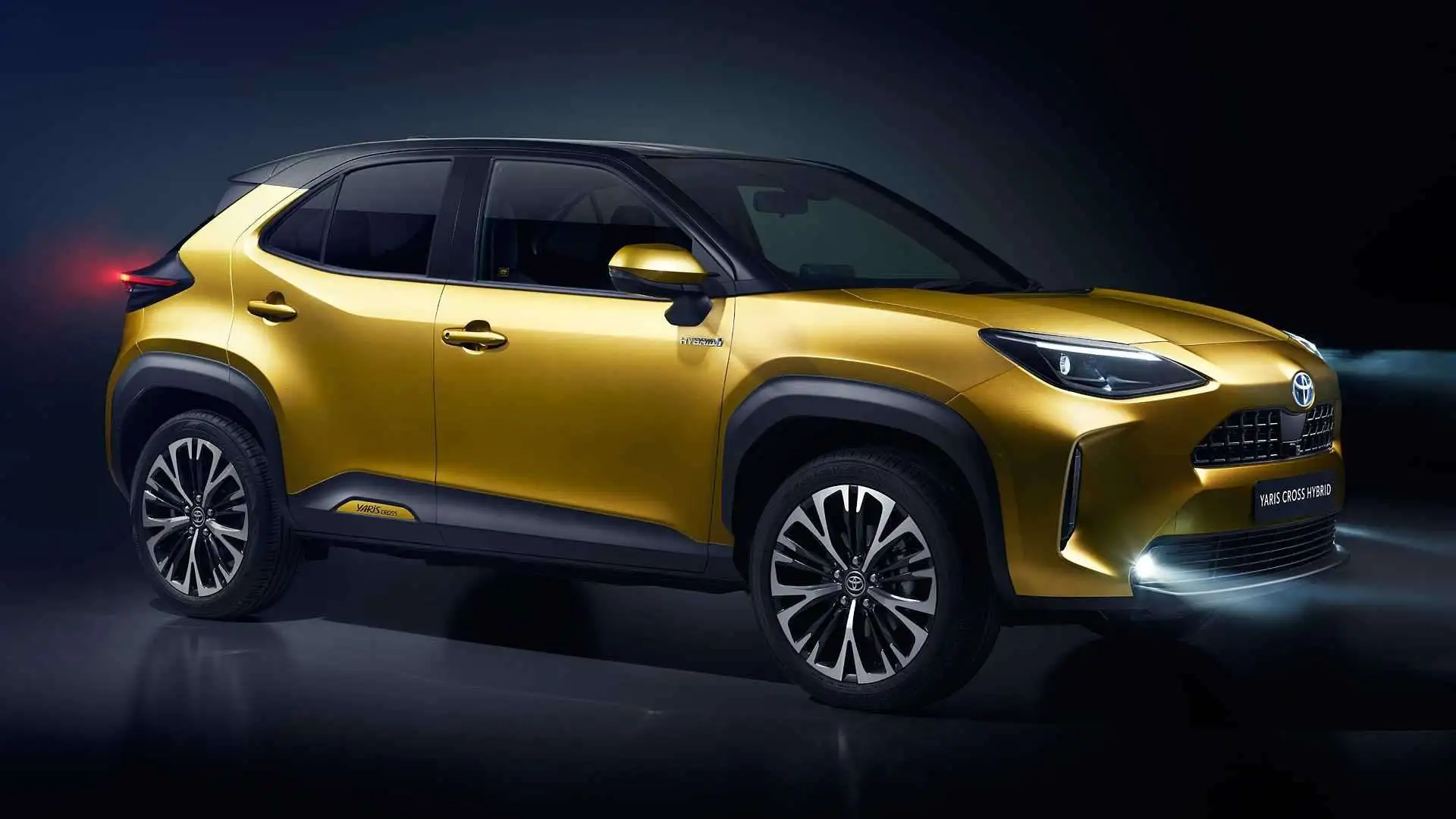
It is essentially the same car as the regular hatchback, given a tougher small-SUV look to raise ride height and stretch the body slightly. Think of a Yaris heading to the gym for a serious workout.
Dimensionally it sits among a long list of rivals: Ford Puma, Renault Captur, Peugeot 2008, Opel Mokka and more.
Distinctive styling is part of the brief in this class, and the Yaris Cross holds its own. It is clearly related to the hatch—especially from the rear—but higher ground clearance and plastic cladding add presence. It is slightly bulkier than a Yaris yet still compact and neat.
That design discipline continues inside. Models we have driven use plenty of soft-touch plastics that look smart and feel good. In classic Toyota fashion, everything feels solidly assembled.
You sit high with a good view out, in comfortable, well-adjusted seats. There is no electric seat option, but the wheel adjusts easily. Rear space is snug—headroom in particular—yet two taller adults can sit in reasonable comfort.
Boot volume is up to 397 litres with rear seats up: larger than an Opel Mokka, smaller than a Peugeot 2008. A flat, low load lip helps loading, and the configurable floor adds versatility.
Safety and assistance are strong across the range. Adaptive cruise control, autonomous emergency braking and lane keeping are standard. Panoramic parking sensors are optional in a pack, as is blind-spot monitoring.
Only one powertrain is offered: a 1.5-litre petrol-electric hybrid with 114 hp driving the front wheels through an easy CVT. All-wheel drive is also available.
Performance is not vivid (0–100 km/h in 11.2 seconds), but the electric motor gives useful low-speed punch for city traffic. Short electric-only bursts help fuel economy.
Light, accurate steering and good visibility make it easy to manoeuvre in town; firm low-speed damping can fidget on rough surfaces. It is more settled at open-road speeds, with some tyre and wind noise but nothing overwhelming.
It corners securely without excessive roll. It is not especially entertaining, but fun is not the point. The Yaris Cross aims to be a handsome, reasonably practical, easy-driving and very economical small SUV.
Inside, logical controls and soft materials stand out immediately. There is less design theatre than in a Peugeot 2008, but familiar layout and solid build have their own appeal. An optional panoramic roof adds light on some grades.
Option packs include an SUV pack (mud flaps, boot liner, rubber mats) and a City pack (advanced parking aid, 360° cameras and voice recognition).
Base Icon gets a 4.2-inch digital driver display; other grades use a 7.0-inch unit. Icon and Design also get an 8.0-inch touchscreen with Apple CarPlay and Android Auto, Bluetooth and DAB radio. No built-in sat-nav is not a problem if you use phone apps.
The system is easy to use, with physical shortcut buttons either side of the screen. Graphics look a little dated versus newer rivals, and responses can lag slightly. Top trims get a 9.0-inch screen with wireless smartphone connectivity, sat-nav and sharper graphics, but lose the physical shortcuts—slightly less intuitive on the move. Physical climate controls remain on all grades. Every version gets six speakers and steering-wheel audio controls.
Standard safety includes pre-collision system, lane departure warning, adaptive cruise and a reversing camera. Rear cross-traffic alert, a 360° camera and advanced parking assist feature on higher trims.
It scored five Euro NCAP stars when tested in 2021, with 81% for safety assist and 86% for adult occupant protection.