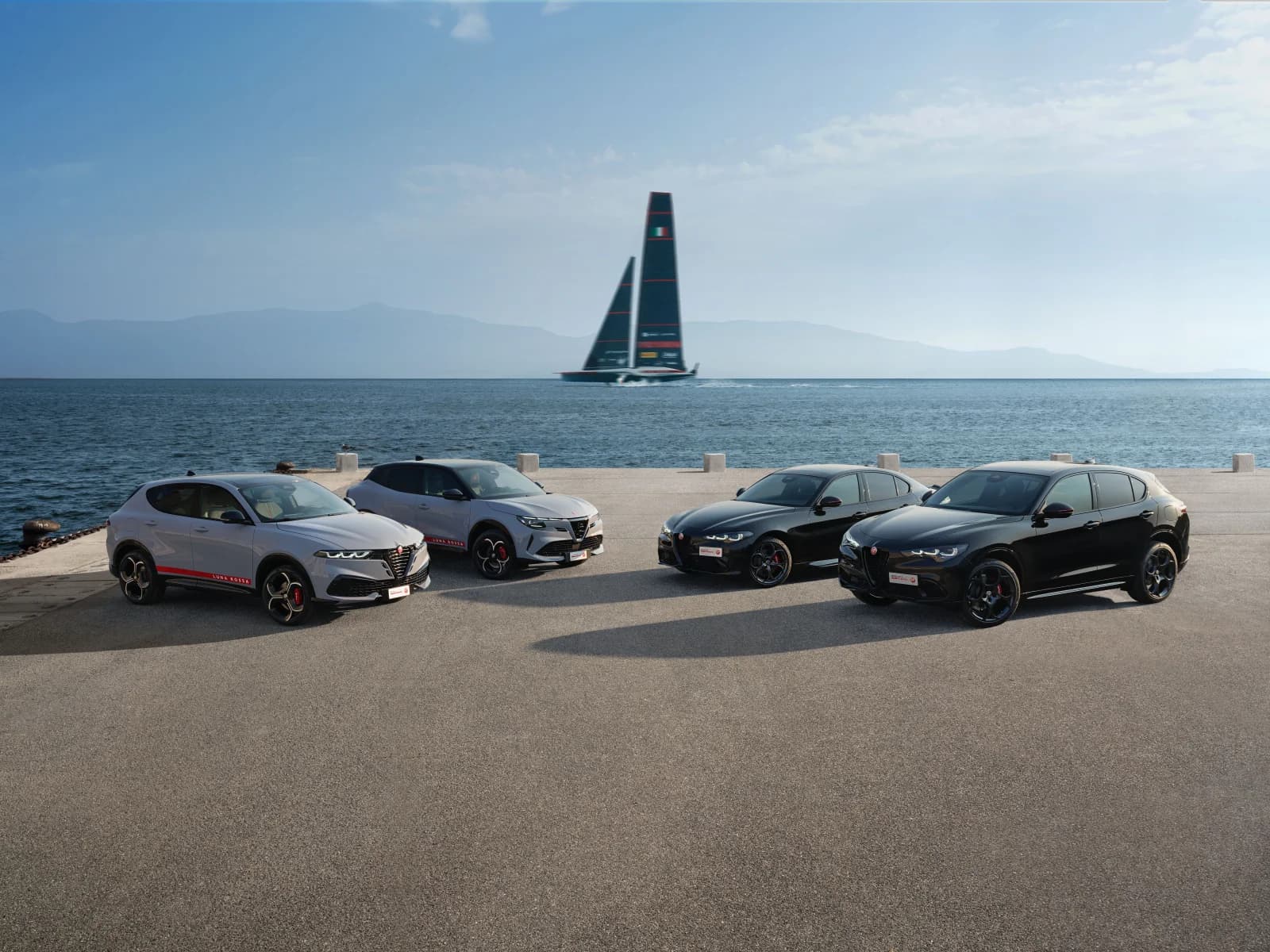
Official Alfa Romeo/Stellantis press photograph released with the Edizione Luna Rossa announcement on 24 September 2026.
Alfa Romeo has introduced Edizione Luna Rossa versions of the Junior, Tonale, Giulia and Stelvio, extending a name first used on the ten-car Giulia Quadrifoglio Luna Rossa across its regular European range. Sales begin in Italy on 25 September 2026, with list prices starting at €37,800 for Junior, €48,950 for Tonale, €71,250 for Giulia and €73,350 for Stelvio.
Those figures apply to Italy. Alfa Romeo's launch material does not set prices or ordering dates for every European market, and it does not describe the cars as a numbered production run. The special edition sits at the top of each model line, below the separate Quadrifoglio performance variants where those are offered.
Junior and Tonale take the most visible approach
Junior and Tonale share a new grey finish said to draw its colour from the personal flotation devices used by the Luna Rossa sailing team. A red side stripe carries the team's script, while red-background Alfa Romeo badges and Glossy Black exterior trim add contrast. White and black body colours are also available.
The wheels are specific to the edition: 18-inch Glossy Black alloys for Junior and 20-inch items for Tonale. The changes do not include wider tyres, revised brakes for Junior or a quoted aerodynamic benefit. This is a trim and equipment package, not a performance derivative disguised by racing imagery.
The two cabins introduce 3D Knit seat material, a first within Stellantis according to the manufacturer. Its continuous-thread construction uses one component and one lining, which Alfa Romeo says cuts both material use and manufacturing waste. Junior combines the fabric with door inserts, grey details and graphics derived from sail structures across the dashboard and centre tunnel. Tonale uses its own patterned ambient lighting, grey stitching and black console, door and air-vent finishes.
Both models have a 10.25-inch central touchscreen with navigation, wireless Apple CarPlay and Android Auto. Junior's configurable instrument display is also 10.25 inches, while Tonale uses a 12.3-inch panel. Keyless access, electrically folding and heated mirrors, heated front seats, a heated steering wheel, an electrically adjustable driver's seat with lumbar adjustment and massage, and an electrochromic rear-view mirror are included in the Italian specification.
Junior is available as a 145 hp 1.2-litre hybrid with a six-speed eDCT automatic. Buyers can choose front-wheel drive or Q4 all-wheel drive. The electric version uses a 115 kW, or 156 hp, motor and a 54 kWh battery. Alfa Romeo has not announced a different battery, range figure or charging curve for Edizione Luna Rossa, so the EV's visual identity should not be read as an electrical upgrade.
Tonale retains a broader engine choice. The 1.5-litre hybrid produces 175 hp and uses a seven-speed automatic, while the 1.6-litre diesel makes 130 hp and has a six-speed automatic. The plug-in hybrid Q4 combines a 1.3-litre petrol engine with electric drive for a quoted 270 hp and all-wheel drive. No special-edition performance figures were published.
Giulia and Stelvio use carbon fibre and recycled nylon
Giulia and Stelvio are more restrained in colour but use more expensive materials. White is standard, with black and the extra-cost Rosso Etna offered as alternatives. Carbon fibre appears on the shield-shaped grille surround and mirror caps, with a Luna Rossa logo on the latter. Giulia also receives carbon side skirts and a rear spoiler influenced by the Quadrifoglio's treatment.
Dark-finished wheels measure 19 inches on Giulia and 21 inches on Stelvio, paired with red brake callipers. Inside, the seats combine leather with ECONYL, a regenerated nylon made partly from fishing nets recovered from the sea. A red Luna Rossa line crosses the seats. Carbon trim extends across the dashboard, centre console and doors, while the steering wheel receives the edition's red Alfa Romeo badge.
Both rear-wheel-drive-platform models use the familiar 2.2-litre turbo diesel. The 160 hp version sends power to the rear wheels, and the 210 hp model uses Q4 all-wheel drive; an eight-speed automatic is standard. That is a clear distinction from the Giulia Quadrifoglio Luna Rossa unveiled earlier in 2026. The ten-car Quadrifoglio used a petrol V6 and a functional carbon aerodynamic package. Every example was sold, according to Alfa Romeo. The wider Edizione Luna Rossa range borrows its visual theme, not its powertrain or downforce specification.
Harman Kardon audio and electronically controlled suspension are standard on both Giulia and Stelvio. Giulia also includes an electric sunroof, which remains an option on Stelvio. Alfa Romeo has not claimed altered suspension calibration, acceleration, fuel consumption or emissions for the new trim.
Driver assistance is extensive, but market lists may differ
For Junior and Tonale, Alfa Romeo lists intelligent adaptive cruise control, autonomous emergency braking, lane-keeping assistance, traffic-sign recognition and driver-attention monitoring. Junior adds blind-spot monitoring, front, rear and side parking sensors and a reversing camera with dynamic guide lines. Tonale has front and rear sensors, a reversing camera and a Brembo braking system with red callipers.
These details come from the Italian launch specification. Equipment bundling can change by country and powertrain, so a local price list remains the decisive reference once the edition reaches another market. The same caution applies to the four Italian starting prices: direct currency comparison does not account for national tax, standard-equipment and registration differences.
The sailing partnership includes software work
Alfa Romeo presented the range in Naples ahead of the second preliminary regatta for the 2027 America's Cup, held from 24 to 27 September. The carmaker has been Luna Rossa's official sponsor since 2025, but the collaboration includes engineering work as well as branding.
According to Stellantis, Alfa Romeo contributes experience gained from vehicle simulation, dynamics and virtual analysis. Its engineers are helping write and tune control software for the hydraulic circuits that move Luna Rossa's sails. The software is tested in the sailing team's simulator before it is released to the actual boat and evaluated by the crew. Luna Rossa supplies aerodynamic loads for the virtual models.
That technical programme should not be confused with a claim that the road cars share the yacht's control systems. Alfa Romeo identifies no new vehicle software arising from the project in these four editions. The direct customer-facing changes are the colours, materials, badges, wheels and bundled equipment described in the price lists.
Availability outside Italy is the main unanswered question. Alfa Romeo has confirmed the Italian order opening and starting prices, but the central release does not publish allocation numbers, delivery timing or a full country-by-country rollout. Until national price lists appear, buyers can compare the equipment but cannot calculate a verified local premium over Sport Speciale or Veloce grades.