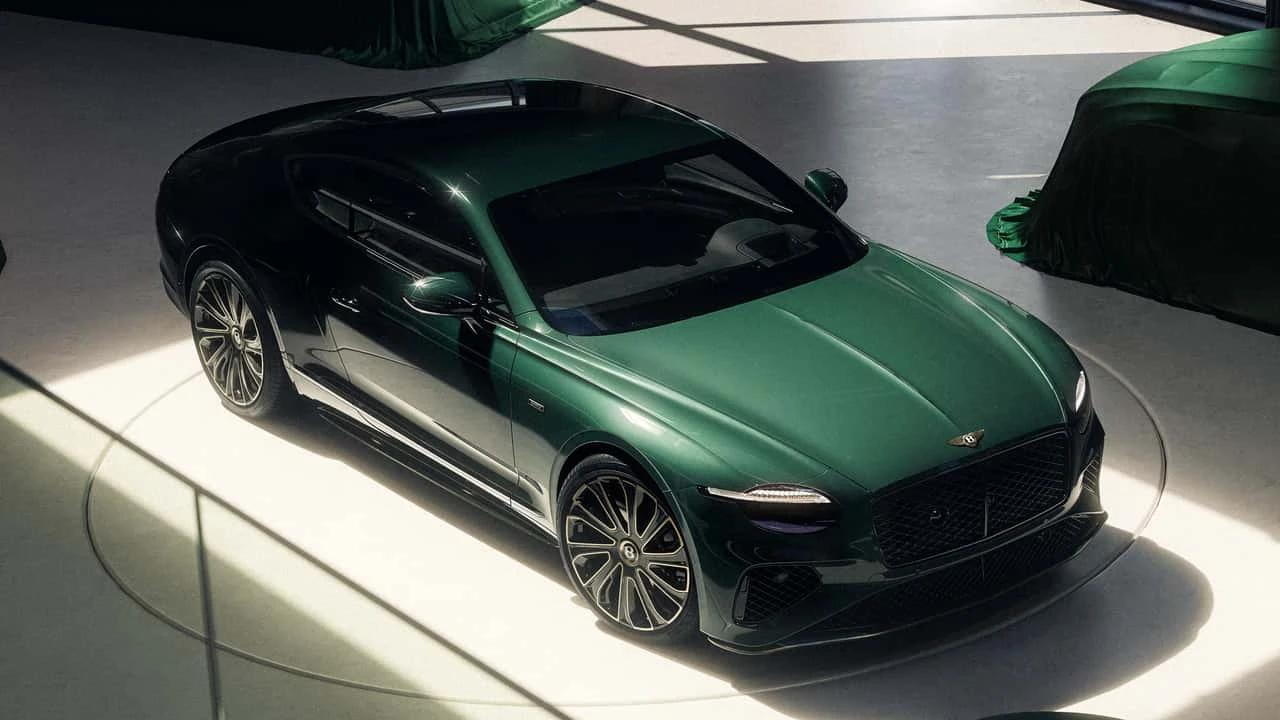
Bentley’s Mulliner division will produce 12 individually numbered Continental GTs for the Olympia Collection, a centenary reference to the complete 6½ Litre displayed at London’s Olympia Motor Show in October 1926. The defining finish changes from Verdant at the front to Midnight Emerald at the rear and takes 56 hours to apply to each car. Bentley has not disclosed a price, regional allocations or a collection-specific powertrain specification.
Those omissions matter. Olympia is presented as a design and materials commission, not as a separately documented performance derivative. Its substance lies in paint, leather, wood, numbered accessories and a carefully selected piece of company history. Any claim about output, acceleration or electric range would require Bentley to identify which current Continental GT powertrain these cars use, and the collection page does not do that.
The anniversary starts with a distinction between 1925 and 1926
Bentley first showed the 6½ Litre’s new chassis and 6,597 cc engine at Olympia in October 1925. Displaying a rolling chassis was normal when buyers could select the mechanical base and then commission a specialist coachbuilder to create the body and cabin. Deliveries began in early 1926, but that is not the exact centenary used for this collection.
In October 1926, the company returned with a complete touring car bodied by Vanden Plas. Olympia Collection commemorates that second appearance: the point at which the engineering package and coachwork were presented together. Mulliner draws a direct parallel with its current role, but the modern Continental GT is an interpretation rather than a replica of the original car.
Bentley’s official history traces the 6½ Litre project to a 1924 road encounter. W.O. Bentley was returning from the European Grand Prix in Lyon towards Dieppe when he met the prototype Rolls-Royce Phantom I. The company says the informal contest persuaded him that his next car needed to be larger and more powerful than the 3 Litre. The new collection turns that account into a visual route motif rather than treating it as a formally recorded race result.
Ombré paint acknowledges what the archive cannot prove
The precise green worn by the 1926 show car is no longer known. Mulliner therefore chose not to claim an exact historical match. Verdant, a brighter forest green, flows into the near-black Midnight Emerald along the body. In the official photography, the transition changes noticeably with the lighting: the front and bonnet reveal the lighter tone, while the rear quarter reads much darker.
Bentley states that the Ombré by Mulliner paint process takes 56 hours per vehicle. It does not publish a stage-by-stage breakdown or a direct comparison with a regular factory finish, so the number should not be converted into a price estimate. It is evidence of labour devoted to blending the colours, not a complete measure of the time required to build the car.
Black 22-inch Mulliner wheels carry Champagne Gold accents across their faces. The same finish appears on the self-levelling wheel badges, exterior emblems and a hand-painted pinstripe low on the body. Blackline trim darkens the matrix grille, intakes and rear diffuser. The restrained Olympia Collection badge on the front wing is one of the few explicit labels.
The Lyon–Dieppe route appears outside and inside
When a door is opened, the welcome lamp projects an animated representation of the journey from Lyon to Dieppe. Between the rear seats, embroidery maps the same route, with Cumbrian Green defining the region and Champagne Gold marking the journey. It is a unusually specific piece of storytelling: owners are shown the episode that inspired the commission rather than being given only an anniversary plaque.
The main hide is a newly developed Coach Green with a heritage-patinated appearance. Cumbrian Green forms the secondary colour, while Champagne Gold piping outlines the seats. Open-pore crown-cut walnut is stained black across the fascia and waistrails. Diamond knurling, gold organ-stop vent controls and Verdant inner vent rings continue the palette without attempting to reproduce a 1920s cabin literally.
The Bentley Rotating Display receives analogue dials and bezels influenced by the 6½ Litre’s instruments. A dedicated laser etching surrounds the centre dial, and the individual build number is incorporated into the display. These are graphic and material references fitted to Bentley’s existing rotating mechanism; the manufacturer does not suggest that the modern instruments duplicate the original mechanisms.
A watch and handover set belong to each numbered car
Every Olympia Collection car is delivered with a handcrafted Mulliner handover box, a book telling the 6½ Litre story and a green cover with Champagne Gold detailing. A numbered Brooklands chronograph is also included, using a Coach Green leather strap cut to match the cabin.
The watch is supplied with two tachymeter bezels intended for the Brooklands Outer Circuit and Double Twelve Circuit configurations. That connection is more precise than a generic motorsport accessory because Brooklands formed part of the early Bentley’s development and competition history. For future owners, keeping the watch, box, book and cover with the car will also make it easier to show that the original delivery set remains complete. Bentley makes no promise about future collectability or resale values.
Price, markets and mechanical details remain undisclosed
Bentley’s page offers a route to enquire through Mulliner but does not list a price or say whether all 12 cars have been assigned. It does not identify countries receiving allocations, so availability in Romania or any other individual market cannot be inferred. Taxes, delivery timing and registration treatment are equally absent.
The announcement also avoids specifying output, acceleration, battery capacity, electric range or fuel consumption for Olympia Collection. It is therefore inaccurate to attach figures from one regular Continental GT version without confirmation. The safest conclusion is narrower: the commission changes the specification Bentley has described—finish, trim, cabin details and accessories—while any mechanical difference remains unconfirmed.
Bentley calls Olympia the first chapter in an intended sequence of Mulliner collections inspired by moments in W.O. Bentley’s life. Future themes are being explored, but no next car, production quantity or date has been announced. For now, the verified proposition is limited to 12 numbered coupes, a non-repeating specification and 56 hours devoted to each ombré paint finish.
The lead photograph comes from the Motor1 article supplied by the reader. Motor1 credits it to Bentley and identifies Bentley as the gallery source; it is reproduced here for editorial coverage of the collection.