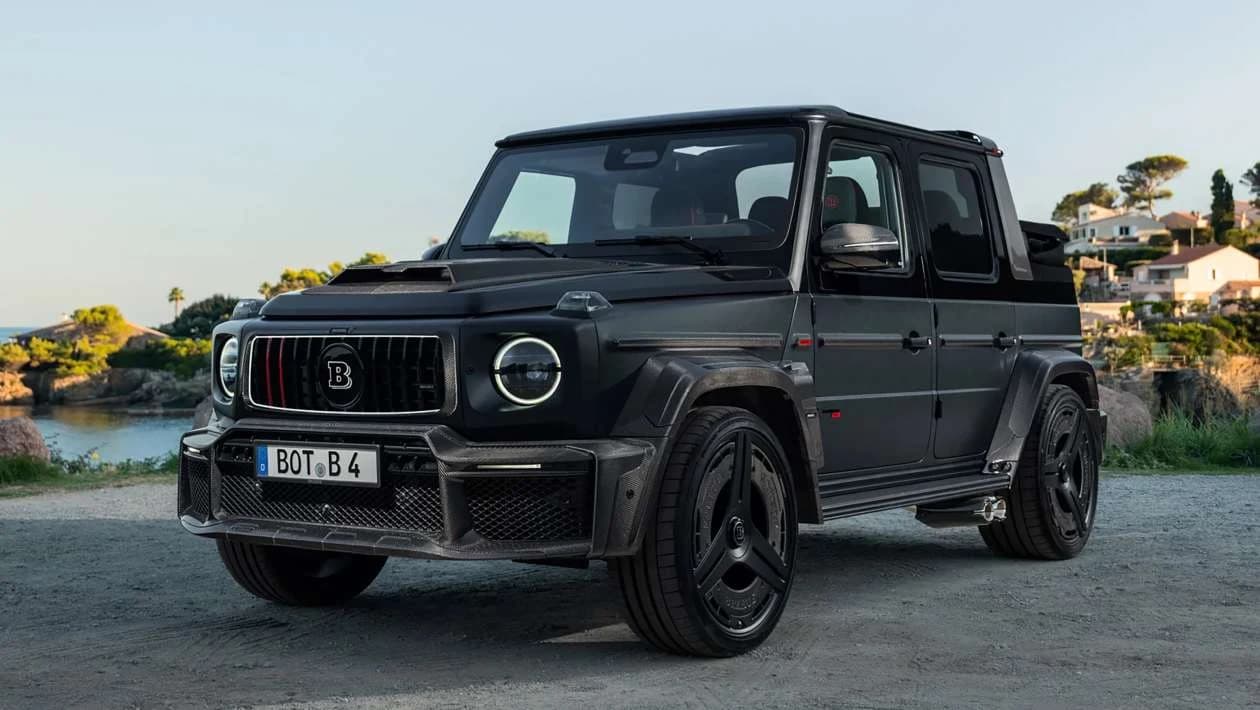
Brabus has unveiled the 900 Rocket Edition Cabrio, a four-door convertible based on the Mercedes-AMG G 63. The German tuner has enlarged the AMG’s V8 to 4.5 litres, fitted its own turbochargers and raised output to 900 hp. Production is limited to 10 examples.
The project arrives before Mercedes-Benz brings back its own four-door G-Class Cabriolet. Brabus uses a folding fabric roof developed for this conversion rather than the roof arrangement shown on Mercedes prototypes. The two-piece top contains more than 500 newly developed components, opens or closes in 20 seconds and includes a heated glass rear window.
Brabus also says every car spends more than 10 hours in a climate chamber under water testing before it is delivered. That detail is important for a vehicle whose body has been extensively modified. The claim is a manufacturer statement, not an independent long-term test of the roof’s durability.
A four-seat open G-Class
The 900 Rocket Edition Cabrio retains four doors and four seats. Its roof system differs from the Mercedes design because the rear section is supported by a visible C-BOW roll-over structure behind the rear doors. When the roof is open, that structure folds behind the rear seats. A tailored tonneau cover protects the folded fabric from dirt.
The roof is built in two sections. A carbon-fibre bow integrated into the front section helps preserve the shape at higher speeds and is intended to reduce wind and road noise. A heated rear window is incorporated into the fabric, while a woven “77” logo references Brabus’s founding year, 1977. Signature stripes and additional Brabus lettering are placed across the roof surface.
Brabus expects owners to use the Cabrio as a full four-seater. The rear doors receive special hinges that allow them to open to 90 degrees, making access to the back seats easier. Rear passengers do not receive the same neck-heating system as those in front, according to the Auto Express report.
A 4.5-litre Rocket V8
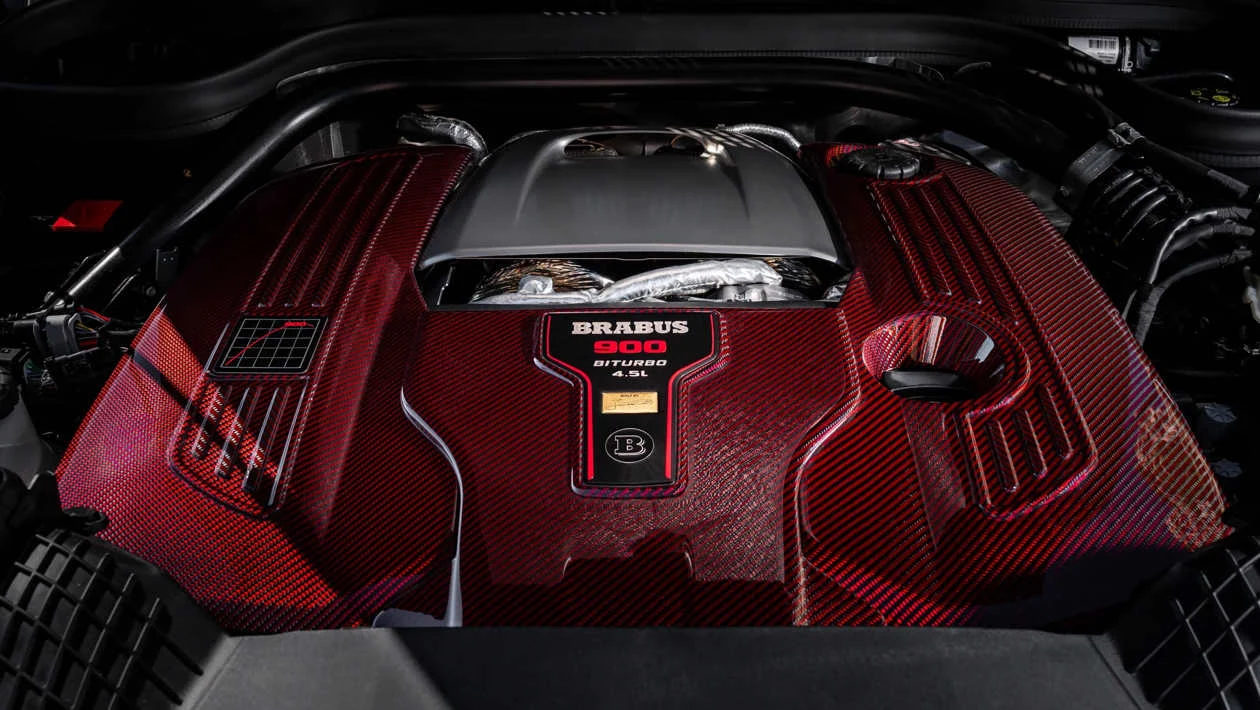
The engine starts with the 3,982cc V8 used by the AMG G 63, but Brabus increases displacement to 4,407cc. The conversion uses an 84mm bore, forged pistons, high-performance connecting rods and a special crankshaft machined from solid material and balanced for the larger engine.
Two Brabus turbochargers with larger compressor units generate up to 1.4 bar of boost. The official figures are 662kW, or 900 hp, at 6,200rpm and 1,250Nm at 2,900rpm. In the vehicle, torque is electronically limited to 1,050Nm. The nine-speed automatic transmission and four-wheel-drive layout remain part of the AMG-based package.
The claimed 0-100km/h time is 3.7 seconds. Top speed is electronically limited to 240km/h, with Brabus citing the tyre specification as the reason for the limit. The speedometer still carries a 300km/h scale, but that marking is not the car’s permitted maximum speed.
The exhaust system uses electronically controlled valves, metal catalysts and particulate filters. Its carbon-fibre tailpipes are positioned ahead of the rear wheels, and a selectable sound management system allows a louder Sport setting or a quieter Coming Home mode. These are Brabus equipment descriptions rather than independent measurements of sound level or emissions.
Widebody design and 24-inch wheels
The convertible receives Brabus’s Widestar widebody treatment with visible carbon-fibre components. The front bumper has large air intakes, the bonnet gets a prominent power dome and the Mercedes star in the grille is replaced by a Brabus emblem. Carbon extensions surround the bumpers, mirrors and wheel arches.
The 24-inch Monoblock II EVO wheels use a three-spoke design and carbon aero blades. The official tyre sizes are 295/30 ZR 24 at the front and 355/25 ZR 24 at the rear. A RideControl coilover chassis developed with KW can lower the vehicle by up to 45mm, with damping adjustment available through the drive-mode control.
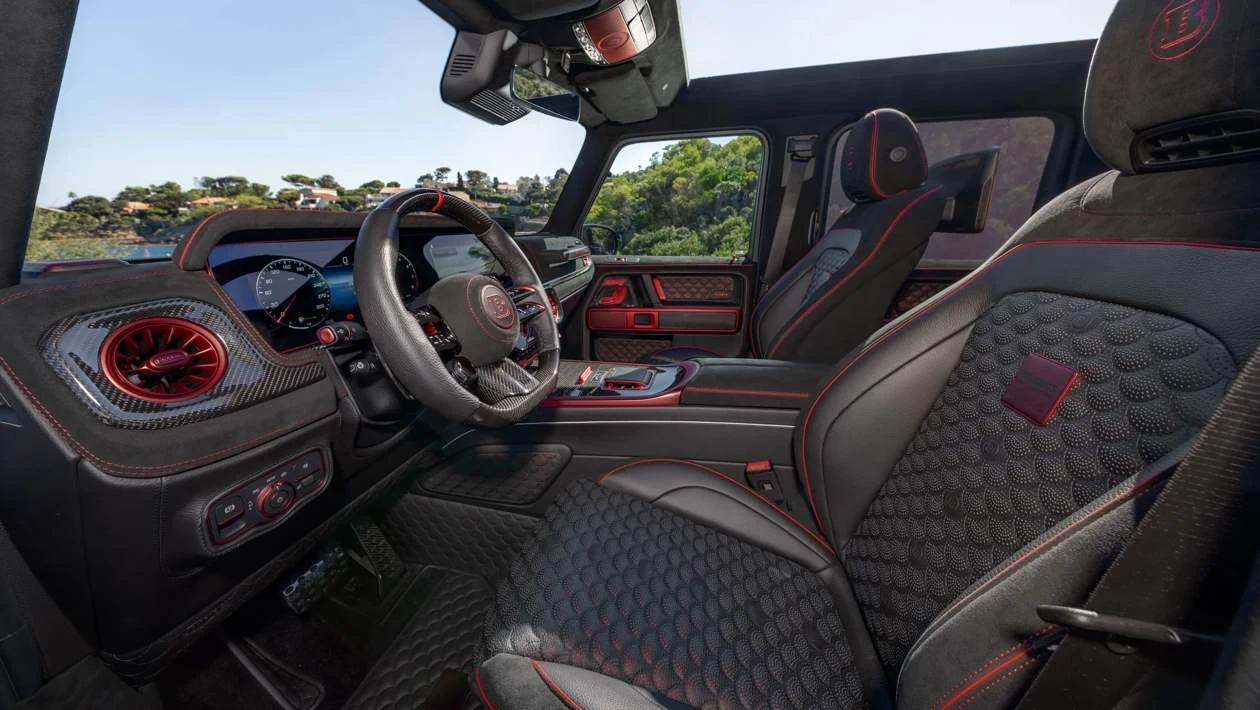
Inside, the Masterpiece cabin combines black leather and Alcantara with Shell-pattern stitching. Red piping and accents are used on the seats, steering wheel, ventilation outlets, speakers and controls. Carbon-fibre trim and illuminated Brabus door sills carry the same theme. Carbon shift paddles include LED indicators that show the engine’s rev range, while the instrument cluster has a 300km/h scale.
Brabus also installs a digital product passport in the boot’s specification plate. The company says the blockchain-based system can verify authenticity, ownership and vehicle specification for each car built at its Bottrop facility.
A collector-scale production run
The 10-car production limit places the 900 Rocket Edition Cabrio closer to a bespoke collector vehicle than to a normal G-Class variant. Brabus has not published a single final price for every possible specification on the technical page. The final cost will depend on paint, leather, carbon parts and customer-selected equipment.
There is no information about a Romanian allocation or an official local sales programme. Any car imported into Romania would require checks covering the conversion documentation, registration, insurance and servicing of the modified roof and powertrain. The performance figures quoted here are Brabus figures and have not been independently tested by Carboratory.
Photo: Auto Express/Brabus. The images are taken from the supplied article gallery and stored locally as WebP files.