The next Dacia Sandero is reported to be getting a fully electric version with a 44 kWh lithium-iron-phosphate battery, an electric motor producing about 80 kW and a range of slightly more than 400 km. The figures come from company sources cited by Autocar, not from a Dacia specification sheet. There is no homologated WLTP result, charging figure or confirmed price yet.
Dacia has officially said that the next-generation Sandero will have a fully multi-energy powertrain range. That statement supports the planned mix of electric, hybrid and combustion options, but it does not confirm the battery, output or precise 2028 launch timetable described in the report.
What the 44 kWh and 400 km claim implies
Autocar's sources associate the electric Sandero with a 44 kWh LFP pack and a Shanghai e-Drive motor rated at roughly 80 kW, or about 109 PS. The components are said to be related to technology intended for more affordable Renault 5 E-Tech versions. An earlier range objective was reportedly around 389 km, with the latest development target moving beyond 400 km.
That number demands context. If all 44 kWh were usable, 400 km would imply approximately 11 kWh per 100 km. Production batteries normally reserve some capacity to protect durability, and homologated consumption also depends on conversion losses, wheels, tyres and equipment. The reported target therefore points to a particularly efficient small car, but it is not enough to calculate a final WLTP result.
LFP chemistry is generally selected for cost, cycle life and its lack of nickel and cobalt in the cathode material. Its energy density is usually lower than an equivalent NMC pack, which can increase weight or volume for a given capacity. Dacia would need to control mass and aerodynamic losses if it intends to combine a modest battery with a range above 400 km.
A combustion platform adapted for an EV
The report says the fourth-generation Sandero will retain a development of the current CMF-B architecture, now identified by Renault Group as RGMP Small. Renault officially describes RGMP Small as a multi-brand, multi-energy platform for smaller vehicles. The electric Renault 5 uses the dedicated RGEV Small architecture instead.
For Sandero, engineers are said to be modifying RGMP Small so an underfloor battery and electric motor can be offered within the same model family as petrol and hybrid systems. Reusing the structure and manufacturing base can reduce tooling and development expenditure. The trade-off is packaging: a dedicated EV floor does not need to preserve space for fuel tanks, exhausts or combustion-related hardware.
Autocar also reports a weight reduction of about 100 kg as part of the efficiency work. Dacia has not confirmed the comparison vehicle or the kerb weight of the finished EV, so the figure should not be read as a promised mass for a customer car.
Familiar size, new body panels and cabin
The new Sandero is expected to stay close to the current model's 4.10-metre length. The roof, A-pillars, door structures and glasshouse are reported to be carried over, while the visible exterior panels and front end would be redesigned. Inside, sources describe a completely new dashboard with more texture and angular shapes, while retaining physical controls for frequently used functions.
A 410-litre boot has also been mentioned for the new range. It is not clear whether that capacity applies equally to the electric version, because the battery installation can affect the cargo floor. Dacia has not published a dimensional drawing or an EV-specific luggage figure.
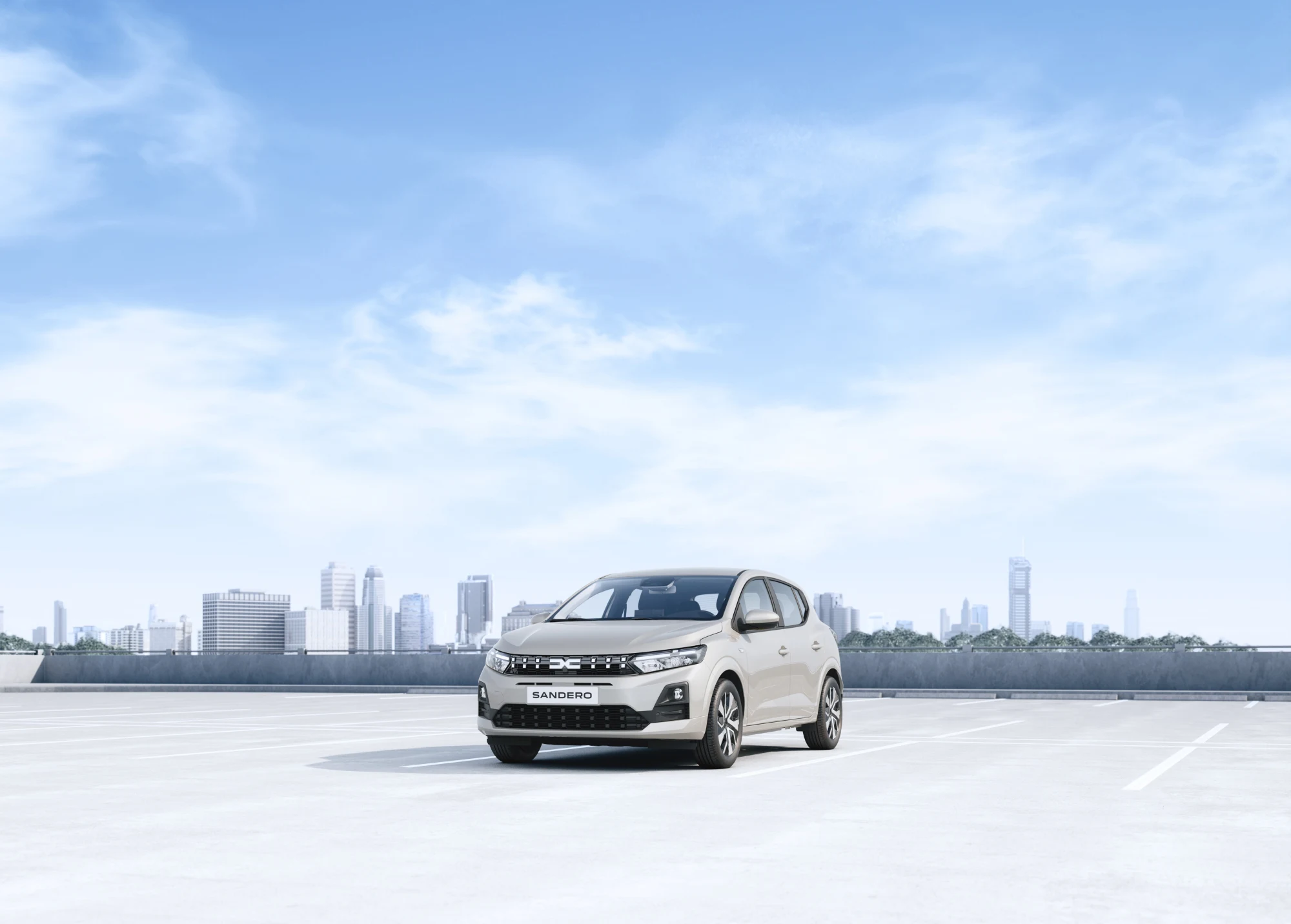
The photograph used here shows the current Sandero following its 2026 update. Dacia has not released an official image of the 2028 generation. Magazine renderings are artist interpretations and should not be treated as final design evidence.
Petrol and a smaller full hybrid remain in the plan
The electric derivative would sit within a wider powertrain range. Autocar reports that a new 1.2-litre TCe with around 100 PS could replace the current 1.0-litre entry engine in some markets. The unit would be produced by Horse, the powertrain company backed by Renault Group.
A more affordable full hybrid is also described, built around a 1.2-litre three-cylinder engine and delivering roughly 116 PS. That would be smaller and less powerful than the current Hybrid 155 system, which uses a 1.8-litre petrol engine and two electric machines. Dacia has not confirmed the next hybrid's detailed layout or output.
This mixed line-up is consistent with the company's futuREady plan, announced on 10 March 2026. Dacia said it intends to launch four battery-electric vehicles by 2030 and wants electrified cars to account for around two-thirds of its sales. The next Sandero was specifically identified as a multi-energy product that should retain the brand's value positioning.
Morocco is linked to production, but dates remain provisional
The report points to a spring 2028 presentation, production in Morocco from April and sales beginning that summer. None of those months appears in Dacia's public product statement. Supplier validation, battery integration, homologation and factory preparation can all change an industrial schedule.
Renault Group confirms that the current Sandero is built at Tangier alongside Sandero Stepway, Jogger and Renault Express. The factory produced 222,257 Sandero units in 2025. Its official site does not yet provide a start date for the fourth-generation EV or explain where its battery packs would be assembled.
The confirmed information is therefore narrower than the reported specification. A multi-energy Sandero is in Dacia's plan, and Renault Group has a small multi-energy platform. The 44 kWh pack, 80 kW motor, range above 400 km, 100 kg reduction and exact launch sequence remain unconfirmed development information.
For buyers, the decisive figures will be the final euro price, usable battery capacity, WLTP range, charging curve, warranty and electric model's luggage space. Until Dacia publishes those details, the reported package is a credible engineering direction rather than a finished retail offer.
Sources
- Dacia Media: futuREady plan and the next multi-energy Sandero
- Renault Group: futuREady platform and battery technology roadmap
- Renault Group: official Tangier plant data
- Dacia Media: 2026 Sandero range and official press image
Image: Dacia / Renault Group official press material showing the current Sandero. The 2028 generation has not been officially revealed.