Ford and Geely are preparing to turn the Almussafes plant near Valencia into a shared European manufacturing hub. Their July agreement calls for Geely to acquire 34% of Ford España for €221 million. Ford will retain 66%, although the partners will exercise joint control over the company that operates the factory.
China's competition regulator has approved the acquisition without conditions. That clearance is an important step rather than confirmation that every closing requirement has been completed. The companies expect the joint venture to begin formal operations in the first half of 2027, after regulatory work and an internal reorganisation, with the first vehicles from the new programmes scheduled for 2028.
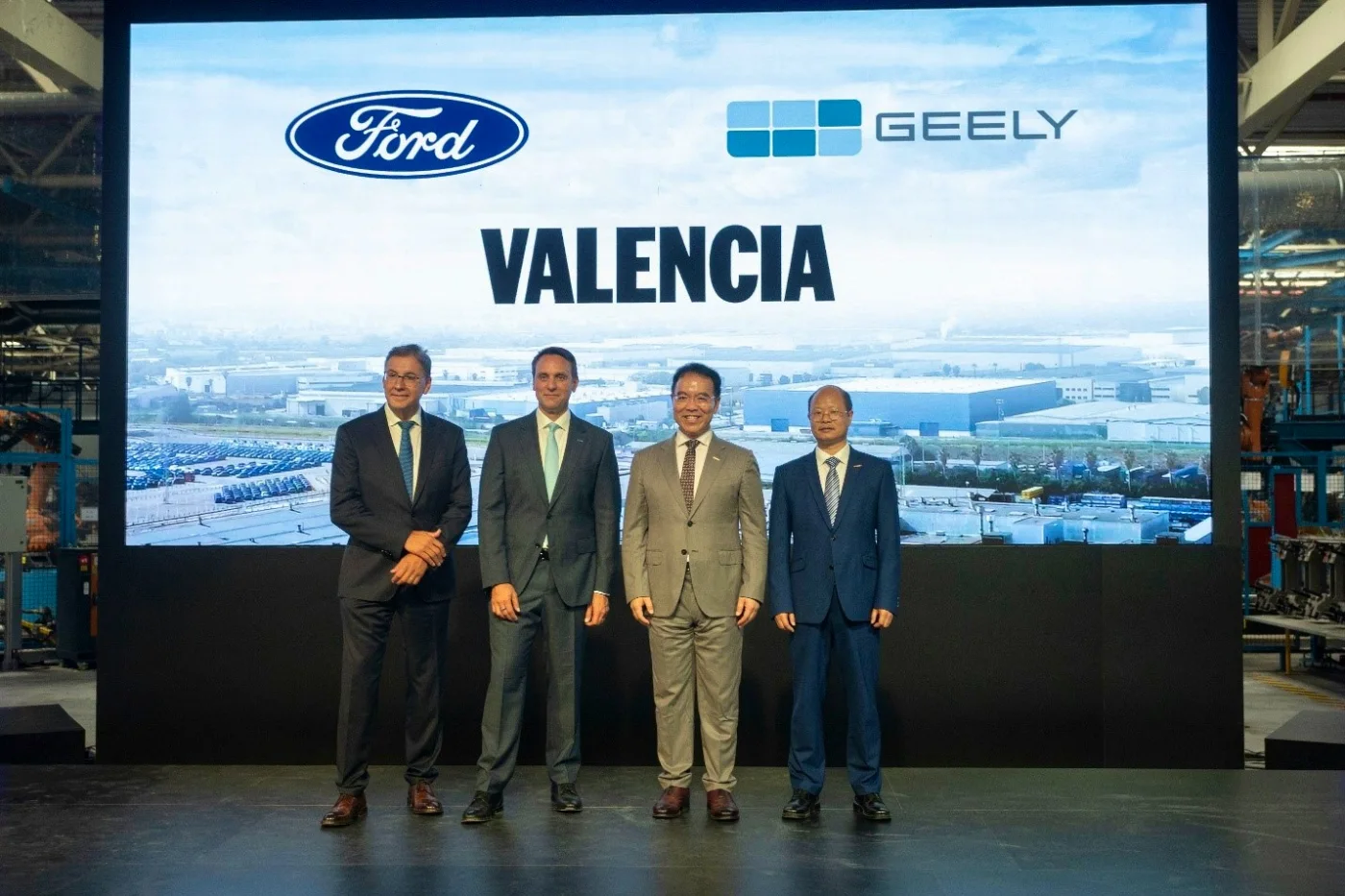
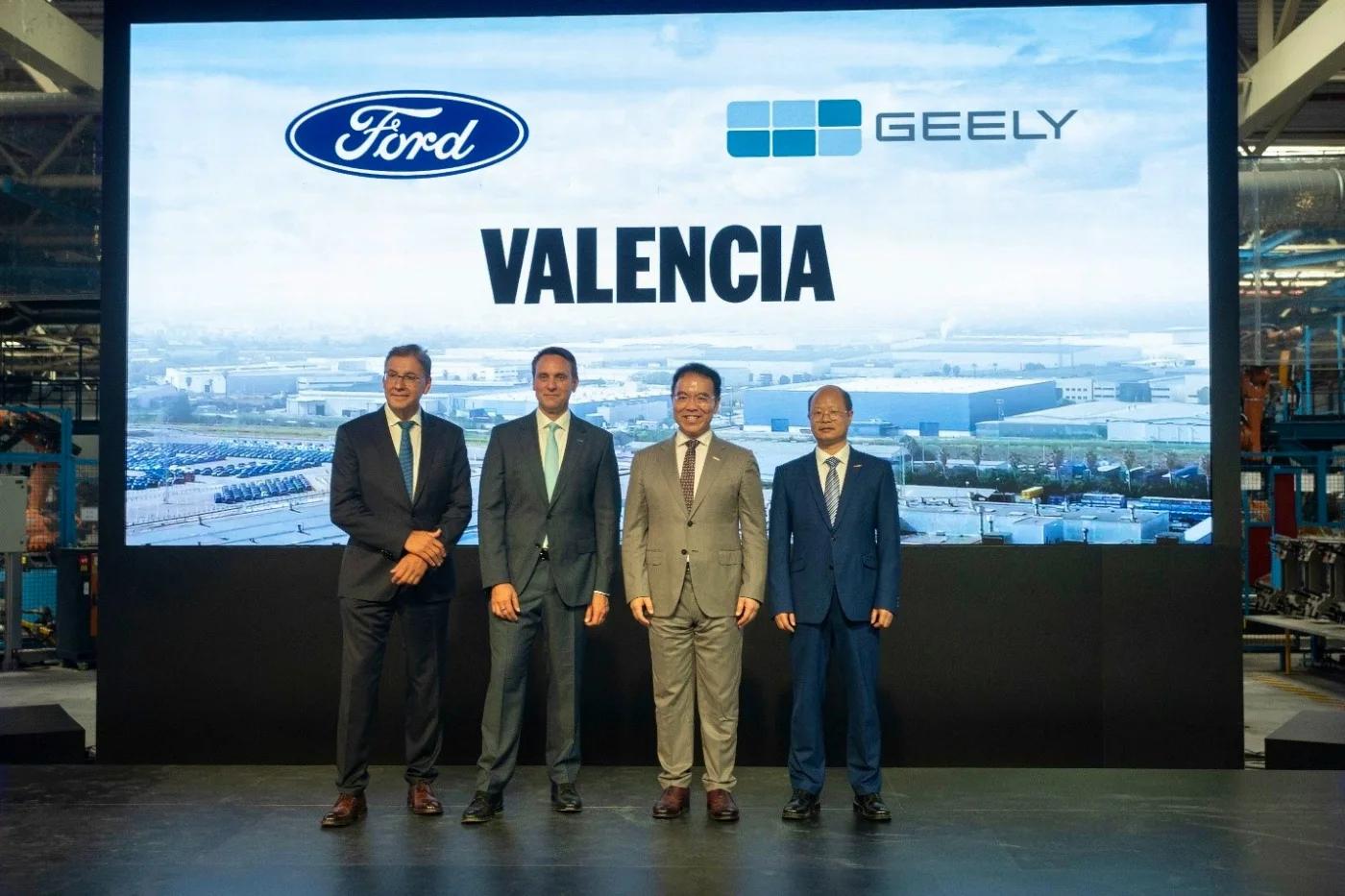
The partnership announcement at Ford's Valencia plant. Photo: Geely Auto, official press image.
Three Ford vehicles and two electric Geely models
The industrial plan covers five vehicles. Ford is due to continue making the Kuga and add a European Bronco, as well as a family “multi-energy” crossover jointly developed with Geely. The Chinese manufacturer plans two battery-electric models carrying the Geely badge.
“Multi-energy” is a broad product description, not a technical specification. Neither company has published battery capacities, WLTP ranges, power outputs, dimensions, prices or model-by-model production targets. The identities of the two Geely EVs are also unconfirmed. Matching them to current Chinese-market cars would therefore be speculation.
The 2028 target does not necessarily mean that all five products will start on the same day. Line conversion, supplier nomination, European homologation and production validation follow separate schedules. A phased introduction would still be consistent with the announced programme.
Geely is buying a stake, not the whole factory
Geely's interim financial report gives the transaction more precision. Centurion Industries Limited, a wholly owned Geely subsidiary, agreed to buy 34% of Ford España from Ford Nederland B.V. for €221 million. The final consideration can be adjusted for net debt, working capital and the assets included when the deal closes.
Ford must first carve out certain assets, liabilities and business units that are unrelated to Ford España's core contract-manufacturing operation. After completion, Ford España will not become a consolidated Geely subsidiary. Geely expects to account for the investment as an associate under the equity method.
That distinction corrects the shorthand claim that Geely is buying Ford's Spanish factory outright. Ford remains the majority shareholder with 66%. Joint control gives Geely a real role in governance, but it is not sole ownership or an independent takeover of the site.
Valencia has capacity that needs more products
Ford opened Almussafes in 1976. The partners put its potential technical capacity at about 500,000 vehicles a year, while Associated Press reported that output fell below 100,000 in 2025. Following the departure of Mondeo, S-Max, Galaxy and Transit Connect production, the plant now relies heavily on the Kuga.
For Ford, Geely volume and a jointly developed vehicle can spread fixed factory costs across more units. For Geely, an established plant provides skilled workers, European suppliers and a faster route to local manufacturing. Those are industrial advantages, but they do not by themselves prove that the finished cars will be inexpensive.
The two Geely EVs will be assembled in Europe. That statement does not disclose where every battery cell, power-electronics component or body part will originate. Customs origin and treatment depend on detailed rules and component content. European assembly may alter exposure to countervailing duties on China-built EVs, but the exact result cannot be inferred from the factory address alone.
Employment could rise, but no number is guaranteed
Ford has said the existing workforce will become employees of the joint venture. Its European leadership also indicated that more workers are likely to be needed as volumes ramp up. Geely said it does not plan to transfer workers from China.
The companies have not published a hiring total, a guaranteed annual output or a hall-by-hall investment budget. The headline capacity of 500,000 vehicles is the site's potential, not a production forecast for 2028. Actual staffing will depend on launch timing, automation, shift patterns and demand.
What European buyers can take from the deal
There is no immediate showroom change. No new model from the programme can yet be ordered, and there is no price list or delivery date. The medium-term significance is clearer: Ford is using a partner to broaden its European product pipeline and share development costs, while Geely gains its first European manufacturing base for Geely-badged cars.
Building in Spain can shorten the logistics route to many European markets compared with importing complete cars from China. Retail prices will still depend on batteries, suppliers, equipment, taxes, distribution and brand strategy. Local assembly does not automatically guarantee a lower price or faster delivery.
Ford also gains access to a partner with modern electric and hybrid architectures, while Geely can learn to operate within an established European industrial system. The agreement does not prove which company will supply the platform, software or battery for each vehicle. Those details must wait for product announcements.
For prospective owners, after-sales coverage will matter as much as the assembly site. Warranty terms, parts inventories, service training and national distribution have not been set out for the Valencia-built Geely models. A European factory can support logistics, but it does not replace a mature retail and repair network.
As of 11 November, the confirmed points are the 66/34 ownership split, Geely's €221 million consideration, Chinese regulatory clearance, the intended 2027 start for the joint venture and new-vehicle production from 2028. Model names, technical specifications, volumes and prices remain to be announced.