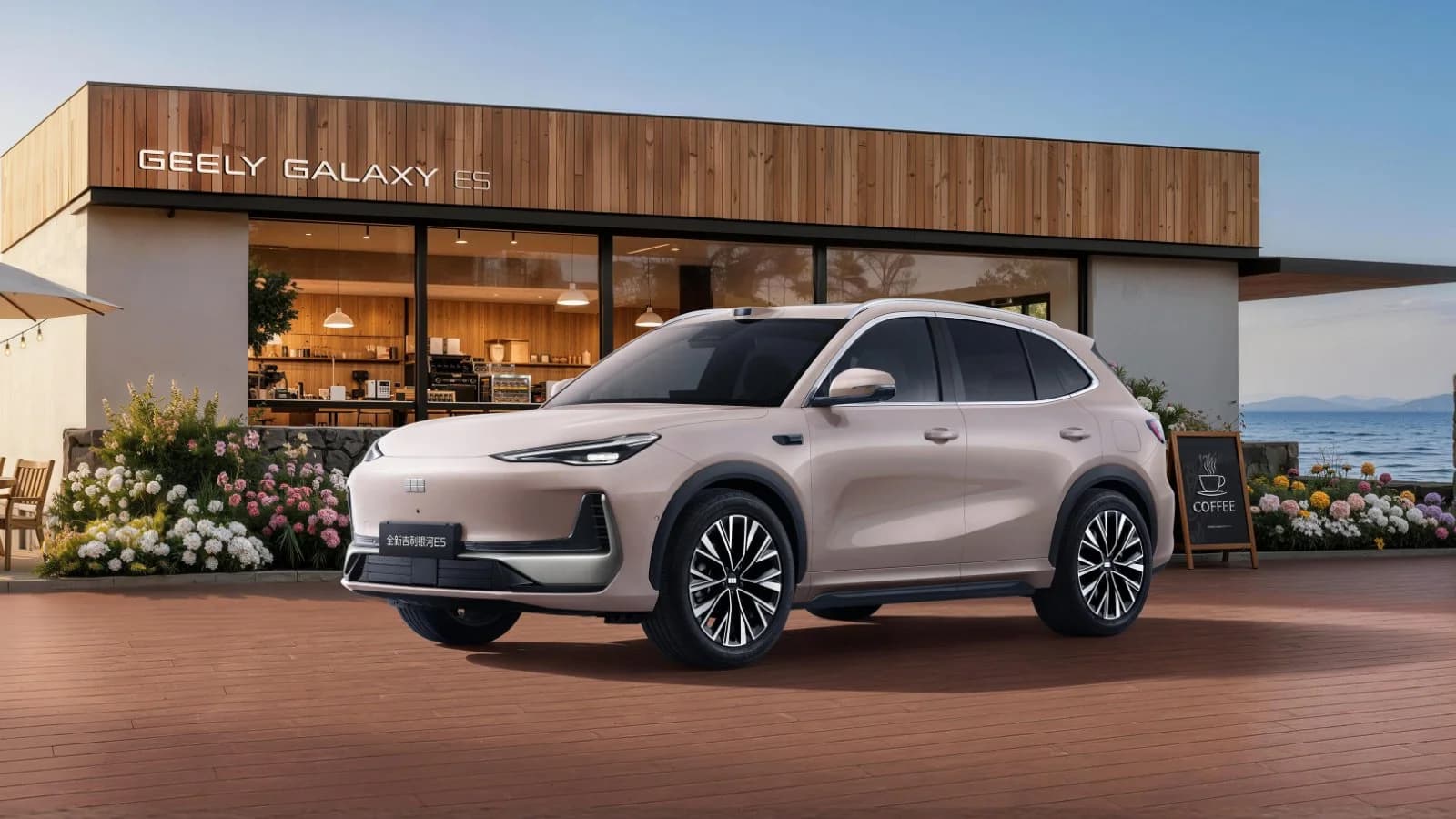
The revised Chinese-market Geely Galaxy E5, known as the EX5 in export markets. Geely has not confirmed this specification for Europe. Official Geely Galaxy press image.
Updated Geely EX5 gets 6C charging and rear-wheel drive
Geely has launched a substantially revised Galaxy E5 in China, adding an 800-volt electrical architecture, a 6C lithium iron phosphate battery and a 245 kW rear-mounted motor. The compact electric SUV is sold outside China as the Geely EX5, but the manufacturer has not announced that the new Chinese specification will be exported.
The headline charging figure is 8 minutes 25 seconds from 10% to 70% at normal ambient temperature. Geely quotes a 460 kW peak for the new battery and up to 635 km of range on China's CLTC cycle. Neither figure is a European rating, and no WLTP result, euro price or regional launch date has been published for the updated car.
The EX5 figure is 8:25, not 4:30
The model announcement appeared alongside Geely's broader Smart Charging technology presentation, which makes the numbers easy to mix up. The group's fifth-generation charging station is rated at up to 2,250 kW, while a different 12C battery fitted to a Lynk & Co 10 and Zeekr 001 charged from 10% to 70% in a claimed 4 minutes 30 seconds. Those test cars reached 97% after 8 minutes 40 seconds.
The Galaxy E5 uses Geely's new Ultra Short Blade Battery with a maximum 6C rate. Its corresponding 10–70% time is 8 minutes 25 seconds and its stated peak is 460 kW. It would therefore be inaccurate to say the EX5 itself accepts 2,250 kW or completes the four-and-a-half-minute test. The charging station, the 12C test battery and the EX5's 6C pack are separate parts of the same technology programme.
Geely describes the 4:30 result as its fastest production-ready performance to date. Claims that the EX5 has the world's fastest charging need more qualification: the company has not published an independent comparison covering every production EV, and charging windows, battery sizes, temperatures and test procedures differ between brands.
What a 6C battery rating tells us
A C-rate relates charging power to nominal battery capacity. In idealised terms, 1C corresponds to charging at a power equal to the pack's capacity, whereas 6C is six times that value. It is a peak capability rather than a promise that maximum power will be sustained throughout the session. Current normally tapers as state of charge and cell temperature rise.
The revised E5 is offered with 61.52 kWh and 70.01 kWh LFP batteries in its 800-volt versions. Geely has not released a complete charge curve, the average charging power over the 10–70% interval, the energy delivered at the plug or detailed test conditions. It also has not identified how closely ordinary public chargers reproduce the announced time.
That matters because a 460 kW-compatible car will still be constrained by a 150 or 200 kW charger. Battery preconditioning, ambient temperature, the starting temperature of the cells and whether the station can hold its rated output all affect the stop. The announced result is useful evidence of the car's potential under Geely's conditions, not a universal eight-minute guarantee.
A 245 kW motor replaces front-wheel drive
Most revised variants move from a front-mounted motor to a 245 kW unit on the rear axle. Peak output rises by 85 kW over the previous 160 kW system, and Geely gives a quickest 0–100 km/h time of 5.8 seconds. The rear-drive cars also use a five-link rear suspension, with electronically controlled CCD dampers available on selected versions.
There is one important exception. The entry 530 km Global Classic model retains the 400-volt platform, front-wheel drive, 160 kW motor and a 1.8C DC charging rate. A Galaxy E5 badge alone consequently does not guarantee the new high-voltage hardware; the version determines which electrical and driveline package is fitted.
The body now measures 4,636 mm long, 1,920 mm wide and 1,670 mm high, with a 2,750 mm wheelbase. Compared with the outgoing Chinese model, length and width increase while height and wheelbase remain broadly unchanged. Moving the motor rearwards also frees space for a 160-litre front luggage compartment.
CLTC range cannot be read as a WLTP number
Three battery capacities are listed in China: 60.22, 61.52 and 70.01 kWh. Their corresponding advertised ranges are 530, 550 and 635 km under CLTC. The smallest pack belongs to the retained 400-volt derivative, while the two larger options are associated with the new 800-volt system.
CLTC and WLTP use different speed profiles, temperatures and test procedures, so the 635 km figure should not be placed directly beside a European WLTP number. The current UK-market EX5 illustrates the gap between specifications. Geely UK lists front-wheel drive, usable capacities of 60.22 and 68.39 kWh, up to 135 kW DC charging and roughly 20 minutes from 30% to 80%. Its best published range is 450 km WLTP.
That comparison shows how extensive the Chinese update is without proving what an exported car will deliver. European homologation could bring different battery buffers, software, charging hardware, tyres and equipment. Until Geely provides an export data sheet, calculations that convert 635 km CLTC into a precise WLTP range remain estimates.
LiDAR appears on selected Chinese versions
Higher specifications add a roof-mounted LiDAR unit and Geely's G-ASD H5 driver-assistance system. The manufacturer describes 27 sensors and navigation-assisted driving functions for Chinese motorways and urban roads. Availability elsewhere would depend on regulation, mapping, software validation and the equipment chosen for each market.
The update also adopts conventional external door handles instead of flush electrically operated units. Inside, equipment can include Flyme Auto 2, a 15.4-inch central screen, a head-up display and a 23-speaker audio system. These details belong to the domestic model and should not be treated as a confirmed European equipment list.
No European launch has been announced
Geely already sells the EX5 in several European markets and has obtained EU whole-vehicle type approval for the existing version. The revised Galaxy E5, however, has only been launched in China. Geely has not named the UK, Italy, the Adriatic markets or Romania in connection with the 800-volt model.
For European buyers, the practical unknowns are therefore larger than the headline time suggests. A local car would need an official WLTP range, connector and charging specification, market-specific driver-assistance package, price and delivery date. Access to public chargers capable of approaching 460 kW would also determine whether the battery's peak rate provides its full benefit.
The confirmed story is narrower: China's Galaxy E5 has gained rear-wheel drive, up to 245 kW, a 70.01 kWh battery option and 6C charging. Its 8:25 result is a manufacturer claim for 10–70% under stated normal-temperature conditions. It is not the group's 4:30 demonstration, and it is not yet a specification offered to EX5 customers in Europe.