Official Geely Automobile Holdings press image distributed with the 23 September 2026 Smart Charging announcement through GlobeNewswire.
Geely Auto Group has unveiled a fifth-generation Smart Charging station with a claimed peak output of up to 2,250 kW. In company-described real-world tests, a Lynk & Co 10 and a Zeekr 001 charged from 10% to 70% in 4 minutes 30 seconds, then reached 97% after a total of 8 minutes 40 seconds.
Those are Geely's fastest production-ready charging results to date, but the two headline figures describe different parts of the system. The 2.25 MW number is the station's maximum rating. Geely's announcement does not say whether that output is available through one connector, nor does it state how much power either test vehicle actually accepted. Battery capacity, a complete charging curve and the amount of energy delivered are also absent.
PowerMind adjusts the session before the battery overheats
The control layer is called Xingrui PowerMind, an energy-management model developed jointly by Geely and StepFun. Geely says it coordinates information from the vehicle, battery, charging station, cloud services, electricity grid and local energy storage. It can alter peak current, cooling effort and charging duration for the particular car and pack connected to the station.
PowerMind is designed to forecast battery temperature up to 30 seconds ahead. Rather than waiting for a temperature threshold to be exceeded, the software can reduce or reshape the power request in advance. Geely's stated targets are an average charging temperature below 55°C and a peak below 65°C.
Thermal control extends across five liquid-cooled points: the station's storage battery, the charging unit, cable, vehicle inlet and traction battery. This matters because a 2,250 kW label on the dispenser cannot by itself make a car charge at that rate. The vehicle needs cells, busbars, contactors, an inlet and cooling hardware capable of accepting the requested power.
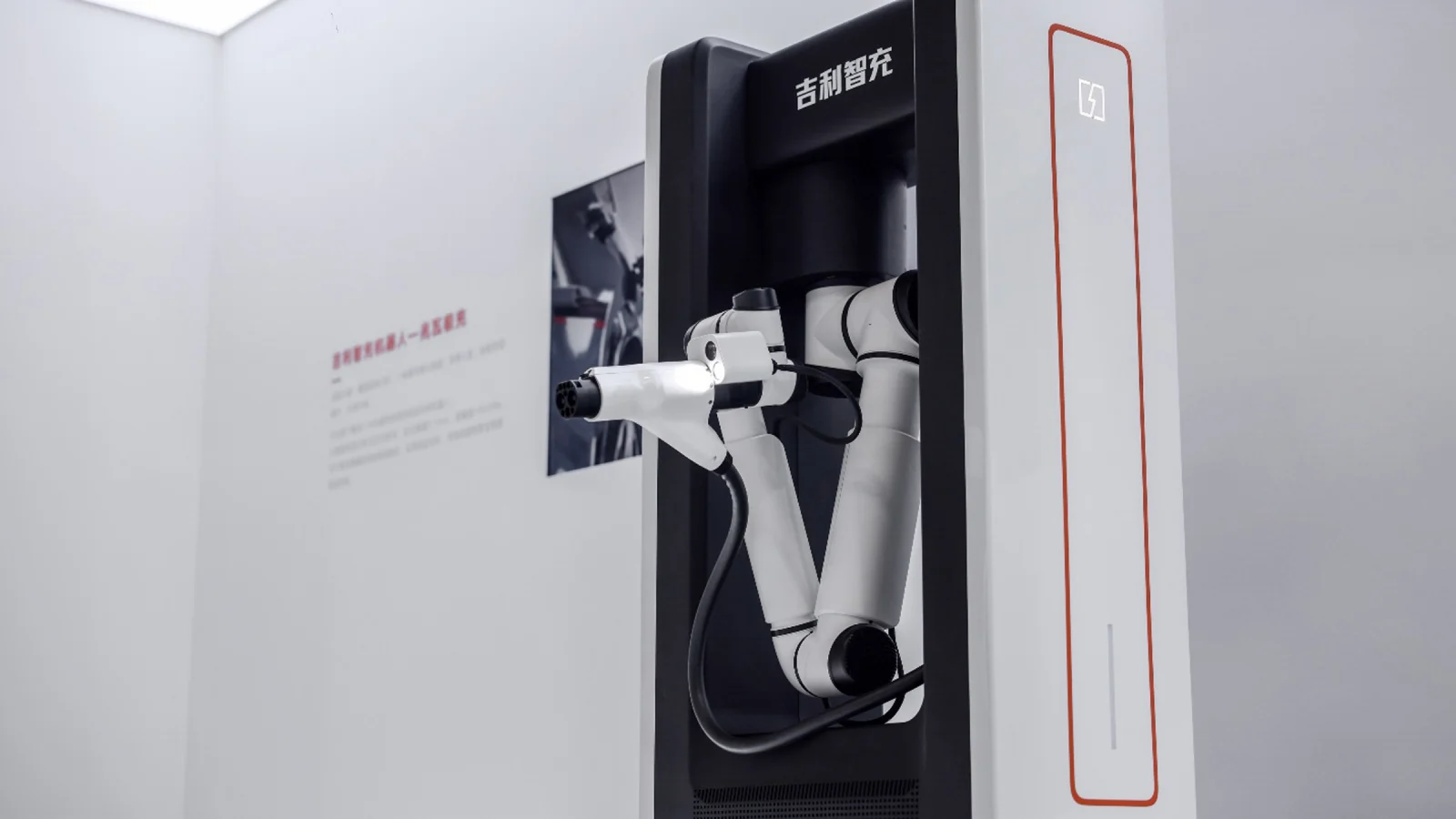
The official images also show an automated arm carrying the connector. Geely has not published the arm's connection time, its commercial availability or the plug specification for overseas markets. It is therefore evidence of the demonstrated hardware, not proof that a robotic 2.25 MW network is already open to drivers.
A 12C battery underpins the quickest test
Geely associates its highest charging performance with the Shendun Golden Battery, which supports a claimed peak charge rate of 12C. C-rate expresses charging power relative to battery capacity. A constant 1C rate would theoretically fill a battery in one hour, while 12C corresponds to five minutes. Real batteries cannot normally hold the peak all the way to full because temperature and cell voltage rise, so the charging rate tapers.
That is why the timed state-of-charge intervals are more useful than the 12C peak on its own. The first 60 percentage points, from 10% to 70%, took 4 minutes 30 seconds. Moving through the next 27 points to 97% required another 4 minutes 10 seconds. The similar duration for a much smaller increase shows the effect of tapering near the top of the pack.
Geely does not identify the usable capacity of the batteries in the two test cars in this announcement. Without capacity and the power curve, an independent reader cannot calculate the average input or make a like-for-like comparison with a larger or smaller pack. The company calls the runs real-world tests, but it provides no full independent protocol, ambient temperature or repeatability data.
A 6C Ultra Short Blade Battery targets lower-cost cars
The company also presented a Next-Gen Ultra Short Blade Battery with a peak rate of 6C. It is positioned for more affordable vehicles, with longevity and safety taking priority alongside faster charging. Geely-developed laser welding for the cell tabs and covers is claimed to cut charging heat by 10%.
The release does not name the reference battery, test temperature or measurement procedure behind that 10% figure. Even so, the 6C product shows that the group is not making 12C a requirement across its portfolio. A lower-rate system may reduce battery and cooling cost while still offering much shorter stops than many current EVs.
Geely has separately developed what it calls lithium-ion pulse restoration. Small current pulses are intended to reactivate lithium ions accumulated at the negative electrode after repeated rapid charging. Combined with the adaptive charging strategy, Geely claims the process can add up to 20% to battery cycle life. No cycle-test duration, chemistry comparison or end-of-life capacity threshold was disclosed, so the 20% remains a manufacturer claim rather than an independently reproducible result.
For home charging, PowerMind can use a lower-rate strategy intended to mitigate degradation accumulated through repeated fast charging. The company does not say how long this restorative cycle takes or which customer vehicles will support it.
The BYD comparison needs two qualifications
BYD introduced its second-generation Flash Charging system in March 2026. Its official specification is up to 1,500 kW through a single connector, with 10–70% in five minutes and 10–97% in nine minutes for a compatible Blade Battery 2.0 vehicle. On the published times, Geely is 30 seconds quicker to 70% and 20 seconds quicker to 97%.
The hardware rating appears to show a larger gap: 2,250 kW for the Geely station against 1,500 kW per connector for BYD. It is not yet a clean comparison. Geely does not define its figure as single-connector output in the English announcement, and the vehicles, batteries and test conditions differ. There is no common independent test in which both systems charged equivalent packs.
Deployment is also part of the comparison. BYD said it had installed 4,239 Flash Charging stations in China by 5 March and targeted 20,000 by the end of 2026. Geely's launch gives no number of fifth-generation stations, opening date, session price or city list. A higher rating on a demonstration unit does not create a usable charging network by itself.
No European rollout has been announced
Geely has not set a date for the fifth-generation station in Europe, identified compatible European models or confirmed whether the overseas version would use the same connector and power specification. The 4-minute-30-second result therefore applies to Geely's test in China, not to a charging service currently available to European Lynk & Co or Zeekr owners.
A 2.25 MW station also raises practical grid questions. Geely says PowerMind coordinates on-site storage and the electricity network, but gives no storage capacity, grid draw or number of simultaneous high-power sessions. Those specifications will determine site cost and throughput more directly than the dispenser's headline peak.
For now, the launch establishes a charging platform, two manufacturer-timed results and a thermal-management strategy. It does not establish the price, network coverage, sustained power at the vehicle or availability outside China. Existing EVs will continue to charge only at the maximum rate their own battery and electronics permit, regardless of the station's higher ceiling.