Tesla’s estimated brand value fell 37.8% in Interbrand’s Best Global Brands 2026 ranking, taking it down 25 places to 50th overall. Mercedes-Benz declined 18.6% and Audi 19.5%. Toyota remained the highest-ranked automotive name, in ninth place, despite a 19.9% reduction in its own estimated brand value.
Published on 28 October, the report compares 100 global brands across industries. These percentages describe changes in Interbrand’s valuation model. They do not measure vehicle depreciation, share-price movements or the change in the number of cars a manufacturer sold. That distinction is particularly relevant when a large headline decline concerns a familiar car badge.
Toyota leads a shrinking automotive category
Mercedes-Benz ranks 20th overall, ahead of BMW in 22nd. BMW’s valuation declined 17.9%. Hyundai is next among the automotive names, in 29th place, with a 1.6% increase. Honda ranks 45th after a 21.8% reduction, followed by Tesla in 50th and Ferrari in 51st.
Ferrari’s position illustrates why the annual percentage and the ranking need to be read separately. Its estimated value increased 14.7%, a much stronger direction than Tesla’s, but it still sits immediately below Tesla by the value calculated for this edition. A faster rate of growth is not the same as a larger starting or finishing value.
Audi and Porsche occupy adjacent positions, 65th and 66th, with Porsche down 17.5%. Volkswagen is 71st after a 23% decline. Kia ranks 87th and gains 2.7%; BYD is 89th and gains 4.5%. Nissan closes the list in 100th place, with its valuation down 23.2%.
These are positions in a cross-industry ranking. Tesla being 50th does not mean 49 car manufacturers are ahead of it. Technology, entertainment, financial services and consumer brands all occupy places in the same list. Nor is BYD’s higher growth percentage enough to move it above Kia in the value ranking.
Four automotive names move against the decline
Interbrand highlights Hyundai, Kia, BYD and Ferrari as outperforming much of the automotive category. Its explanation is that they offer clearer propositions and stronger reasons for consumers to choose them. This is the consultancy’s interpretation of its valuations, rather than a separate technical assessment of every vehicle those brands sell.
The report describes automotive as the sector with the sharpest decline. Entertainment overtakes it as the ranking’s second most valuable sector. That comparison concerns the brands represented in Best Global Brands; it is not a calculation of the complete worldwide revenue or economic output of either industry.
There is also a contrast with the overall list, whose combined estimated brand value rises 8.1%. Apple leads, followed by Microsoft and Google. NVIDIA reaches sixth place with growth of 71.5%, entering the top ten. Automotive’s result therefore comes in an edition with substantial gains elsewhere, rather than a uniform reduction across all brands.
What the technology argument establishes
Interbrand says car manufacturers are finding it harder to turn innovation into meaningful differentiation. In this context, spending on a technology is not itself a measurement of the commercial contribution made by the brand. The relevant question for the consultancy is whether the brand gives customers a reason to choose it and supports future demand.
The ranking does not publish a separate return calculation for each software programme, electric platform or assistance system. It cannot establish that a particular development project caused a specified share of Tesla’s, Mercedes-Benz’s or Audi’s decline. Assigning such a cause would go beyond the valuation figures and the sector commentary.
Equally, a 37.8% reduction in Tesla’s brand valuation is not a forecast that every used Tesla will lose that percentage of its price. Interbrand evaluates an intangible commercial asset. A car’s resale value is a different subject requiring evidence about the model, market, age and condition.
The three parts of Interbrand’s method
The consultancy combines financial performance, the role of the brand in purchase decisions and competitive brand strength. Its financial analysis looks at economic profit: after-tax operating profit less a charge for the capital used to generate the brand’s revenue and margins. This differs from simply listing annual turnover.
The Role of Brand component seeks to identify how much of a purchase decision is attributable to the brand, as distinct from factors such as price, convenience or product features. Interbrand can use commissioned research, benchmarking against comparable client work in the same industry, or expert-panel assessment. It should not be described as one worldwide ballot in which motorists directly picked the final order.
Brand Strength considers the ability to create loyalty and sustain future demand and profit. Interbrand evaluates ten factors against other names in the industry and wider global benchmarks. The resulting brand value is therefore a modelled estimate with financial and behavioural inputs, not an observed sale price for the company as a whole.
Why a familiar name may be absent
Eligibility requires a substantial share of revenue outside the brand’s home region, coverage in emerging markets and sufficient public financial information. Interbrand also requires positive economic profit to be expected over the longer term, enough global awareness, and a Brand Strength Score of at least 50.
Those filters matter when interpreting omissions. A brand’s absence cannot alone establish that it makes worse cars, just as Toyota’s leading automotive position cannot certify every Toyota model’s reliability. Best Global Brands provides a view of the commercial value attached to a name. Buyers still need model-specific evidence for safety, warranty coverage and ownership costs before choosing a particular car.
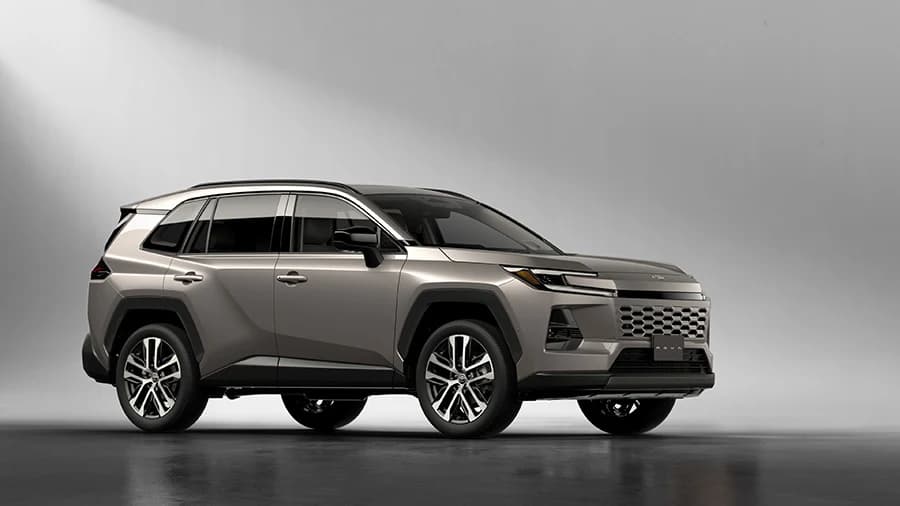
Photo: Toyota Motor Corporation. RAV4 Core prototype shown in May 2025, illustrating the Toyota brand rather than the Interbrand study. Converted to WebP for editorial use.