Jaguar Land Rover and BYD are involved in Dutch legal proceedings over the Ti7, the boxy plug-in hybrid SUV sold in China under BYD’s Fangchengbao brand. Court-appointed bailiffs acting for JLR seized digital records from BYD offices in Schiedam and Hoofddorp in August 2026, according to reporting by The Sunday Times that was subsequently detailed by The Guardian. JLR reportedly suspects that technology from a Defender was reverse-engineered during the Ti7’s development. That is an allegation, not a judicial finding, and no court has established that BYD copied the Defender.
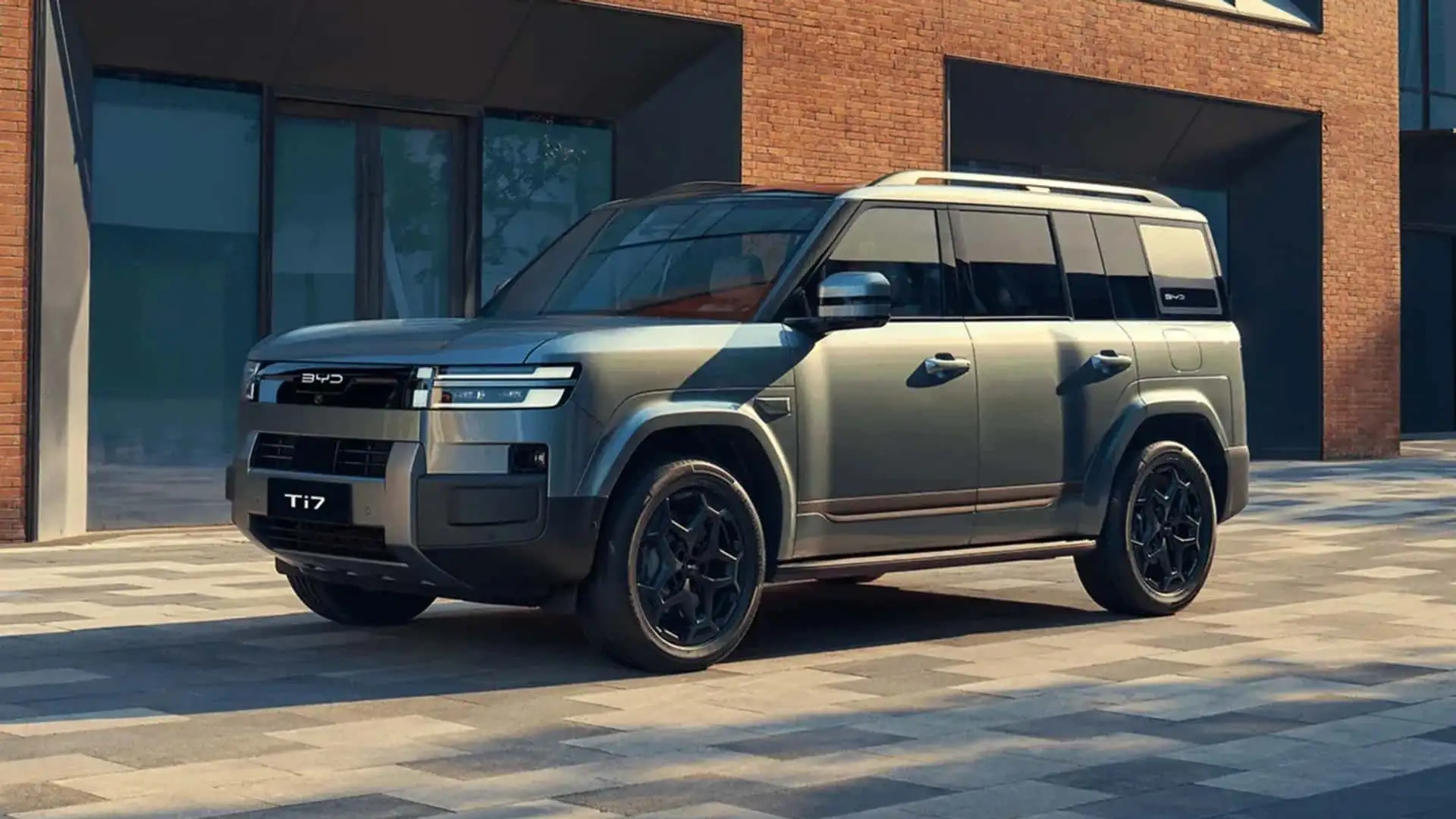
The lead image is a BYD press photograph of the Ti7 and is credited to the manufacturer.
The first fight concerns evidence
The action in the Netherlands was designed to preserve records before the underlying dispute is heard. Public reporting says JLR sought material that might show how BYD developed the Ti7. BYD’s lawyers argued that too many files had been taken and described the exercise as a “fishing expedition”. JLR’s advisers accused BYD of obstructing the process. Both statements are litigants’ positions and should not be read as facts already accepted by the court.
The Dutch judiciary’s own guidance explains that a conservatory attachment is provisional. A bailiff carries it out, after which the party that requested the measure must pursue the main claim. If the claim fails, the attachment ends and an unjustified measure may create a separate damages issue. That procedural context matters: the widely used word “raid” can sound like the conclusion of a criminal investigation, while the available information describes a court-authorised civil evidence-preservation step.
A preliminary decision was expected in The Hague on 11 November 2026. The immediate questions concern which records may be examined and whether JLR’s claim can proceed. Neither company has offered a substantive public comment on the ongoing case. The protected rights allegedly involved, the components in dispute and the contents of the seized records have not been published.
A visual resemblance is not the technical case
The Ti7 and Defender 110 share the upright proportions now used by several large SUVs. Both have a long, almost flat roof, near-vertical surfaces and an off-road visual theme. Those similarities make the comparison easy to illustrate, but images cannot establish whether a technical system was copied. The reported JLR claim goes beyond exterior styling and concerns possible reverse-engineering. Proving that would require identified protected information, access evidence and technical analysis.
JLR’s previous attempt to protect the shape of the old Defender provides useful but limited context. In 2020, the High Court of England and Wales upheld a decision refusing three-dimensional trade marks for the old Defender 90 and 110 shapes. The case turned in part on the difference between consumers recognising and associating a shape with Land Rover and treating the shape itself as an exclusive indicator of commercial origin. It did not give competitors permission to copy confidential technology, and it does not decide the Dutch dispute.
JLR has also won a materially different case. A Chinese court ruled in its favour in 2019 in the dispute over the Jiangling Landwind X7 and the Range Rover Evoque. Different vehicles, rights, evidence and jurisdictions prevent that outcome from being treated as a prediction for BYD. It merely shows that JLR has previously pursued what it considered an imitation through to judgment.
Official dimensions explain why the comparison persists
BYD’s Argentine subsidiary published a detailed specification when it launched the Ti7 there in October 2026. That market’s version is 5,016 mm long, 1,995 mm wide and 1,865 mm tall, with a 2,920 mm wheelbase. It uses BYD’s all-wheel-drive DM-p plug-in hybrid system. The manufacturer quotes 354 hp and 630 Nm, as well as declared fuel use of 5.9 litres per 100 km. DiSus-C controlled suspension and 6.6 kW vehicle-to-load capability are also listed for the Argentine model.
Land Rover’s UK technical data gives the Defender 110 an overall length of 5,018 mm with the spare wheel, a width of 2,008 mm with the mirrors folded and a 3,022 mm wheelbase. It can be specified with five or 5+2 seats and is four-wheel drive. On those official figures, the two vehicles are separated by only 2 mm in total length, while the Defender’s wheelbase is 102 mm longer and its stated folded-mirror width is 13 mm greater.
Those measurements support the observation that the vehicles occupy similar physical territory. They do not reveal common software, suspension logic, electrical architecture or copied hardware. Even the quoted Ti7 figures apply to one national specification; BYD may homologate different powertrains or equipment in other countries.
Commercial questions remain separate
The Ti7 is not currently listed in BYD’s Romanian range, and no Romanian euro price or delivery date has been announced. Reports of plans for other markets do not create local availability. Nor has a public injunction been announced that would stop the Ti7 from being sold generally. Any restriction would require a specific court order, regulatory action or an agreement between the companies.
The case nevertheless has commercial weight. Defender is now a distinct JLR house brand and one of the group’s most recognisable products. Ti7 places a BYD-backed SUV of almost identical total length into the same broad visual category. That gives JLR a reason to test the boundary of its intellectual property, while BYD has a reason to resist an evidence request it considers overbroad. Those incentives explain the dispute; they do not resolve it.
Until the Dutch court publishes more detail, three propositions must remain separate. The Ti7 resembles the Defender in several visible proportions. JLR alleges that the issue also involves reverse-engineered technology. A court has not yet ruled that BYD infringed JLR’s rights. The next reliable update will be a procedural order or a substantive decision, rather than another visual comparison of the two SUVs.