Lotus's Type 135 supercar will use Horse Powertrain's new W40, a 4.0-litre twin-turbo V8 developed from the outset for a hybrid system. The combustion engine alone produces more than 500 kW, approximately 680 metric horsepower, and 800 Nm. It will be paired with Horse's eight-speed wet dual-clutch transmission when the car reaches the market, currently planned for 2028.
The announcement adds substantial engineering detail to the model Lotus confirmed under its Focus 2030 strategy. It does not confirm the production name. The Type 135 is widely expected to become a modern successor to the Esprit and may revive that badge, but Lotus has not officially named it Esprit.
A compact hot-V engine designed for hybrid duty
The W40 is Horse Powertrain's first production-ready V8. Its two turbochargers sit between the cylinder banks in a hot-V arrangement, shortening the route taken by exhaust gases and helping the complete installation remain compact. This layout can improve response, although placing the turbochargers in the centre of the engine also makes thermal management an important engineering task.
Horse quotes more than 500 kW and 800 Nm, together with an engine mass of 200 kg. Direct injection, a short intake route and lightweight construction are among the disclosed features. The company has not published the compression ratio, maximum engine speed or the revolutions at which peak power and torque are reached in the Lotus installation.
The accompanying 8LDCT is an eight-speed transmission with two wet clutches. Horse says it can accept up to 1,050 Nm, while hydraulic pre-fill takes less than 50 milliseconds and shift response can take less than 20 milliseconds. Those figures concern transmission operation; they are not performance times for the complete car.
The 1,000 PS target needs electrical assistance
Lotus has previously set a target of more than 1,000 PS for the complete Type 135 powertrain. With the W40 contributing roughly 680 PS, electric motors would supply a large share of the combined output. Lotus has not yet specified how many motors it will use, their position, battery capacity, system voltage or the exact division of power between the axles.
All-wheel drive has been widely anticipated, and an electrically driven front axle would be one way to achieve it without a mechanical propshaft from the rear powertrain. That remains an interpretation rather than a confirmed production layout. Combined torque, acceleration, top speed and final certified output have not been announced either.
This distinction matters because component ratings cannot simply be added to predict vehicle performance. Electrical output may be limited by battery state, temperature and control strategy, while peak combustion and electric power may occur at different speeds. Lotus will need to publish a complete homologated specification before meaningful comparisons can be made.
Type 135 changed from electric to hybrid
Type 135 began as Lotus's intended battery-electric sports car. In May 2026, Lotus introduced Focus 2030 and explicitly described the project as an all-new hybrid-V8 supercar due to enter the market in 2028. The switch is a major revision to the brand's earlier rapid transition towards an all-electric range.
Lotus says the new programme is intended to reinforce its traditional focus on low mass, rapid responses and driver involvement. A V8 hybrid still brings considerable complexity: engine, fuel system, transmission, battery, power electronics and electric motors must all be packaged and cooled. Until Lotus publishes the production kerb weight, it is impossible to establish whether the Type 135 will deliver the weight advantage sometimes claimed for it over a fully electric rival.
The manufacturer says the model is expected to be built in Europe. It has not confirmed price, production volume, order timing or a detailed country launch plan. A 2028 market introduction is the current objective, not a guaranteed customer delivery date in every market.
Esprit heritage is relevant, but the badge is not settled
The original Esprit became one of Lotus's defining road cars and remained in production, through multiple evolutions, until 2004. A low silhouette and mid-mounted engine helped distinguish it from larger grand tourers. The Type 135's longitudinal V8 and performance ambitions create an obvious historical link, but modern hybrid hardware and safety requirements make it a fundamentally different proposition.
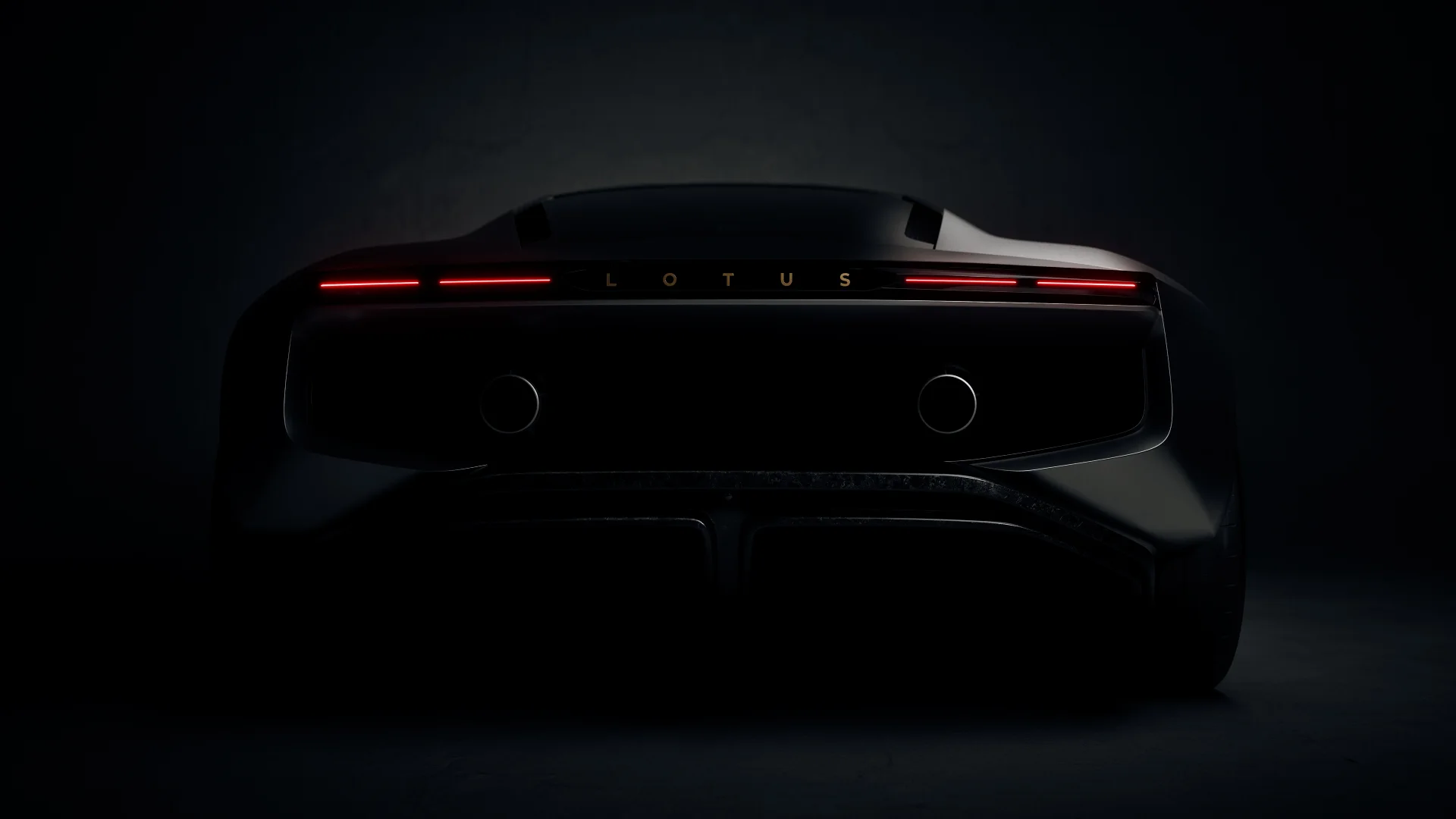
Using the Esprit name would carry considerable recognition. It would not, by itself, establish that the new car recreates the original's character. Steering, dimensions, visibility, brake feel, mass distribution and the calibration of the hybrid assistance will be more revealing than the badge. Lotus's official teaser only shows a darkened rear view with a full-width light signature, two round exhaust outlets and LOTUS lettering; it is not a complete reveal of the production design.
Several ownership questions also remain unanswered. Lotus has not disclosed fuel consumption, CO2 emissions, electric-only range or whether the battery can be charged externally. Calling the system a hybrid therefore does not establish how efficient it will be in real driving. Battery warranty, service requirements and local pricing will be important for a low-volume car carrying a new powertrain.
For now, the firm facts are significant enough: the Type 135 will have a production-ready 4.0-litre hot-V engine exceeding 500 kW, an eight-speed dual-clutch transmission and electrical assistance intended to take the system beyond 1,000 PS. The final name and the numbers that define the complete car must wait.
Sources
- Lotus Cars — Focus 2030 and the Type 135 hybrid-V8 confirmation
- Lotus Technology — investor document confirming the 2028 Type 135 plan
- Horse Powertrain — official W40 and 8LDCT technical information
- Image: Lotus Cars official Focus 2030 press material; rights remain with Lotus