Mercedes-Benz expects internal-combustion engines to remain part of the global vehicle market for at least another decade and potentially 15 years. Chairman Ola Källenius gave that range at a media roundtable in Pune, India, while explaining why the company is funding new electric vehicles and updated petrol and diesel engines at the same time.
Counting forward from 2026 puts the broad horizon between about 2036 and 2041. It is not a formal end-of-production date and does not guarantee that a particular engine will be sold in every country throughout that period. Källenius was describing the worldwide transition, where charging infrastructure, regulation and customer demand move at different speeds.
A transition estimate rather than a product promise
Autocar Professional reported that Källenius sees the industrial shift towards electric mobility taking 20 to 25 years. Mercedes intends to retain what it calls high-tech electrified combustion powertrains while there is meaningful demand, rather than setting one global cut-off that applies to approximately 150 markets.
The company's own 2026 strategy presentation supports that approach. Its combustion plan lists four-cylinder petrol and diesel engines, six-cylinder petrol and diesel engines, and an eight-cylinder petrol engine. Mercedes describes the range as EU7-ready and pairs it with continuing investment in battery-electric models.
“EU7-ready” needs a narrow reading. It is Mercedes' description of the engineering programme, not proof that every existing model and engine has already received every approval required for future sales. Type approval applies to a defined vehicle configuration, and model availability remains a market-by-market decision.
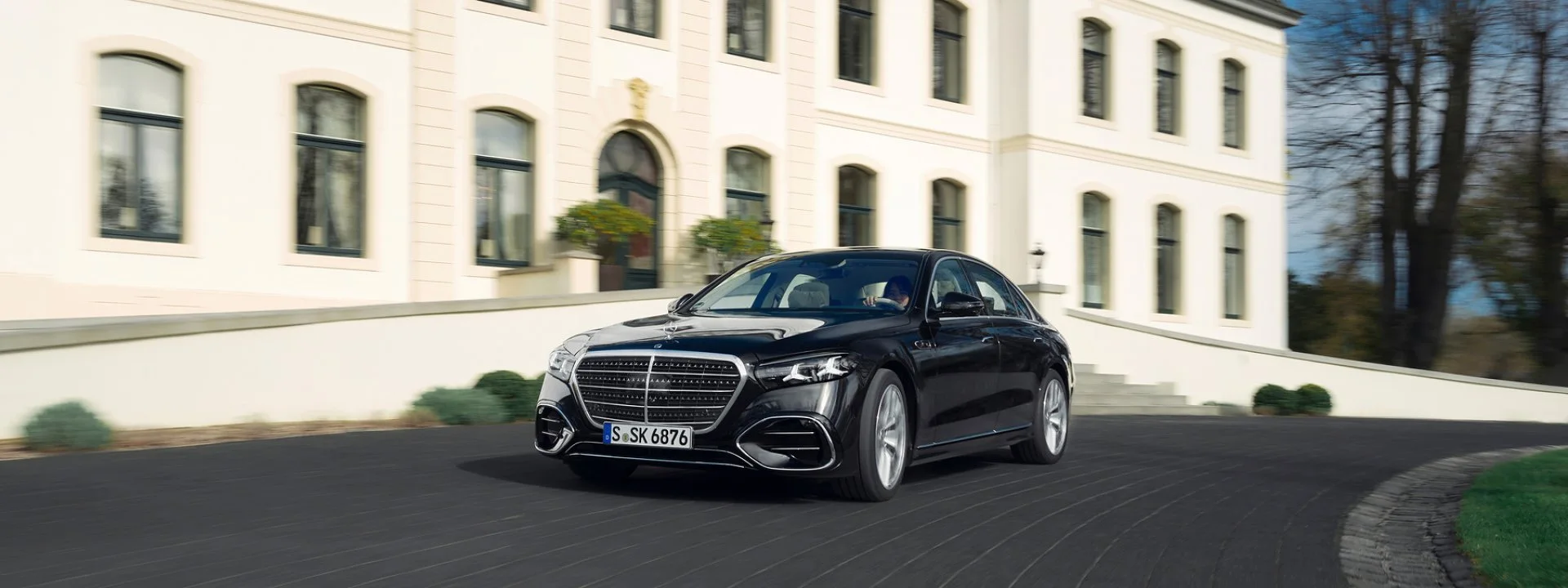
The latest Mercedes-Benz S-Class demonstrates how much variety sits behind the strategy. Its official range includes the M 177 Evo V8, six-cylinder petrol and diesel engines, and plug-in hybrids. The S 580 4MATIC's mild-hybrid V8 is rated at 395 kW and 750 Nm. The OM 656 Evo diesel uses an electrically heated catalytic converter to bring exhaust aftertreatment to its operating temperature more quickly.
Each of the three S-Class combustion-engine families detailed by Mercedes uses a 17 kW integrated starter-generator and a 48-volt electrical system. The plug-in-hybrid S 450 e and S 580 e are offered separately, with an official electric-range claim of about 100 km depending on specification and the applicable test procedure.
Euro 7 is the nearer deadline
The immediate European engineering milestone is Euro 7 rather than the end of combustion. Regulation (EU) 2024/1257 applies from 29 November 2026 to new types of M1 passenger cars and N1 light commercial vehicles, and from 29 November 2027 to all new vehicles in those categories. It also goes beyond tailpipe pollutants by covering brake and tyre particles and battery durability.
Mercedes' investment in updated engines therefore has a defined regulatory purpose. The company is not simply extending old powertrains unchanged. Its current systems combine combustion with 48-volt functions such as energy recuperation, electric assistance and smoother stop-start operation. Plug-in hybrids add a traction battery that can be charged externally, which makes them materially different from mild hybrids despite both being described as electrified.
The distinction matters to buyers. A 48-volt mild hybrid cannot normally cover a meaningful journey solely on electric power, while a plug-in hybrid can complete many daily trips without starting its combustion engine if it is charged regularly. Neither layout should be inferred from the word “hybrid” alone; the exact model and technical specification are required.
Diesel is being retained for a narrow use case
Källenius linked diesel's continuing relevance to light commercial vehicles, larger passenger cars and exceptionally high annual mileage. He cited drivers covering 60,000–70,000 km per year. That is a specific commercial or long-distance profile, not a general recommendation for private motorists.
At lower mileage, any fuel saving has to be weighed against purchase price, taxation and the complexity of exhaust-aftertreatment hardware. Repeated short urban journeys can also be unsuitable for a modern diesel particulate filter because regeneration needs sufficient temperature and running time. Drivers covering long motorway distances face a different calculation, which is why Mercedes is keeping the option available.
The Pune discussion also reflected Indian fuel prices and local demand. Those conditions cannot be transferred directly to Germany, France, Romania or another European market. A buyer needs local fuel costs, tax rules and the actual manufacturer offer, not a global statement in isolation.
Mercedes is not cancelling its electric programme
The combustion timetable does not reverse Mercedes' electric product plans. Källenius said the company aims to offer an electric alternative in every meaningful model position by the end of the decade. The group's climate-policy report similarly says Mercedes wants to serve customer needs well into the 2030s with both fully electric vehicles and efficient electrified combustion engines.
That dual programme is capital-intensive. Mercedes-Benz Group reported €6.4 billion of research and development expenditure and €2.9 billion of investment in property, plant and equipment during the first nine months of 2026. The Q3 release does not allocate those totals solely to EV or combustion work, so they should not be presented as spending on one side of the powertrain programme.
Zero-emission mobility remains the stated destination. What has changed is the expected route and timing: Mercedes is preparing for uneven adoption rather than assuming that every region will switch together. That gives the company more product flexibility, but it also leaves future model availability less predictable than a single firm phase-out date would.
What the announcement means for owners and buyers
For an owner, the statement indicates that Mercedes expects to maintain engineering, parts and product expertise for combustion vehicles for years. It does not provide a warranty extension, a residual-value guarantee or an exemption from future low-emission-zone rules. Those matters are governed by the vehicle contract and by national or local authorities.
For a new-car buyer, the practical checks remain the model listed in the local configurator, its emissions approval, its official WLTP consumption and the type of electrification fitted. A 10–15-year global outlook cannot confirm that today's V8 or diesel will be offered in the next generation of the same nameplate.
Official press image: 2026 Mercedes-Benz S-Class, supplied by Mercedes-Benz Media, resized and converted to WebP for editorial use. Rights remain with Mercedes-Benz.