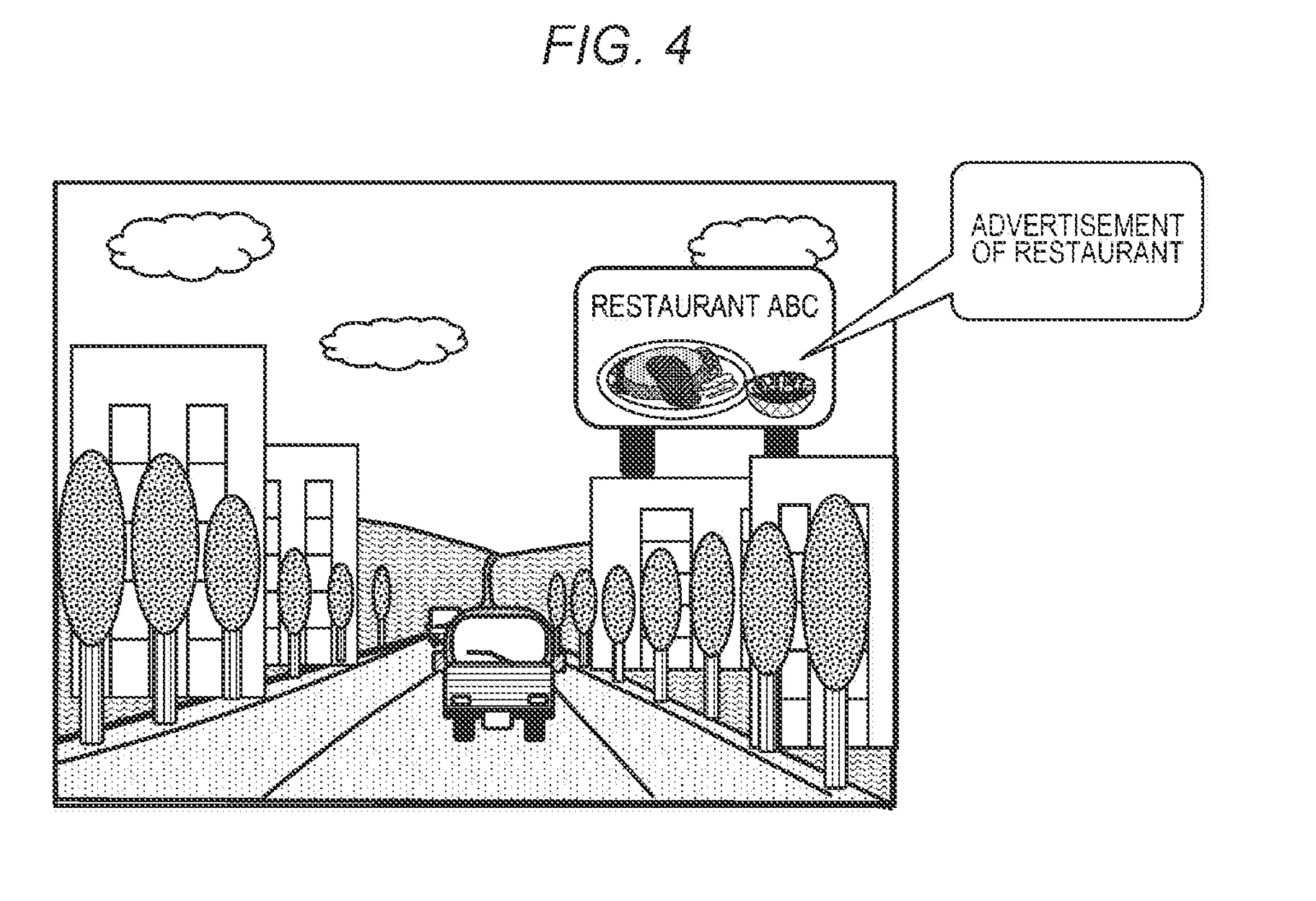
Sony Group has published a US patent application for a system that recognises adverts around a car and releases an associated scent inside the cabin. Its clearest example is a roadside restaurant billboard followed by the smell of a hamburger. The filing does not announce a production feature, a launch date or a partnership with a car manufacturer.
The United States Patent and Trademark Office published US 2026/0346685 A1 on November 5, 2026. Sony filed this continuation on July 7, 2026, but the underlying work is older: it claims Japanese priority from July 26, 2019. Satoshi Konya, Shuji Fujita, Yukito Inoue and Cedric Duvert are named as inventors.
The billboard is checked against a server record
The proposed architecture connects an outward-facing camera, GNSS positioning, network communication and one or more scent-output units. Software looks for an advert in the camera image, estimates its position and direction, then asks a scent-management server whether that display matches a registered campaign.
Registration data can associate an advert with a scent identifier, location, display direction, permitted time and conditions for output. That second check matters. A visually similar restaurant sign should not be enough on its own: the position and orientation are intended to confirm that the car is passing the registered display while the campaign is valid.
The filing also describes varying scent intensity with distance, vehicle speed and direction. In the restaurant example, the smell can become stronger as the car approaches the billboard, creating the impression that it is coming from the food pictured on the sign. This is a proposed control method, not a result demonstrated in an independently tested vehicle.
Cabin cameras would decide where the scent goes
An interior camera adds passenger targeting. The system can detect which seats are occupied and estimate an occupant’s age or gender. It can then compare that profile with the campaign conditions stored on the server and direct the chosen scent only towards a matching seat.
One drawing places separate scent units at each seating position. Another uses a single ceiling-mounted unit capable of aiming its airflow. The hardware description includes a blower, controlled air paths and cartridges holding different scent components. Examples in the specification include forest, ramen, hamburger and cosmetics scents, alongside lavender, lemon and jasmine.
That creates a privacy question distinct from the novelty of a scented advert. The patent discusses analysing faces and matching age or gender conditions, but it is not a consumer privacy policy. It does not establish how a production system would obtain consent, store images or present an off switch. Those details would depend on an actual implementation and the laws of each market.
The targeted-seat design also shows that this is not simply an automatic air freshener connected to the ventilation system. The proposal combines advertisement recognition, occupant analysis and directional output. Each of those elements would need its own hardware, software and safeguards before a carmaker could offer it to customers.
Screen, radio and phone adverts are covered too
A second embodiment does not rely on a road camera. It analyses an advert delivered through a television, radio, computer or smartphone used in the vehicle. The server can compare the media source and broadcast time with campaign records. A chocolate commercial is the filing’s example for triggering a chocolate scent.
The same document lists several non-advertising possibilities. A manufacturer could associate a signature scent with engine start. A taxi or car-sharing service could load a passenger’s saved preference. A concentration-related smell could accompany information about congestion or an accident, alongside sound, vibration or a display warning.
Sony also suggests that a taxi operator could receive an advertising fee. That is an example of a possible business model rather than a disclosed commercial agreement. The application names no advertiser, carrier or vehicle brand, and supplies no price for the hardware or replacement cartridges.
A 2026 continuation of a patent family dating to 2019
The publication date can make the proposal appear entirely new, yet it sits at the end of a longer chain. International application PCT/JP2020/025270 was filed in 2020 with Japanese priority from 2019. A US application was published in 2022 and granted as US 11,987,102 in May 2024. A further continuation filed in April 2024 became US 12,734,861 in September 2026. The July 2026 application continues that family.
Continuation practice allows an applicant to pursue different claim sets using an existing disclosure. It does not prove that the described system is approaching production. A patent can protect a concept without establishing demand, automotive validation, regulatory approval or a manufacturing programme.
Sony’s own olfactory-technology page adds another piece of context. It says the business covering the NOS-DX1000 scent device and Grid Scent platform was transferred to Solfactir Technologies on August 1, 2026. The notice does not connect that transfer with the vehicle patent or promise an automotive product.
The lead image is Figure 4 from the official USPTO publication. It shows exactly the roadside restaurant scenario used in the specification. It is a patent illustration, not a photograph of working hardware, and is reproduced here for editorial reporting on the document.