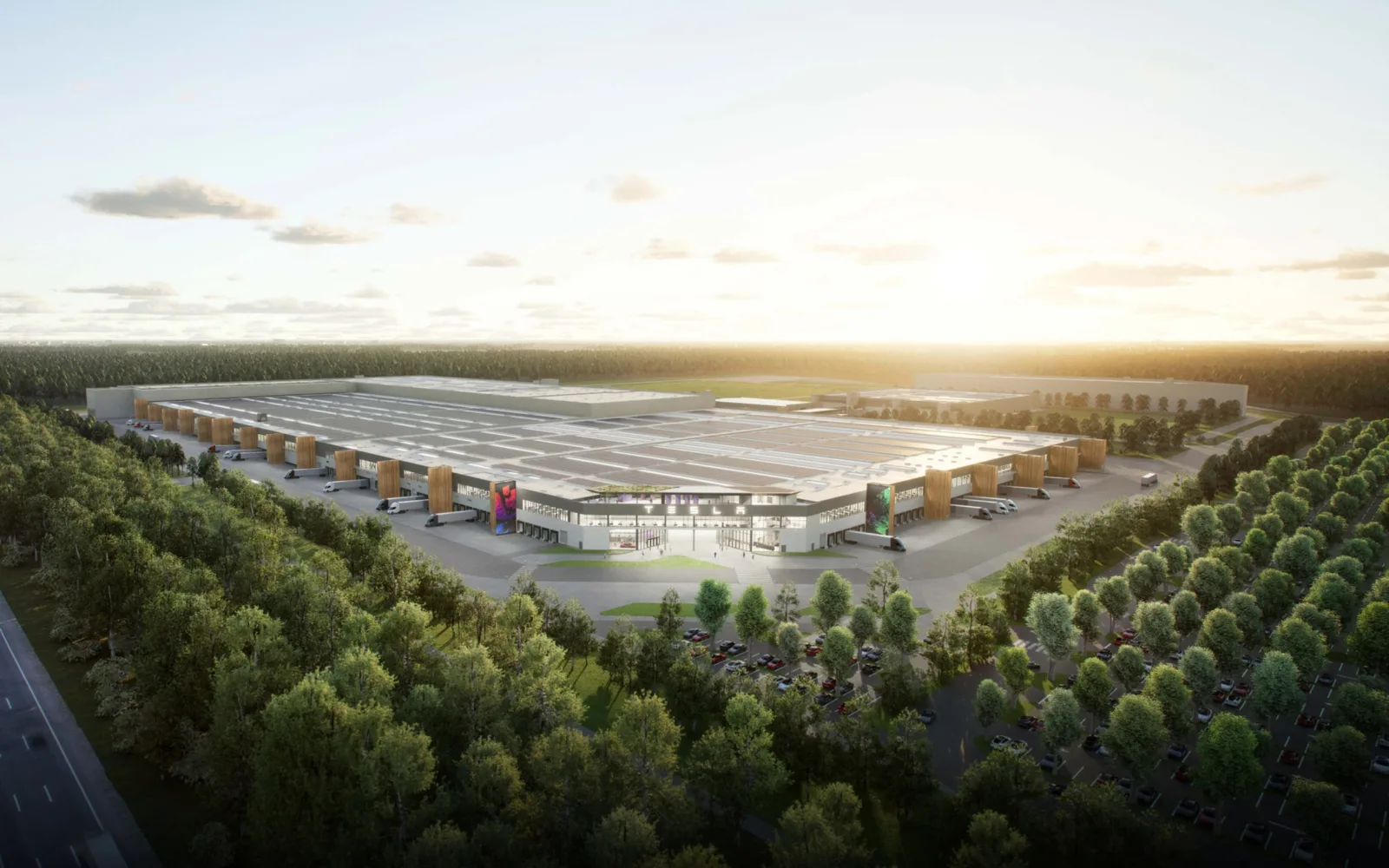
Tesla intends to begin manufacturing complete battery cells at its Grünheide factory in mid-2027, plant director André Thierig said at an industry conference in Berlin on 11 November. Reuters reported that the battery building is finished and the site has already started making some battery parts. That is a more precise timetable than Tesla had previously published, but it is not confirmation that series output has begun.
Tesla's own third-quarter 2026 update still labels the Berlin 4680 project as “Construction” and gives no installed annual cell capacity for the site. The distinction is central to the announcement: a completed building, installed processes and component production can precede qualified, repeatable cell production by months. Tesla has not disclosed the initial line rate or the point at which the factory is expected to reach its proposed full volume.
The Berlin line is intended for 4680 cells
Tesla identifies the cell project at Berlin as 4680 manufacturing. The name refers to the cylindrical cell's approximate dimensions, 46 mm in diameter and 80 mm tall. The company already lists more than 40 GWh of installed annual 4680 capacity in Texas. Its Q3 table leaves the capacity field blank for Berlin, offering a useful check against treating the German plan as an operating asset.
An IAA Mobility report published in May said Tesla would put a further $250 million into the Grünheide cell operation and increase its planned annual capacity from 8 GWh to 18 GWh. The figure is a project target. It does not describe 2026 output, and Tesla's latest quarterly document does not repeat 18 GWh as installed capacity.
IAA estimated that 18 GWh could supply roughly 250,000 to 350,000 vehicles a year, depending on pack size. That range is illustrative rather than a promised production count. A 50 kWh usable pack and a larger long-range pack consume different amounts of cell capacity, while manufacturing yield, maintenance stops and inventory strategy also affect the number of finished vehicles a line can support.
Cell production would sit beside Model Y assembly
Gigafactory Berlin-Brandenburg is Tesla's only vehicle factory in Europe. It builds the Model Y and is listed by the company with more than 375,000 units of installed annual vehicle capacity. Tesla cautions that installed capacity is not the same as the current production rate. Equipment uptime, component availability, upgrade shutdowns and regulatory issues can all prevent a factory from reaching that ceiling.
Bringing cell work onto the same site could shorten part of the supply chain and give Tesla more direct control over production timing. The Q3 update separately names vehicle-pack capacity in Berlin as one of the battery projects still being expanded. Cells, modules and complete packs are different manufacturing stages; progress in one does not prove that all three are operating at their final rate.
Tesla has not said that every Berlin-built Model Y will switch to German-made 4680 cells. Nor has it identified the first derivative to use them, the pack architecture, the chemistry or the proportion of locally sourced materials. Buyers should therefore not infer a range increase, a price reduction or a battery specification change for cars currently on sale.
The project had officially been classified as paused
The revised timetable follows a year of conflicting status signals. In a federal-government answer published by the German Bundestag on 25 March 2026, the planned Tesla cell factory in Brandenburg was among five German projects described as stopped or paused. The government specifically classified Tesla's project as paused, a term it defined as interrupted implementation with a possible continuation, rather than a cancelled scheme.
By May, the additional investment and 18 GWh target indicated that work was moving again. Tesla's October quarterly update then showed Berlin 4680 construction in progress. Thierig's November statement adds the target of mid-2027 and says battery-part manufacturing is already under way. Together, those points establish resumed work, but not commercial cell output.
The wording on Tesla's public Berlin-Brandenburg page is broader. It calls the facility the company's first European location to manufacture cells in-house alongside electric vehicles and says millions of battery cells are manufactured there. The more granular quarterly table still places the 4680 line in construction. The safest reading is that the site performs cell-related component work now while complete series-cell production remains scheduled for 2027.
What the announcement does not establish
No public source in this set provides the line's planned start-up rate, monthly ramp curve, expected yield or confirmed date for reaching 18 GWh. Tesla has not specified whether Grünheide will perform every material-processing step, which suppliers will support the line, or how many cells will be reserved for Berlin vehicle production rather than other company operations.
Battery plants normally move from equipment installation to commissioning, trial batches, process validation and a gradual yield ramp. A start date can refer to the first qualified production without implying that the facility will immediately operate at nominal annual capacity. Tesla's quarterly caveat makes the same point at company level: capacity figures are not actual production rates.
The buyer impact is consequently indirect for now. Local cell production may eventually reduce transport exposure, provide another source of 4680 supply and connect cell, pack and vehicle work at one European location. Those are operational possibilities, not confirmed savings passed to customers. Tesla has announced no new European Model Y price, range rating or warranty term as part of Thierig's statement.
The verifiable position on 11 November 2026 is narrower and more useful: the dedicated building is complete, some battery parts are being made, Tesla continues to classify Berlin 4680 as under construction, and the plant director is aiming for complete-cell production in mid-2027. The 18 GWh figure and the corresponding vehicle estimate remain targets until Tesla reports installed capacity and actual output.