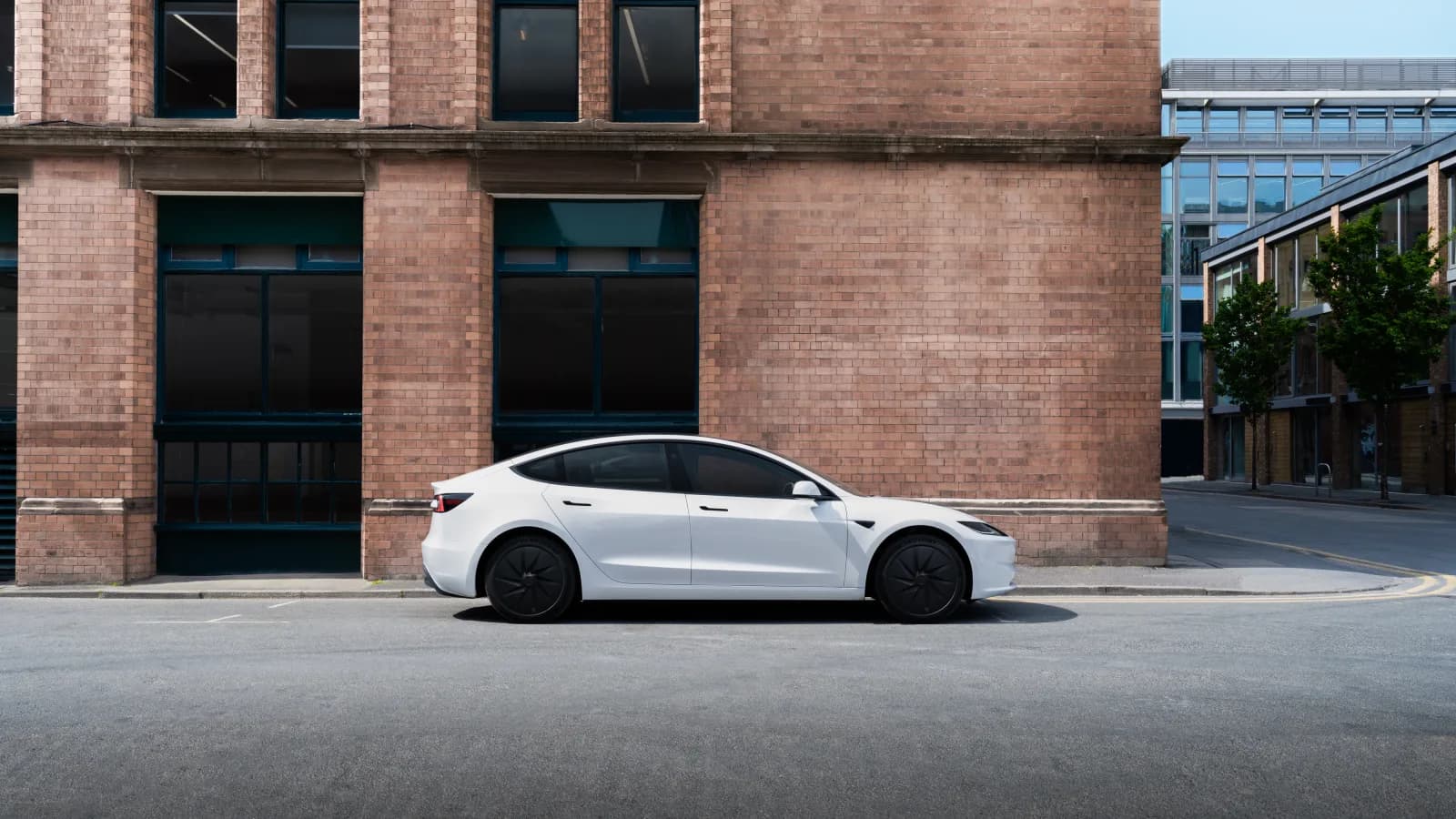
Tesla Model 3. Official media photograph, Courtesy of Tesla, Inc.
Tesla FSD frequently broke urban speed limits in Belgian test
Tesla Full Self-Driving (Supervised) exceeded the legal limit on 16 of 29 Brussels road sections restricted to 30 km/h in an independent test by Belgian mobility group johanna.be. Across the sections where it sped, the average recorded maximum was 44 km/h. The car also displayed the wrong limit on roughly 90% of the 30 km/h sections.
Those findings identify a specific urban safety problem, not the performance of every Tesla. Researchers used one recently registered Model 3, one FSD software release and three days of dry-weather driving. A later version or a different vehicle may behave differently, and the study was not designed to calculate a fleet-wide failure rate.
How the Brussels test was conducted
Testing ran from 20 to 22 July 2026 and covered about 400 km, according to Reuters. The Model 3 was first registered on 11 June and ran software 2026.21.100 with FSD v14.2.2.6. It was set to Standard mode, with the speed offset at 0% and contextual maximum speed switched off.
A GoPro Hero 13 recorded the road and central display together. The researchers systematically selected 29 different 30 km/h sections and completed 59 runs over them. On clearly signed sections where traffic did not force the car to slow down, the report found speeding on 59% of sections, with the mean section maximum close to 46 km/h.
The vehicle would often recognise a 30 km/h sign, then show 50 km/h again. As a limited comparison, the group drove seven sections in a Citroën C3 with conventional sign recognition. The Citroën retained the correct limit in all seven; the Tesla did so in one. Seven runs do not establish a broad model comparison, but they reduce the likelihood that the signs were simply unreadable.
Home zones and cycle streets exposed other errors
On 12 home-zone sections limited to 20 km/h, FSD exceeded the limit on five. Its average maximum on those five sections was about 26 km/h, and the displayed limit was too high in two thirds of the home-zone sample.
The car also failed to show the correct 30 km/h limit on six cycle streets and attempted to pass cyclists several times. The supervising driver aborted those manoeuvres. Belgian rules prohibit motorists from overtaking cyclists on these streets; the rule differs from the Dutch framework, which matters because the original provisional approval was issued in the Netherlands.
The home-zone and cycle-street routes were convenience samples, so their percentages should not be treated as representative of all Belgian roads. The report also recorded positive behaviour. FSD was generally cautious and courteous around pedestrians and cyclists, at times yielding proactively rather than waiting for an intervention.
Tesla's own evidence does not answer the same question
Tesla identifies FSD Supervised as a Level 2 driver-assistance system. Its manual requires a fully attentive driver who is ready to take control at any moment. The driver remains responsible for speed, direction and compliance with local road rules; the system does not make the Model 3 autonomous.
Tesla's Safety & Evidence Dashboard reports favourable collision associations and more than 230,000 scenario tests across six European cities. These are manufacturer-published results, not an independent certification. Tesla also notes that its fleet studies are observational, cannot prove causation and do not fully stratify for traffic, weather, lighting or scenario complexity.
For speed choice, Tesla examined 708 samples in which FSD drove above the limit determined by the system while another vehicle was detected travelling in the same direction. After excluding speeds below 25 km/h, 680 cases remained. Tesla says 98% were at or below the median surrounding-traffic speed. johanna.be argues that selection misses its central finding: in Brussels the system-determined limit was itself often too high, while low-speed cases were excluded.
Approval is provisional, not EU-wide
The Dutch vehicle authority RDW issued provisional approval for FSD Supervised on 10 April 2026, initially valid only in the Netherlands. Article 39 of EU Regulation 2018/858 allows a national authority to approve new technology provisionally when it is incompatible with existing harmonised rules. Other member states may choose to accept that approval, as Belgium and several others did.
That acceptance is not the same as unrestricted EU authorisation. Wider validity requires the European procedure. UN Regulation No. 171 for Driver Control Assistance Systems keeps responsibility with the driver and requires a system to determine the permitted speed and reduce its current maximum when that limit falls.
johanna.be recommends withdrawing the provisional approval until an updated version has been independently tested. That is the organisation's recommendation, not a decision already taken by RDW or European institutions. Reuters reported that Tesla and RDW did not respond to requests for comment on the Belgian results.
For a driver, the immediate consequence is clear: the sign beside the road takes precedence over the number on the screen. With FSD Supervised active, the person behind the wheel must monitor continuously, correct the speed and stop an illegal manoeuvre. That obligation is also stated in Tesla's own manual.
Sources
- johanna.be — full FSD30 study report
- Reuters via Investing.com — test findings and requests for comment
- Tesla — FSD Safety & Evidence Dashboard
- Tesla — Model 3 FSD Supervised manual
- RDW — explanation of the provisional Dutch approval
- EUR-Lex — Regulation (EU) 2018/858
- UNECE — UN Regulation No. 171
- Tesla Gallery — official image and media-use terms